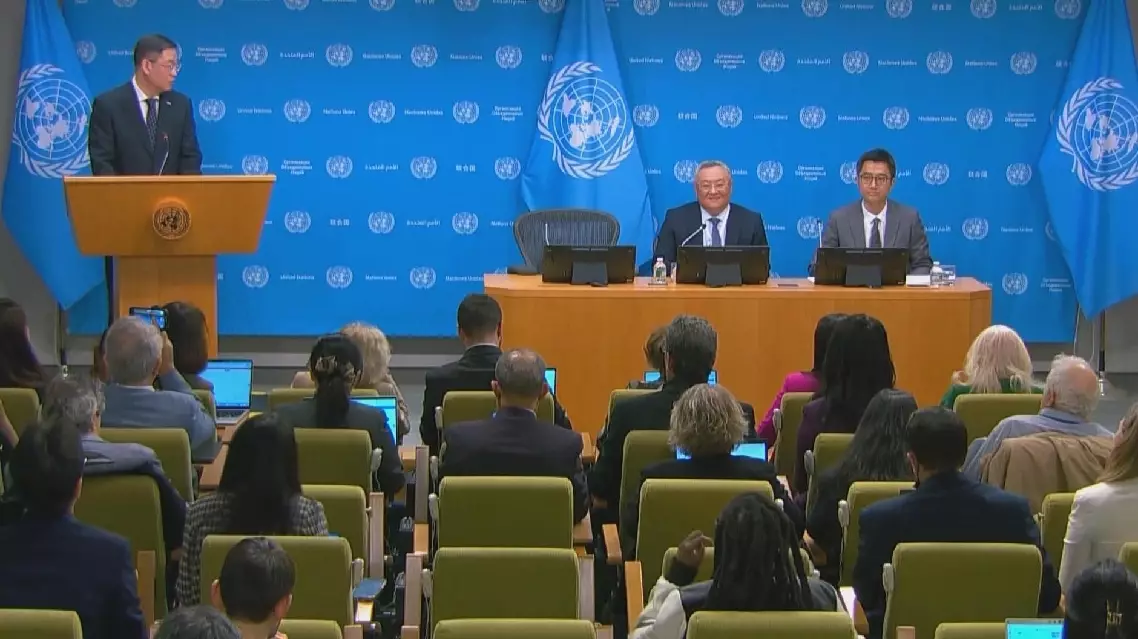
More than 1,300 civilians have been killed and 9,669 civilian sites destroyed in Iran in the military strikes launched by the United States and Israel since Feb. 28, Amir Saeid Iravani, Iran's ambassador and permanent representative to the United Nations, said Tuesday.
The civilian sites included 7,943 residential homes, 1,617 commercial and service centers, 32 medical and pharmaceutical facilities, 65 schools and educational institutions, 13 Red Crescent buildings, and several energy supply facilities, Iravani told the press in a statement.
"The world is witnessing how a rogue and irresponsible state, together with an illegitimate regime, is targeting the Iranian schools, hospitals, residential building infrastructure, a sports hall and relief facilities. These attacks have already claimed the lives of hundreds of innocent civilians, including women and children," he said.
"Some council members are attempting to reverse the roles and position of victims and aggressors. They seek to reward the aggressor and punish the victims through a biased and politically motivated resolution," said the envoy.
He said that the international community must act now to stop the war against the Iranian people.
"Today it is Iran. Tomorrow it could be any other sovereign state. We will take all necessary measures to defend our people, our territory and our independence," he said.
Over 1,300 Iranian civilians killed, nearly 10,000 civilian sites destroyed in U.S.-Israeli military strikes: Iran's UN envoy
China's first 500-kV cross-border alternating-current power interconnection project entered service Monday, creating the highest voltage grid tie between the two countries and advancing Belt and Road energy cooperation.
The project raises two-way power transfer capacity between the two countries from 50,000 kW to 1.5 million kW, enabling the annual transmission of about 3 billion kWh of clean electricity, roughly 30 times the capacity of previous lines, according to China Southern Power Grid.
As the largest cross-border grid project and the highest-voltage power link between China and Laos, it connects southwest China's Yunnan Province with Oudomxay and Luang Namtha provinces in northern Laos.
Cross-border electricity trading began as the project entered operation. About 4.81 million kWh of power from clean energy bases in northern Laos was transmitted to Yunnan through the new line, marking a more regular and institutionalized phase of power connectivity between the two countries.
It is also the first time an overseas new energy project has participated in China's electricity market, the company said. The power involved in the transaction came from a large mountain photovoltaic project in Laos, one of the core supporting power sources for the interconnection line.
"This project is the cross-border power grid project with the highest voltage level between China and Laos. Leveraging the China-Laos power grid interconnection and the power markets in southern China, surplus hydropower from Laos can be transmitted to China during the rainy season, while China can supply supplemental power to northern Laos during the dry season. This project represents yet another landmark achievement between China and Laos in deepening power cooperation and jointly advancing the high-quality development of the Belt and Road Initiative," said Li Jingru, general manager of Electricite du Laos Transmission Company Limited (EDL-T), a joint venture of China Southern Power Grid and Lao state-run Electricite du Laos.
The solar project has an average annual power generation capacity of about 1.65 billion kWh. In 2026, it is expected to transmit about 1.1 billion kWh of solar power across the border, supporting energy complementarity between the two countries.
"In the future, efforts will be made to further promote normalized cross-border electricity trading, meet the trading needs such as electricity transmission from Laos to China's Yunnan, from China's Yunnan to Laos, and from Laos to China's Guangdong, and facilitate the optimal allocation of energy resources in the Lancang-Mekong region," said Li Minhong, marketing director of China Southern Power Grid.
Construction of the interconnection project began in late February last year. Spanning a total length of 177.5 km, the transmission line includes a 145-km Chinese section and a 32.5-km Lao section.
New China-Laos power link expands transfer capacity 30-fold, boosts electricity trading