Skip to Content Facebook Feature Image

Shanghai's new trend of stand-up comedy bridges cultures

China

China

China

Shanghai's new trend of stand-up comedy bridges cultures

2025-03-19 22:39 Last Updated At:23:07

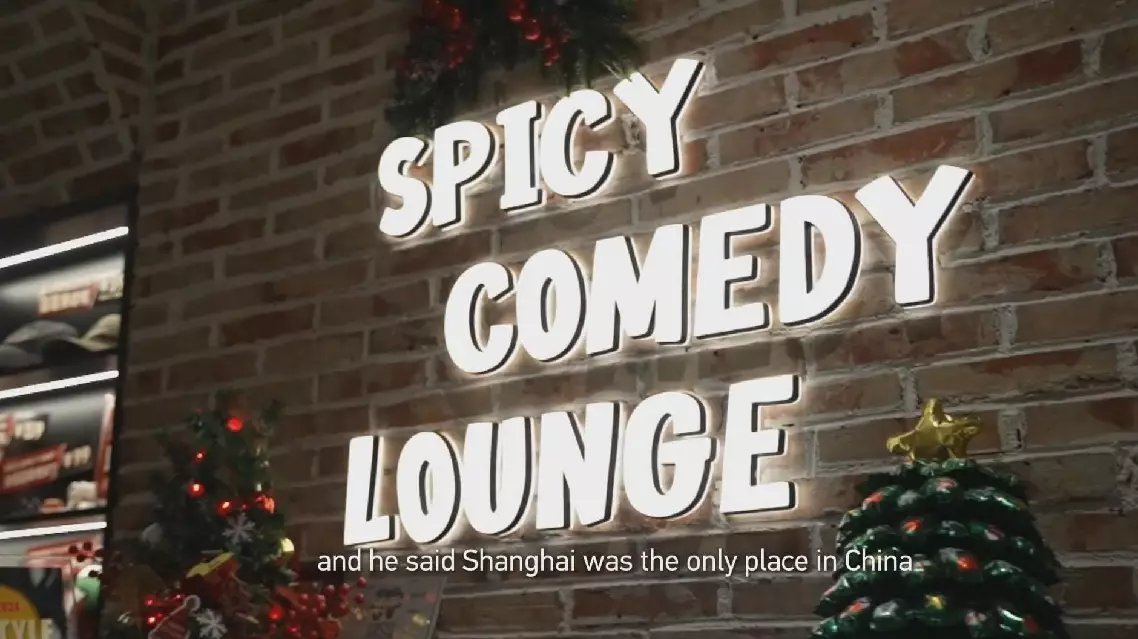
Shanghai's burgeoning stand-up comedy scene is attracting both local and international audiences, with shows that blend local elements with global humor.

The city's comedy scene has exploded in recent years, a stark contrast to other places, according to English stand-up comedian Ian Badenhorst.

"Shanghai was like international. It was seven days a week. Every night was busy. Where I came from, it was Wednesday nights, Friday night, Saturday. That was the only time people did any partying or going out. And when I came to Shanghai, it was just every day of the week and it was growing and it was crazy," he said.

Badenhorst highlights the challenge of appealing to both local and international audiences.

"To get the joke to work on foreigners and on locals, that's my challenge. The reason we have an English comedy club in Shanghai is for also foreigners can have a place to, they live in China, they came just relax and enjoy it. So I try to make my jokes work everywhere," he said.

The multilingual nature of Shanghai's comedy is a unique aspect. Even for those who don't fully grasp every joke, the atmosphere is contagious.

"When I first started speaking English stand-up comedy in Shanghai, the owner of the club at the time, he did a French show, a Russian show, a Spanish show, a German show once a year, and then the venue would be around 80-100 people, and it would be full every time, in 2017, 2018, I think. So it was a big shock to me at the time, and he said Shanghai was the only place in China where he felt the most confident to do multilingual shows," said Norah, a Chinese multilingual stand-up comedian.

Audience members appreciate the cultural exchange.

"It's a great way to bring the culture of each country and the kind of memes of each country to China, and I think it's a very unique view of Shanghai," said a Chinese audience member.

"Because I saw a lot of videos from Norah and I found it very interesting and I always thought, okay, how do I go to view this show?" said a foreign audience member.

Norah also pointed to favorable government policies as a boost for the industry.

"There are also some big policies that are good for our industry, such as the new visa policy that we have opened up for foreigners. So we have actually seen a wave of new visitors this year due to the policy," she said.

Badenhorst sees comedy as a way to bridge cultural misunderstandings.

"Comedy is something I wanted to develop because I feel like what annoys me the most is no one really understands China. You always just become the foreigner who says what Chinese people wanna hear. I don't wanna be that. Just wanna be an international comedian to relate to the rest of the world. And I think that's why English comedy is important. So we can actually export Chinese culture," he stated.

The unifying power of comedy is evident in the diverse audiences, and Shanghai's comedy scene reflects the city's cosmopolitan spirit.

"This is a very diverse venue in terms of audience structure. I used a way that this domestic audience prefers, but if all the audience laughed, those moments I would feel, wow, a very united feeling. That's comedy! And I feel that comedy has a kind of power in it, that's the feeling of integrating everyone in the same room," said Baiwan, a Chinese multilingual stand-up comedian.

"To increase the understanding of overseas friends about China, like it's a cool city, it has a lot of languages. There are a lot of different experiences when you come to play. I think it's very much in line with the cultural heritage and the spirit of Shanghai itself," Norah said.
Shanghai's new trend of stand-up comedy bridges cultures

Shanghai's new trend of stand-up comedy bridges cultures
Chinese officials attending a recent study session at the National Academy of Governance in Beijing have pledged to make solid efforts for the country's development over the next five years.

Speaking at the opening meeting for the session, Chinese President Xi Jinping called the session attendees, principal officials at the provincial and ministerial levels, to secure a good start for the country's 15th Five-Year (2026-2030) Plan.

Xi said it is necessary to develop a comprehensive, profound and accurate understanding of the strategic arrangements for economic and social development during the 15th Five-Year Plan period, which were made at the fourth plenary session of the 20th Central Committee of the Communist Party of China (CPC).

He stressed that China is currently at a stage where strategic opportunities and risks coexist, with increasing uncertainty and unpredictable factors. He added that building a modern industrial system and achieving an overall industrial structure upgrade are key strategic tasks for the 15th Five-Year Plan period.

"The year 2026 marks the beginning of the 15th Five-Year Plan period. For the first time in a Five-Year Plan, the CPC Central Committee has proposed making China strong in the energy sector, clearly defining the strategic direction and priorities for the country's energy development. Building a country strong in the energy sector means to make the country independent in energy supply so as to provide reliable energy assurance for the country's modernization," said Dai Houliang, chairman of China National Petroleum Corporation.

Yin Hejun, minister of science and technology, said the next five years is a critical phase for building a solid foundation and exerting comprehensive efforts to basically achieve socialist modernization.

"We must focus on the goal of building a strong country in science and technology, take a holistic approach to formulating the 15th Five-Year Plan for science and technology innovation, strengthen strategic, forward-looking, and systematic planning for basic research, promote the deep integration of sci-tech innovation and industrial innovation, and provide solid support for comprehensively advancing Chinese modernization through high-level sci-tech self-reliance and self-improvement," Yin said.

Chen Zhongyue, chairman of China Mobile Communications Group, said it is essential to study and comprehend the spirit of the fourth plenary session of the 20th CPC Central Committee.

"Currently, digital-intelligence technologies are deeply integrated into all sectors of the economy and society, presenting broad opportunities for the information and communications industry. We will deepen scientific and technological innovation, develop new quality productive forces, and contribute more to Chinese modernization with new achievements in building a strong cyber power and a Digital China," he said.

Speaking at the study session, Xi said that improving livelihoods should be prioritized to promote social development. And while advancing economic growth, steady efforts should be made to raise quality of life for the people.

"We will strive to make healthcare security services more accessible to the public, support the development of the medical and health sector, and foster the growth of the pharmaceutical industry. Healthcare security is not only a traditional undertaking in the health domain but also a concrete manifestation of new quality productive forces in health. We are continuously exploring ways to drive emerging industries with new technologies so as to benefit all people," said Zhang Ke, head of the National Healthcare Security Administration.

Chinese officials pledge to make solid efforts to implement 15th Five-Year Plan

Chinese officials pledge to make solid efforts to implement 15th Five-Year Plan

Recommended Articles