With another round of extravehicular activity on the Chinese Tiangong space station scheduled soon, its mechanical arms installed are in focus, and space experts expect them to play a vital role in the process.
Members of the Shenzhou-19 crew aboard China's orbiting space station on Friday completed their mission's third series of extravehicular activities, according to the China Manned Space Agency.
Weighing 0.74 tons, the two mechanical arms in China's space station can bear 25 tons. Such capacity allows them to support various tasks for astronauts, from spacewalk and maintenance to payload transport, according to Yang Yuguang, president of the International Astronautical Federation’s Space Transportation Committee.
"The robotic arm can play a very important role in our extravehicular activities. Whether it is the 10-meter-long big arm, the 5-meter-long small arm, or their combined mechanical arm in the space station, they all can help astronauts to move quickly from one location to another that is far away. Also, in this process, astronauts can carry heavy equipment which is difficult to move for them to handle and install. This will greatly improve efficiency and save astronauts' physical strength," said Yang.
Apart from colossal strength, these mechanical arms are also quite agile like human arms. They have shoulder, elbow, and wrist joints, which are easy to maneuver.
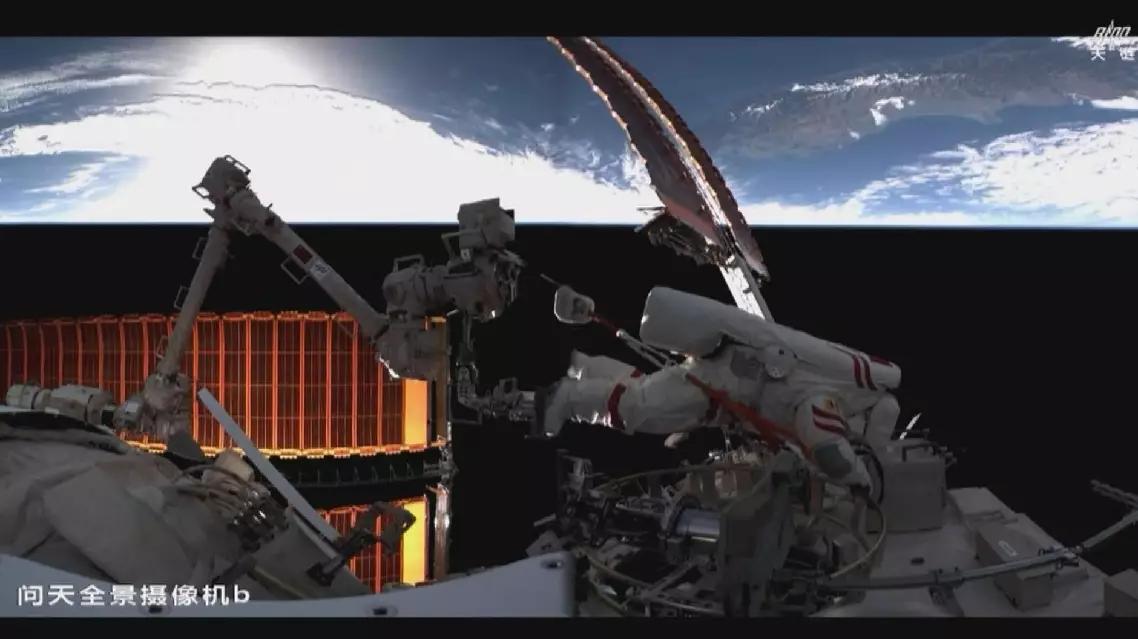
Mechanical arms vital for extravehicular activity: space expert
U.S. economic growth in the first quarter was significantly slower than initially estimated, while consumer inflation remained elevated in April, official data showed Thursday.
GDP expanded at an annual rate of just 1.6 percent in the first quarter, according to a revised reading from the U.S. Department of Commerce's Bureau of Economic Analysis (BEA). The figure represents a sharp downgrade from the initial estimate of 2.0 percent, missing market consensus expectations that the earlier estimate would hold.
Meanwhile, inflation continued to hit consumer wallets. The personal consumption expenditures price index, which serves as the Federal Reserve's preferred inflation gauge, increased by a seasonally adjusted 0.4 percent in April month on month. This puts the 12-month inflation rate at 3.8 percent, the department reported.
When excluding volatile food and energy costs, the core PCE price index rose 0.2 percent for the month and 3.3 percent annually. The monthly figure came in slightly below economists' estimate of 0.3 percent.
Despite the softer GDP reading and persistent inflation, U.S. consumer spending increased by 0.5 percent in April, meeting market forecasts. However, personal income remained flat, missing estimates for a 0.4 percent rise and signaling continued strain on household finances.
The fresh pricing data is expected to keep the Fed on the sidelines until the current wave of inflation subsides. Traders currently expect the central bank to remain on hold until at least late 2026, with markets pricing in the likelihood that the Fed's next policy move will be an interest rate increase, possibly in early 2027.
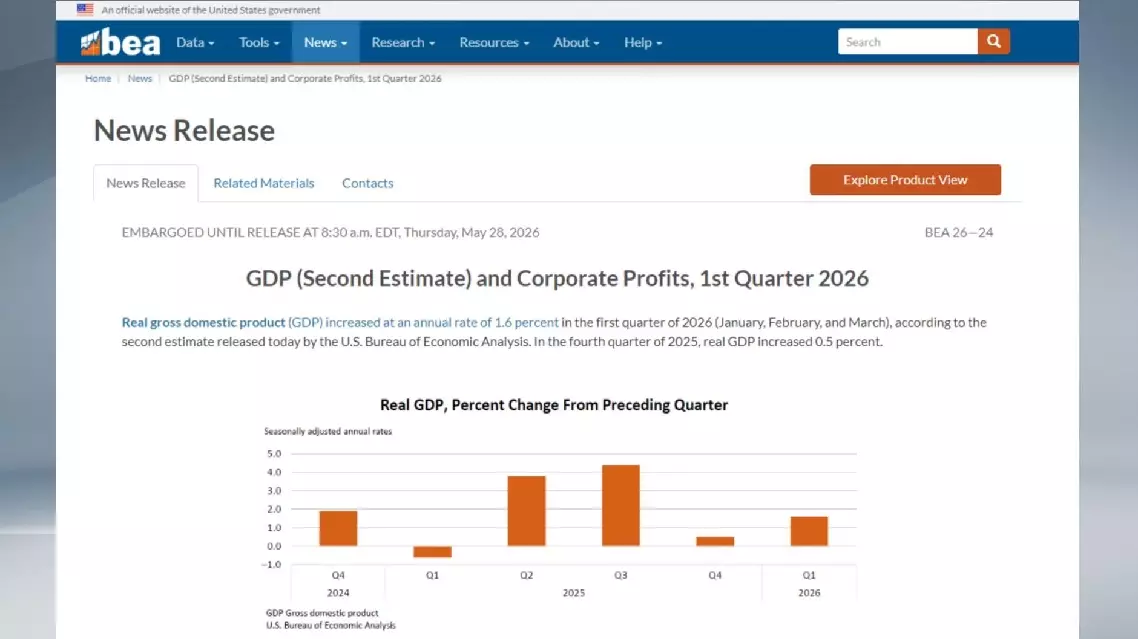
U.S. first-quarter GDP growth revised down to 1.6 pct annual rate