The Association of Southeast Asian Nations (ASEAN) and China have always engaged in win-win cooperation, and ASEAN must learn from China's experience in promoting common prosperity and green development, said ASEAN Secretary-General Kao Kim Hourn.
Kao made the remarks while talking about the concept of "a community with a shared future for mankind" proposed by Chinese President Xi Jinping in a recent interview with the China Media Group (CMG).
President Xi proposed the vision of building a community with a shared future for mankind for the first time in 2013. The concept advocates for an equal and orderly multipolar world and a universally-beneficial and inclusive economic globalization, and upholds the principles of openness, inclusiveness, mutual benefit, win-win results, and fairness and justice.
On the ASEAN-China relations, Kao believes the foremost concern is long-term peace.
"For sure, I think, we have a shared future. Our future lies in making sure that we have long-term peace. We should never think that war and conflict are obsolete. So I think the shared future we have between ASEAN and China, I think President Xi Jinping, he wants to see long-term peace, I'm sure," he said.
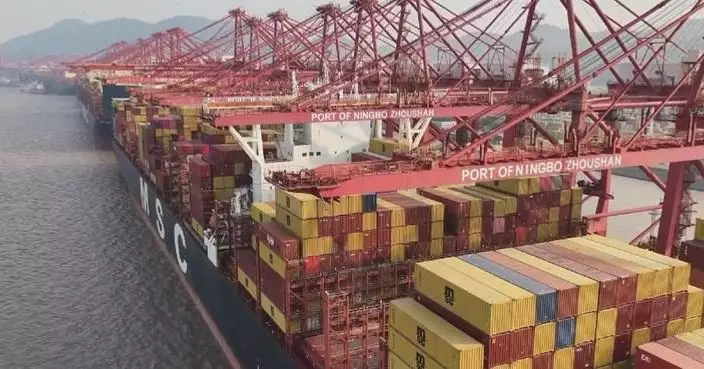
Kao also touched the economic ties that have been central to the partnership between ASEAN and China. He affirmed that China's prosperity has always been a shared prosperity, particularly evident in their trade relations.
"The economic development, economic growth and transformation require a lot of constant innovation, constant re-thinking, constant leadership to look at how we can continue to invest in the economy, and the economy continues to grow to benefit the people. I think the prosperity in China has always been a shared prosperity. The fact that we have been doing a lot of trade together is a win-win cooperation."
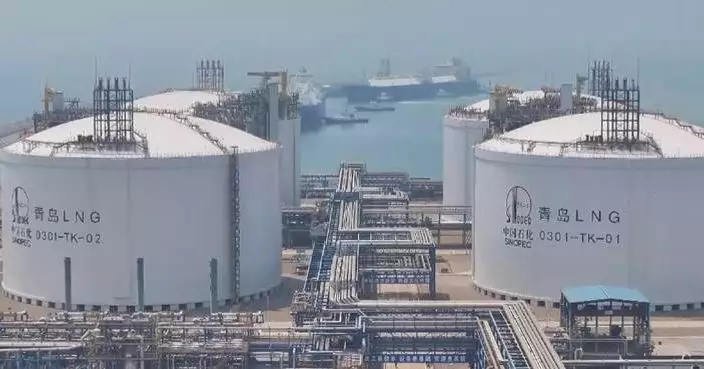
The ASEAN secretary-general praised China's pioneering position in green development, and welcomed more investment from China in this area.
"What kind of future do we leave for our future generations? Again, this planet agenda, I think, is win-win together if we work together very closely. That's why we should welcome more green investment from China, we should welcome more participation of China in the renewable and clean energy in ASEAN, including turning waste into energy solutions project. I think China is already experienced in the technology there," he said.
For Kao, the foundation of a successful partnership lies in collaboration, and he believes President Xi is very visionary in this regard.
"It's all about partnership. We cannot do it alone. Some of the global issues today require more cooperation, more collaboration at the international level, as well as at the regional level. So that's why it is important for us, ASEAN and China, to work together for a shared future in that context. So I think what has been pronounced by President Xi Jinping, I'm sure that he is very visionary in that regard," he said.
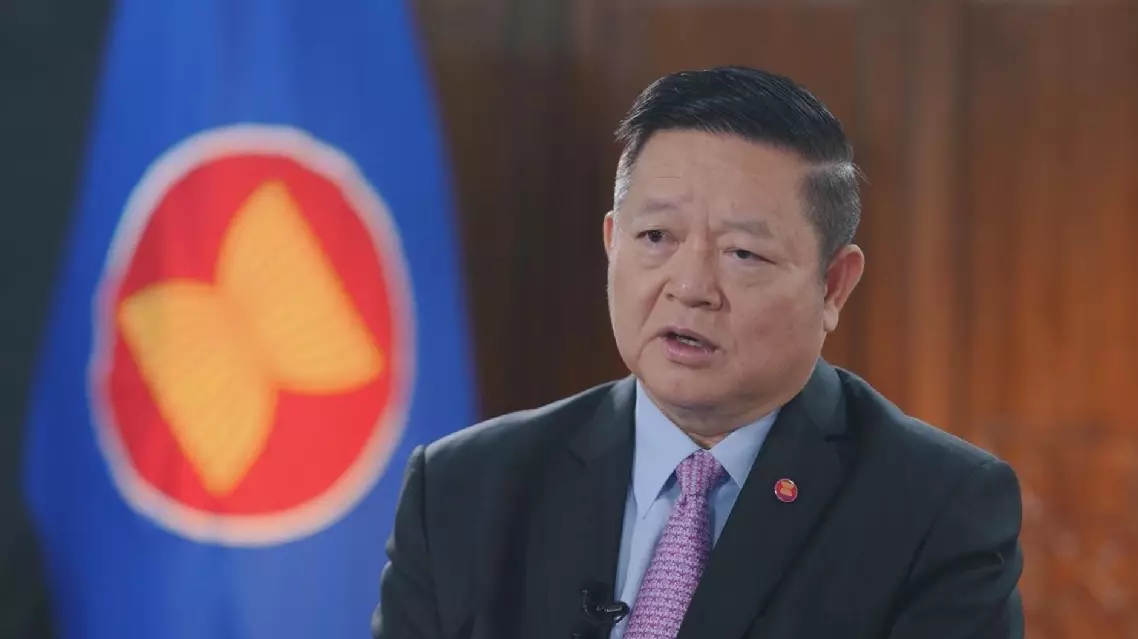
ASEAN secretary-general speaks highly of concept of "shared future" in relations with China

Chinese President Xi Jinping's New Year message delivered on the New Year Eve has drawn positive responses from scholars and former officials from several countries, who say that the series of global initiatives proposed by Xi have provided fresh momentum for multilateralism and shared development at a time of growing uncertainty.
While the reactions touched on the broader vision outlined in Xi's New Year message, they also focused on the initiatives Xi has put forward over recent years, particularly the Global Development Initiative, the Global Security Initiative, the Global Civilization Initiative and the newly proposed Global Governance Initiative.
Highlighting the significant importance of these initiatives, they have emphasized the need for equality, inclusiveness and a fairer international order.
"We need a more just international order and a truly multilateral system. China stands almost alone today as a global force actively advancing genuine multilateralism. Therefore, these initiatives are most welcome," said Michael Schumann, chairman of the German Federal Association for Economic Development and Foreign Trade.
Former Lebanese Prime Minister Hassan Diab has placed the emphasis on dialogue and trust-building between civilizations.
"It is essential now more than ever to promote communication and understanding between China and the world to enhance cultural exchanges and build mutual trust. As President Xi has repeatedly emphasized, China supports principles of unity, inclusiveness and peacefulness. These values should guide our collective efforts to build bridges rather than walls," he said.
From a governance perspective, Russian scholar Ekaterina Zaklyazminskaya, head of the Center for World Politics and Strategic Analysis at the Institute of China and Modern Asia under the Russian Academy of Sciences, has viewed the Global Governance Initiative as a structured response to global challenges.
"The recently proposed Global Governance Initiative presents a comprehensive framework of ideas. It prioritizes establishing a more just international order, champions multilateralism, and upholds the principle of 'people first.' Through its concrete practices, financial assistance, and tangible support for multilateral bodies like the U.N., China has demonstrated that its commitments are substantive. China is taking tangible steps toward a fairer and more reasonable global governance system," she said.
Scholars from the Global South also have seen historical echoes in the initiatives.
"Some of the developed and developing countries have highly welcomed the Global Development Initiative, because this initiative emphasizes the need for partnerships -- partnerships that commit resources to end global poverty and pursue common and shared development. The Global Governance Initiative, in my view, echoes again the call that was made by Asian [and] African countries at the Bandung Conference in 1955 for equality, for mutual respect, for respect of territorial integrity, [and] for respect of sovereignty," said Bongani Maimele, director of international relations at South Africa's National School of Government.
"These initiatives are revolutionary in nature. They are reshaping the political philosophy of global governance. Today's world is far more complex than it was 80 years ago, and interdependence among nations has deepened. Therefore, we need new philosophical perspectives to examine our world and new models of engagement to foster a new type of international relations," said Sheradil Baktygulov, director of Kyrgyzstan's Institute of World Policy.
Int'l scholars praise Xi's initiatives, call for stronger multilateralism