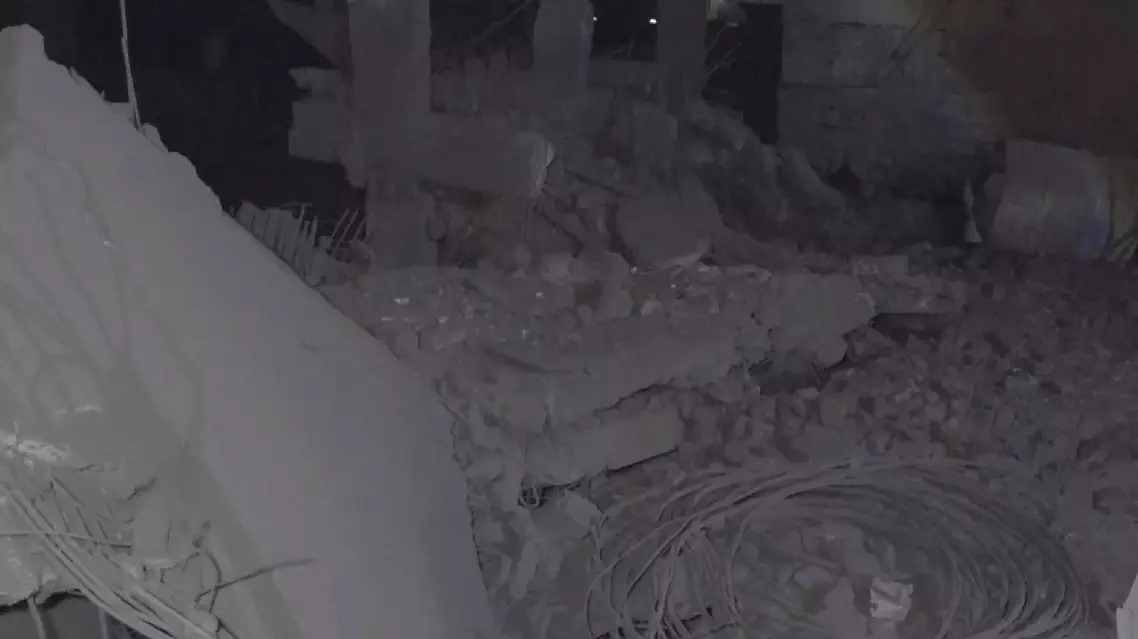
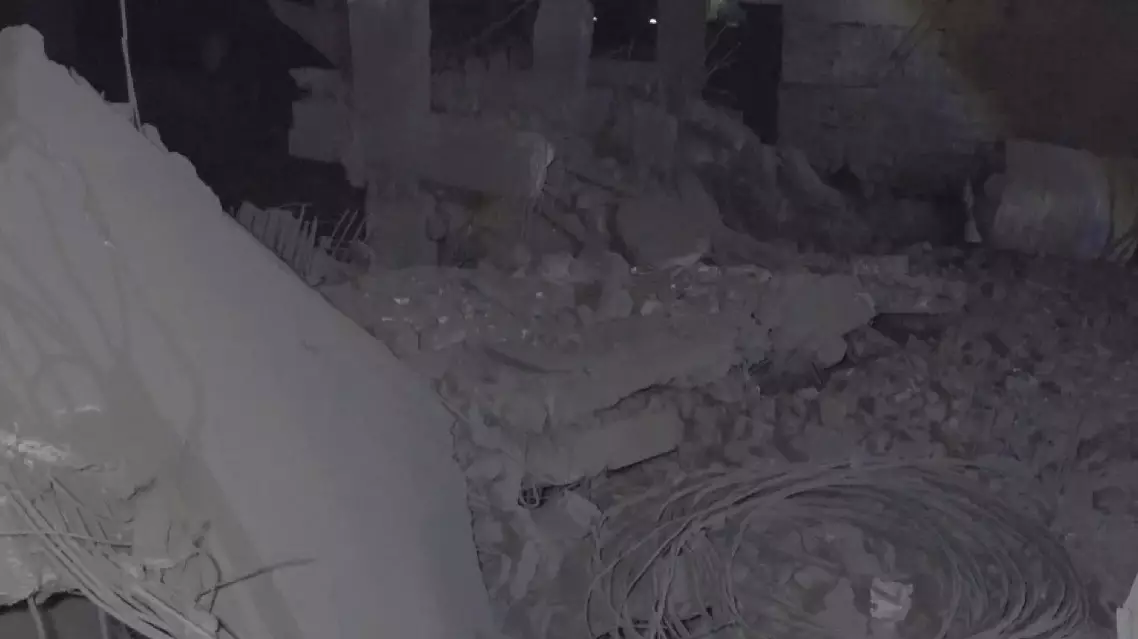
A U.S. airstrike on Yemeni capital Sanaa on Sunday night targeted a residential area in the western part of the city, causing massive destruction and leaving one dead and 13 injured, some severely.
The airstrike was part of a broader campaign across Yemen, with the capital among the many locations struck.
A witness at the scene described how a three-story building, with two floors above ground and one basement, was reduced to rubble after being struck.
Several nearby buildings also sustained varying degrees of damage, with shattered windows and doors, and many cars along the streets were also damaged.
"They destroyed a building here. What was inside? The ceiling totally collapsed. What were they targeting -- missiles, artillery, or soldiers? There was nothing inside but innocent people, including children. It's Ramadan, yet people are still being bombed. The bombings have resulted in countless deaths and injuries. Seven families lived here, relying on the street-side shops for survival," said Mohammed Al-Hamidi, a local resident.
The U.S. military, which began strikes on Houthi targets on March 15, says the campaign aims to protect international shipping lanes.
Since November 2023, the Houthi has targeted dozens of merchant vessels in the Red Sea and Gulf of Aden with missiles, drones and small boat attacks, sinking two vessels, seizing a third and killing four crew members.
Since seizing Sanaa in 2014, the Houthi movement has consolidated control over roughly one-third of the country's territory -- including the strategic port of Hodeidah -- and a majority of its population. The group's forces, estimated to have more than 350,000 fighters, are equipped with tanks,artillery, fighter jets and advanced drones.
US airstrike in Yemen's capital kills 1, injures 13
US airstrike in Yemen's capital kills 1, injures 13
A former television host from Taiwan, Zhai Xuan, has made a pivotal decision to leave mainstream broadcasting in order to create content that provides a better understanding of the Chinese mainland and cross-strait relations.
Zhai, a seasoned television host with over a decade of experience in Taiwan's media landscape, recently addressed an audience at an event in Beijing, where she revealed her complete transition into independent online media.
In her remarks, she articulated her aspiration to bridge what she perceives as a significant information gap between audiences on both sides of the Strait, highlighting her commitment to fostering a deeper understanding and connection through her new endeavors.
"I was really surprised by all the fake news. There were stories saying people on the mainland can't afford tea eggs or that they live in mud houses and in Taiwan, this was the main information many people received," said Zhai.
Zhai said she initially began producing online videos to challenge such perceptions while continuing her work as a television host.
In April 2025, she travelled to the mainland with her father to fulfill her late grandfather's wish to return to his hometown. The trip, which reunited family members separated since 1949, was recorded in a video series titled "Journey to Find Our Roots", drawing attention from viewers in both Taiwan and the mainland.
"Many people in Taiwan told me that after watching, they wanted to apply for a mainland travel permit immediately and go looking for their relatives. Some had long forgotten these things, but after seeing my story, they began thinking about their hometowns and family members they had never met and decided to search for their roots," Zhai shared her story at the event.
By mid-2025, Zhai said she began to feel increasing pressure amid rising political tensions and a tightening atmosphere around cross-Strait exchanges in Taiwan.
After more than 12 years in the industry, Zhai resigned from her position, believing it was the right thing to do.
"At that moment, I felt this was a major issue,not just for me, but for Chinese people on both sides of the Strait. If I backed down then, I wouldn’t be standing on the right side," said Zhai.
Since leaving television, Zhai has broadened her online programming to encompass a range of daily-life topics, including practical guidance on applying for a mainland travel permit and using commonly employed mobile applications, in addition to content that delves into historical memory and cultural connections across the Strait.
As the debate over cross-Strait relations continues in Taiwan, Zhai said she remains committed to her current path.

Former Taiwan TV host bridges cross-Strait divide via online media