Skip to Content Facebook Feature Image

Supreme Court upholds Biden rule requiring serial numbers and background checks for ghost guns

News

Supreme Court upholds Biden rule requiring serial numbers and background checks for ghost guns
News

News

Supreme Court upholds Biden rule requiring serial numbers and background checks for ghost guns

2025-03-27 05:05 Last Updated At:05:10

WASHINGTON (AP) — The Supreme Court on Wednesday upheld a Biden administration regulation on the nearly impossible-to-trace weapons called ghost guns, clearing the way for continued serial numbers, background checks and age verification requirements for buying the kits online.

The 7-2 opinion found that existing gun laws allow regulation of the kits increasingly linked to crime. It comes after President Donald Trump ordered a review of federal gun policy that could undermine or reverse regulations championed by his predecessor.

Sales of the homemade firearms grew exponentially as kits allowing for easy at-home building came into the market, Justice Neil Gorsuch wrote in the majority opinion. “Some home hobbyists enjoy assembling them. But criminals also find them attractive,” he said.

The number of ghost guns found at crime scenes around the country has also soared, according to federal data. Fewer than 1,700 were recovered by law enforcement in 2017, but that number grew to 27,000 in 2023, according to Justice Department data.

Since the federal rule was finalized, though, ghost gun numbers have flattened out or declined in several major cities, including New York, Los Angeles, Philadelphia and Baltimore, according to court documents. Manufacturing of miscellaneous gun parts also dropped 36% overall, the Justice Department has said.

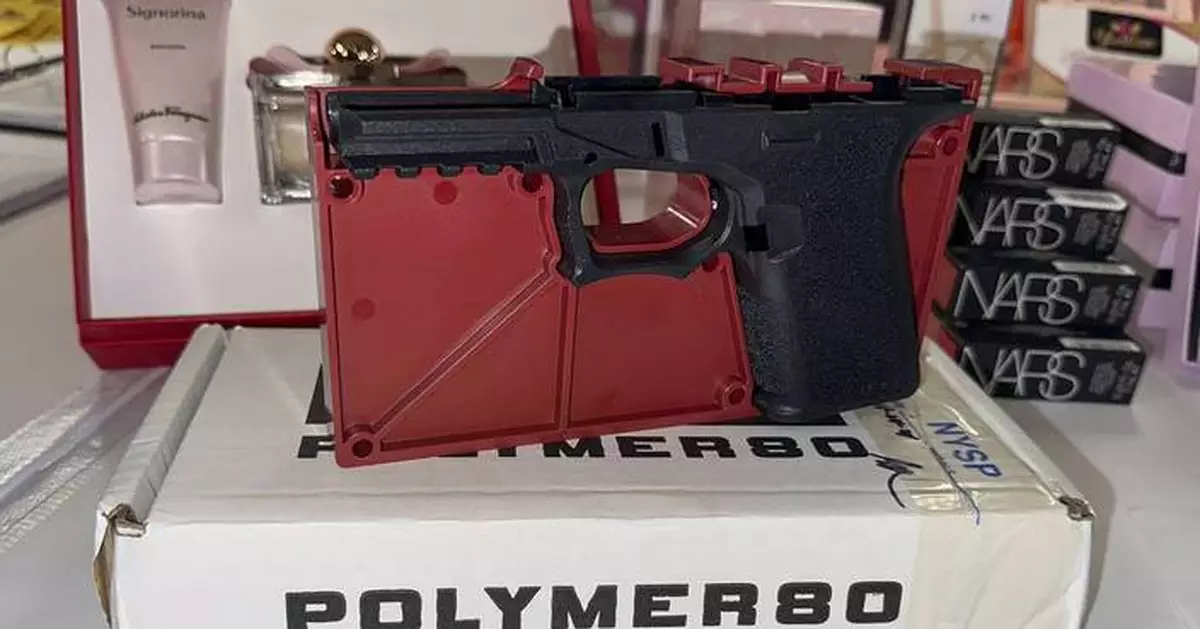
Ghost guns are any privately made firearms without the serial numbers that allow police to trace weapons used in crime. The 2022 regulation was focused on kits sold online with everything needed to build a functioning firearm — sometimes in less than 30 minutes, according to court documents.

Ghost guns have been used in high-profile crimes, including a mass shooting carried out with an AR-15-style ghost gun in Philadelphia that left five people dead. Police believe a ghost gun used in the slaying of UnitedHealthcare’s CEO in Manhattan was made on a 3D printer rather than assembled from a kit of the kind at the center of the Supreme Court case.

Finalized at the direction of then-President Joe Biden, the “frame and receiver” rule requires companies to treat the kits like other firearms by adding serial numbers, running background checks and verifying that buyers are 21 or older.

Gun groups challenged the rule in court in the case known as Garland v. VanDerStok. Most crimes are committed with traditional firearms, not ghost guns, they argued. It's legal for people to build their own firearms at home, the challengers said, arguing that the Bureau of Alcohol, Tobacco, Firearms and Explosives overstepped its authority by trying to regulate the kits.

The Supreme Court majority disagreed, pointing out that the law gives the ATF the power to regulate items that can be quickly made into working firearms.

“The ‘Buy Build Shoot’ kit can be 'readily converted' into a firearm too, for it requires no more time, effort, expertise, or specialized tools to complete,” Gorsuch wrote, referring to a specific product.

Some kits may take more time to build into guns and therefore fall outside the ATF’s power, he wrote, but many popular kits are subject to regulation.

In response to the ruling, a Justice Department spokesperson said the administration would “continue to support and defend the Second Amendment rights of all Americans.”

Gun safety groups celebrated the ruling, with Everytown Law executive director Eric Tirschwell saying the rule also had broad support from law enforcement. “Fundamentally, today's decision confirms the ghost gun industry is dead as a viable business model," he said.

A Michigan woman whose son lost an eye when he was accidently shot by a friend who bought a ghost gun before he was old enough to legally buy a typical weapon also applauded. “We are deeply relieved by today’s ruling, which will help ensure that a tragedy like ours never happens again,” she said.

New Jersey Attorney General Matt Platkin said the ATF policy is a major factor in two years of record-low numbers of shootings in his state. “These are common-sense regulations on ghost guns that all too often end up in the hands of felons,” he said.

The court previously expanded Second Amendment rights with a finding that modern gun regulations must fit within historical traditions. The justices also struck down a firearm regulation from President Donald Trump’s first administration, a ban on gun accessories known as bump stocks that enable rapid fire.

In a dissent, Justice Clarence Thomas wrote that the ghost gun rule should meet the same fate. The kits, he wrote, are only firearm parts and shouldn't be subject to a regulation that could open the door to rules on other popular weapons. “Congress could have authorized ATF to regulate any part of a firearm or any object readily convertible into one," he wrote. “But, it did not.”

Justice Samuel Alito also filed his own dissent.

Associated Press writer Darlene Superville in Washington and Geoff Mulvihill in Cherry Hill, New Jersey, contributed to this report.

Follow the AP’s coverage of the U.S. Supreme Court at https://apnews.com/hub/us-supreme-court.
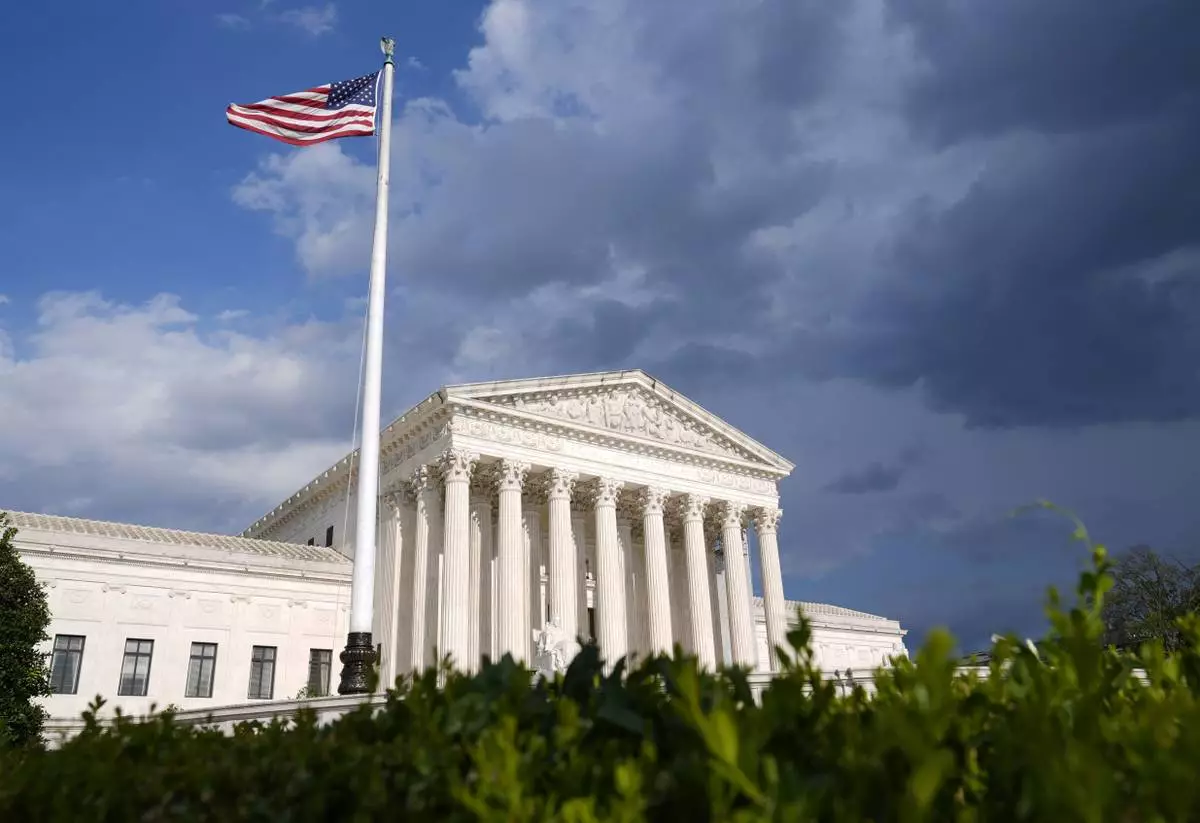
FILE - The Supreme Court in Washington, June 30, 2024. (AP Photo/Susan Walsh, File)
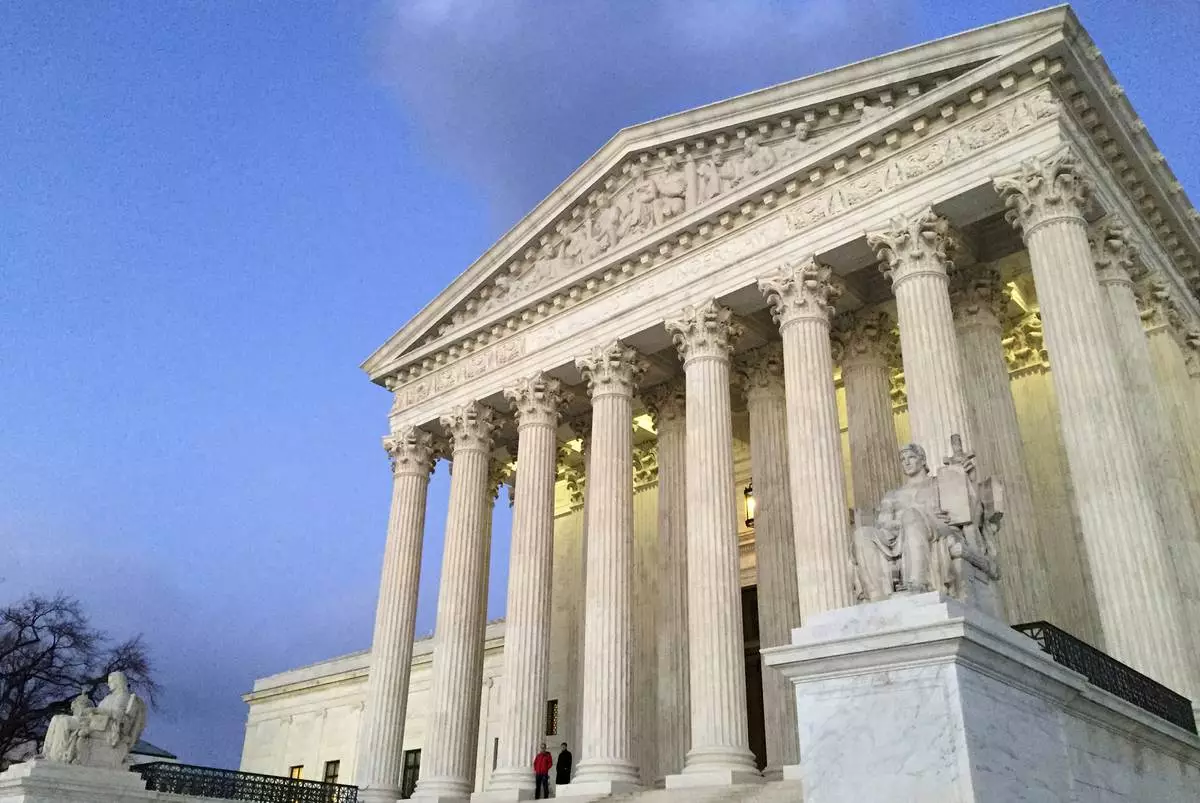
FILE - The Supreme Court in Washington, June 30, 2024. (AP Photo/Susan Walsh, File)

FILE - The Supreme Court at sunset in Washington, Feb. 13, 2016. (AP Photo/Jon Elswick, File)
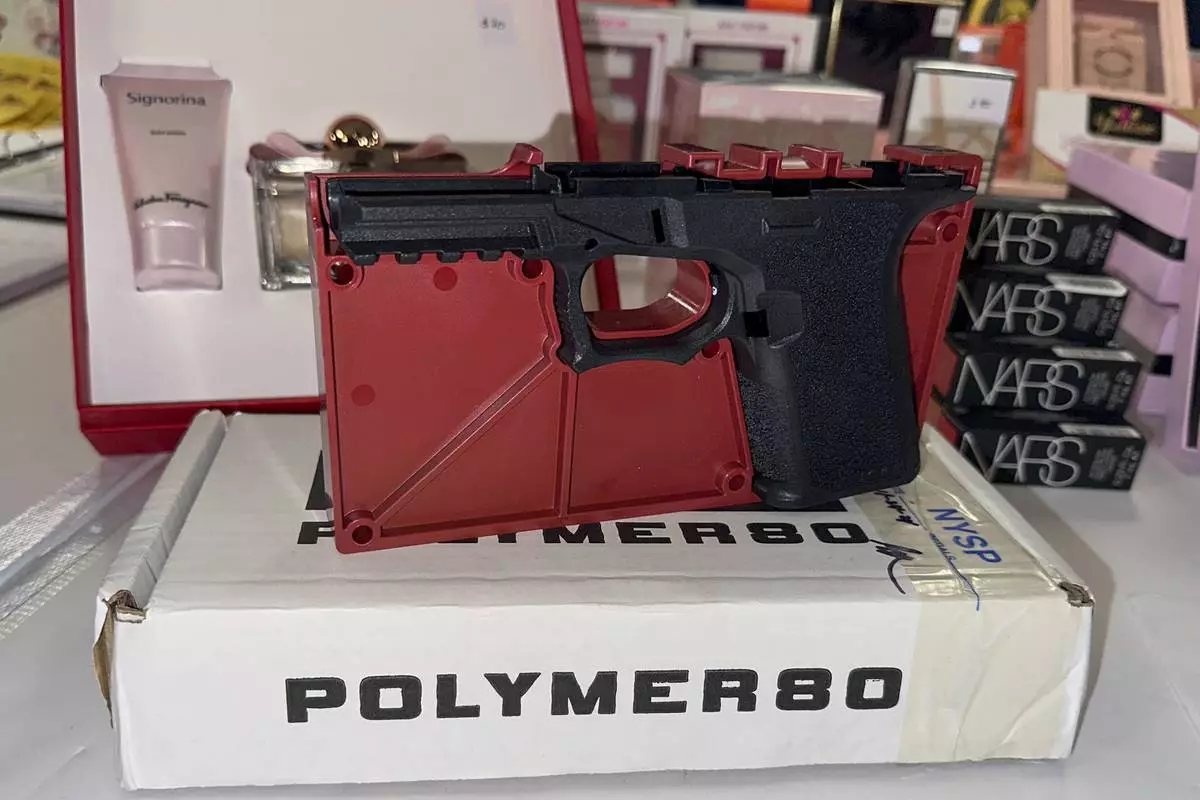
FILE - The Supreme Court at sunset in Washington, Feb. 13, 2016. (AP Photo/Jon Elswick, File)

FILE - A ghost gun that police seized from an organized shoplifting crime ring is on display during a news conference at the Queens District Attorney's office in New York City, Nov. 26, 2024. (AP Photo/Ted Shaffrey, File)
FILE - A ghost gun that police seized from an organized shoplifting crime ring is on display during a news conference at the Queens District Attorney's office in New York City, Nov. 26, 2024. (AP Photo/Ted Shaffrey, File)

Glenn Hall, a Hockey Hall of Famer whose ironman streak of 502 starts as a goaltender remains an NHL record, has died. He was 94.

Nicknamed “Mr. Goalie,” Hall worked to stop pucks at a time when players at his position were bare-faced, before masks of any kind became commonplace. He did it as well as just about anyone of his generation, which stretched from the days of the Original Six into the expansion era.

A spokesperson for the Chicago Blackhawks confirmed the team received word of Hall’s death from his family. A league historian in touch with Hall’s son, Pat, said Hall died at a hospital in Stony Plain, Alberta, on Wednesday.

A pioneer of the butterfly style of goaltending of dropping to his knees, Hall backstopped Chicago to the Stanley Cup in 1961. He won the Conn Smythe Trophy as most valuable player of the playoffs in 1968 with St. Louis when the Blues reached the final before losing to Montreal. He was the second of just six Conn Smythe winners from a team that did not hoist the Cup.

His run of more than 500 games in net is one of the most untouchable records in sports, given how the position has changed in the decades since. Second in history is Alec Connell with 257 from 1924-30.

“Glenn was sturdy, dependable and a spectacular talent in net,” Commissioner Gary Bettman said. “That record, set from 1955-56 to 1962-63, still stands, probably always will, and is almost unfathomable — especially when you consider he did it all without a mask.”

Counting the postseason, Hall started 552 games in a row.

Hall won the Calder Trophy as rookie of the year in 1956 when playing for the Detroit Red Wings. After two seasons, he was sent to the Black Hawks along with legendary forward Ted Lindsay.

Hall earned two of his three Vezina Trophy honors as the league's top goalie with Chicago, in 1963 and '67. The Blues took him in the expansion draft when the NHL doubled from six teams to 12, and he helped them reach the final in each of their first three years of existence, while winning the Vezina again at age 37.

Hall was in net when Boston's Bobby Orr scored in overtime to win the Cup for the Bruins in 1970, a goal that's among the most famous in hockey history because of the flying through the air celebration that followed. He played one more season with St. Louis before retiring in 1971.

“His influence extended far beyond the crease," Blues chairman Tom Stillman said. “From the very beginning, he brought credibility, excellence, and heart to a new team and a new NHL market.”

A native of Humboldt, Saskatchewan, Hall was a seven-time first-team NHL All-Star who had 407 wins and 84 shutouts in 906 regular-season games. He was inducted into the Hall of Fame in 1975, and his No. 1 was retired by Chicago in 1988.

Hall was chosen as one of the top 100 players in the league's first 100 years.

Blackhawks chairman and CEO Danny Wirtz called Hall an innovator and “one of the greatest and most influential goaltenders in the history of our sport and a cornerstone of our franchise.”

“We are grateful for his extraordinary contributions to hockey and to our club, and we will honor his memory today and always,” Wirtz said.

The Blackhawks paid tribute to Hall and former coach and general manager Bob Pulford with a moment of silence before Wednesday night’s game against St. Louis. Pulford died Monday.

A Hall highlight video was shown on the center-ice videoboard. The lights were turned off for the moment of silence, except for a spotlight on the No. 1 banner for Hall that hangs in the rafters at the United Center.

Fellow Hall of Famer Martin Brodeur, the league's leader in wins with 691 and games played with 1,266, posted a photo of the last time he saw Hall along with a remembrance of him.

“Glenn Hall was a legend, and I was a big fan of his,” Brodeur said on social media. “He set the standard for every goaltender who followed. His toughness and consistency defined what it meant to play.”

AP Sports Writer Jay Cohen in Chicago contributed to this report.

AP NHL: https://apnews.com/hub/nhl

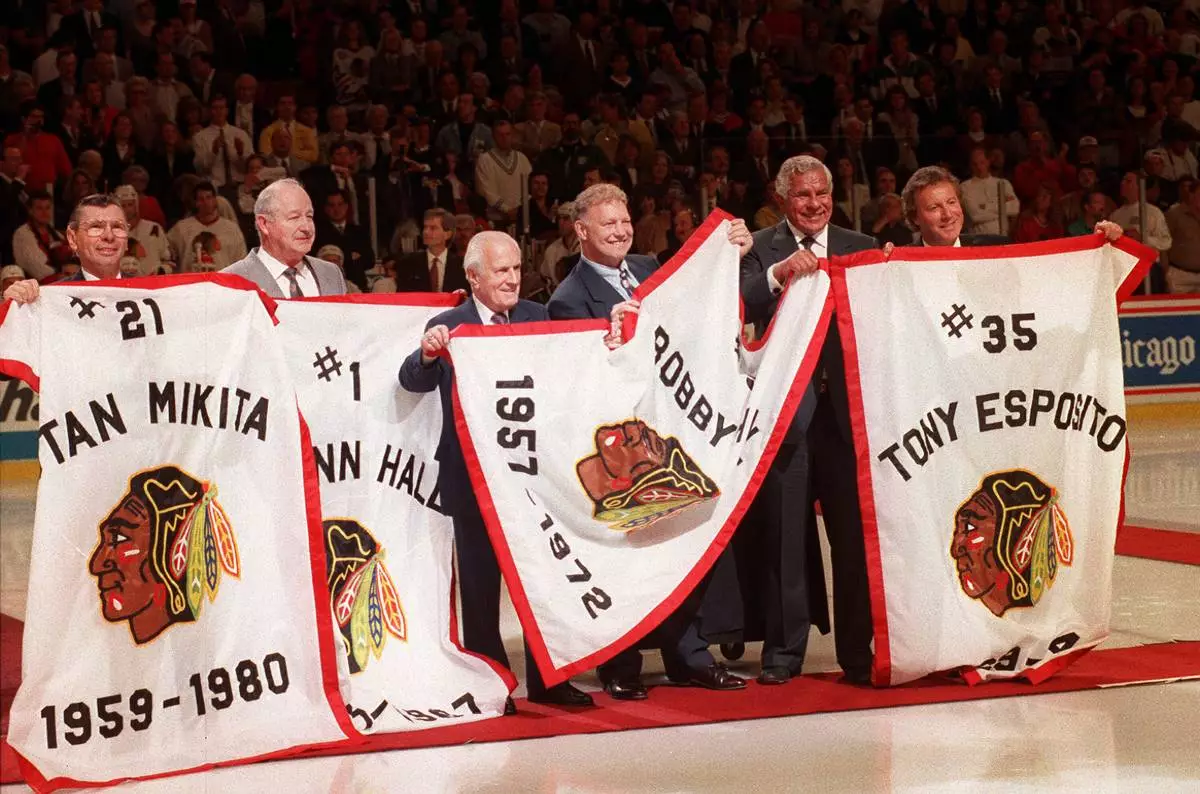
FILE - Glenn Hall, second from left, stands with fellow former Chicago Blackhawks players Stan Mikita, former general manager Tommy Ivan, Bobby Hull, Bill Wirtz and Tony Esposito during a pre-game ceremony at the Chicago Stadium in Chicago, Ill., April 14, 1994. (AP Photo/Fred Jewell, File)

FILE - Glenn Hall, second from left, stands with fellow former Chicago Blackhawks players Stan Mikita, former general manager Tommy Ivan, Bobby Hull, Bill Wirtz and Tony Esposito during a pre-game ceremony at the Chicago Stadium in Chicago, Ill., April 14, 1994. (AP Photo/Fred Jewell, File)

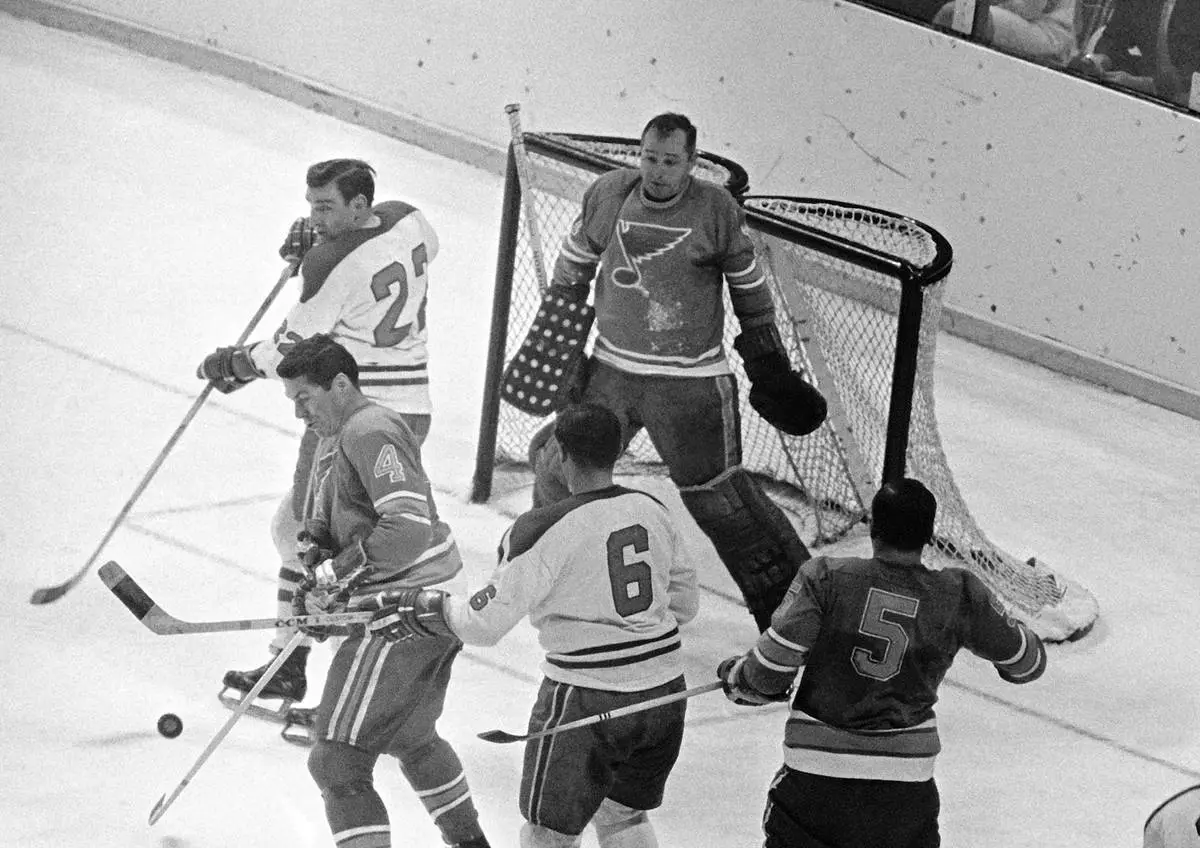
FILE - St. Louis Blues goalie Glenn Hall, top right, is pinned to his net waiting to make a save on a Montreal Canadians shot as Blues' Noel Picard (4) tries to block the puck while Canadiens' John Ferguson (22) and Ralph Backstorm wait for a rebound in the third period of their NHL hockey Stanley Cup game, May 5, 1968. (AP Photo/Fred Waters, File)

FILE - St. Louis Blues goalie Glenn Hall, top right, is pinned to his net waiting to make a save on a Montreal Canadians shot as Blues' Noel Picard (4) tries to block the puck while Canadiens' John Ferguson (22) and Ralph Backstorm wait for a rebound in the third period of their NHL hockey Stanley Cup game, May 5, 1968. (AP Photo/Fred Waters, File)

Recommended Articles