MIAMI GARDENS, Fla. (AP) — Jessica Pegula stopped the string of upsets at the Miami Open by ending the stalwart run of Britain’s unseeded Emma Raducanu on Wednesday night.
The fourth-seeded Pegula won 6-4, 6-7 (3), 6-2 in a two hour, 25 minute battle, to move into her third Miami Open women's semifinal in four years. Pegula, the last American in the field, faces the teenage wild card from the Philippines, Alexandra Eala, on Thursday.
Pegula's match ended at 11:23 p.m. and forced the postponement of the men's quarterfinal between Novak Djokovic and Sebastian Korda until Thursday.
Raducanu, who won the 2021 U.S. Open, came in ranked 60th world after experiencing multiple coaching changes and injuries.
Pegula won the first set. But Raducanu flashed her power in taking the second set, though not before she appeared to struggle physically with Miami’s high humidity that reached 70%.
Grimacing through points and showing signs of overheating, Raducanu posted five set points on Pegula’s serve but couldn’t convert. Pegula then held to close to 5-4.
At that juncture, medical personnel took Raducanu’s blood pressure and pulse rate as the chair umpire declared a medical timeout. The medical officials rubbed ice bags on Raducanu’s legs and put cold towels around her neck.
Raducanu sprang to life and dominated the tiebreaker 7-3.
In the third set, Pegula rallied, going up an early break at 2-0. On her third break point, Pegula put away Raducanu's short ball and ended the match by breaking Raducanu at love.
In a nearly three-hour, men’s quarterfinal, a cramping, 14th-seeded Grigor Dimitrov barely survived the oppressive humidity to outlast No. 23 seed Francisco Cerundolo 6-7 (6), 6-4, 7-6 (3).
Dimitrov was led off the court by a tournament doctor and ATP physio after sitting in his chair for over 25 minutes, saying he was feeling “dizzy."
Dimitrov, a Miami Open finalist in 2024, saved a match point in the third set when trailing 5-6 before forcing a tiebreaker. He squandered seven set points in the opening set and lost the tiebreaker 6-4.
He will face the Djokovic-Korda winner in the quarterfinals.
The high seeds were falling earlier on Wednesday.
Soon after unseeded wild card Eala stunned No. 2 seed Iga Swiatek in a straight-set women's quarterfinal, men’s top seed Alexander Zverev got bounced by No. 17 seed Arthur Fils of France, 3-6, 6-3, 6-4 in a fourth-round men’s match postponed by rain.
Fils, who beat American Frances Tiafoe in his previous match in a marathon three setter, will face Jakub Mensik in Thursday’s quarterfinals.
In the third set, Fils broke Zverev at 3-3 and kept the German moving. On match point, Fils pounded a ball down the left sideline that the top seed couldn’t retrieve.
Fils, 20, received treatment on his back after the first set but rallied to win the next two, winning in two hours.
“I was feeling not great in the rallies," he said. "I’ve had a little problem in my back since I was young, so sometimes it hurts me a little bit. I had to find a rhythm, more aggressive and come into the court to play my game and not let him play. Because when you let him play, he is one of the best tennis players in the world. I’m really happy about the way I did it.”
Eala, ranked 140th, is on the verge of becoming the first star player to ever come out of the Philippines after topping Swiatek 6-2, 7-5.
Eala became the third wild card to reach the Miami Open semifinals, following Justine Henin in 2010 and Victoria Azarenka in 2018.
She never rattled as the first four games went to at least one deuce and five of the first six games were service breaks. Swiatek held serve just twice in the match and committed 32 unforced errors in the one hour, 39-minute battle.
Eala has beaten three major winners during her remarkable run — Jelena Ostapenko, Madison Keys and Swiatek, a five-time Grand Slam winner from Poland.
“There is a lot of emotions, definitely,’’ said Eala, who had never beaten a top 40 player. “Happiness has to be on the top of the whole list.’’
__
This story has been changed to correct the spelling of Raducanu throughout.
AP tennis: https://apnews.com/hub/tennis
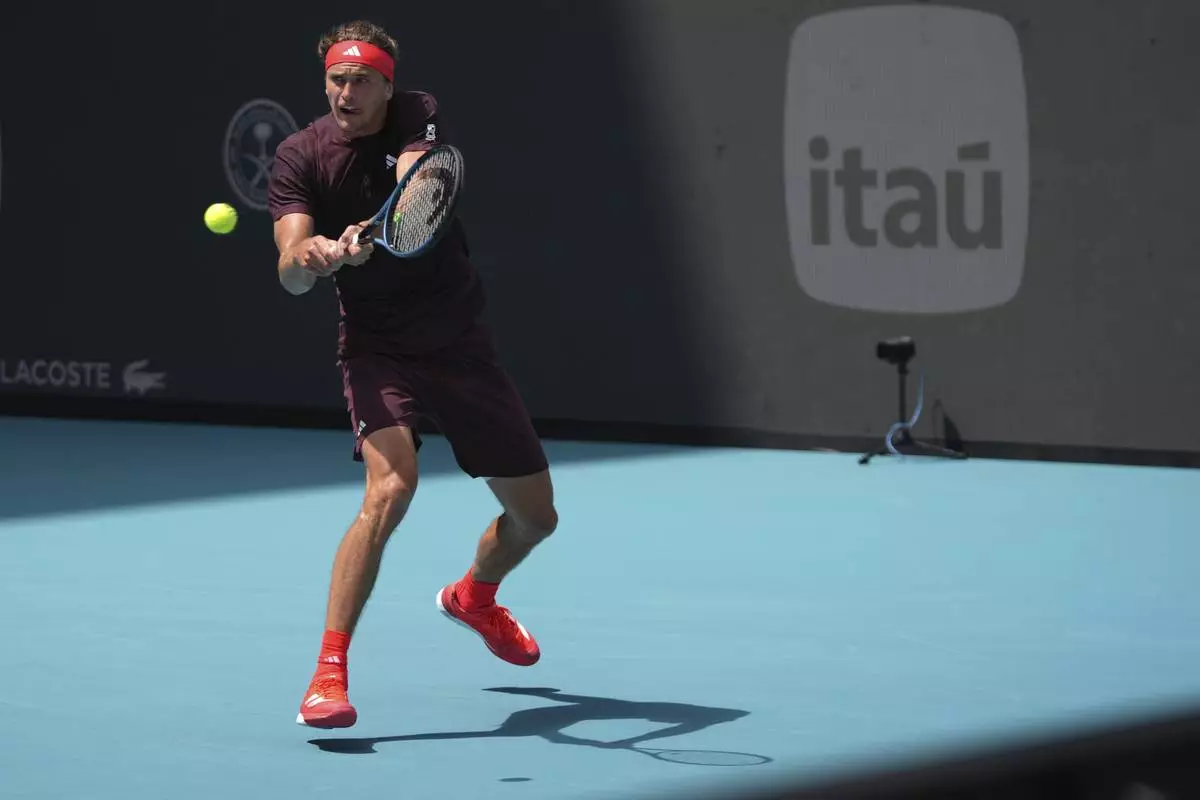
Alexander Zverev, of Germany, hits a return to Jacob Fearnley, of Great Britain, during the Miami Open tennis tournament, Saturday, March 22, 2025, in Miami Gardens, Fla. (AP Photo/Lynne Sladky)

FILE - Arthur Fils of France gestures during his third round match against compatriot Ugo Humbert at the Australian Open tennis championship in Melbourne, Australia, Friday, Jan. 17, 2025. (AP Photo/Manish Swarup, File)

CHERNIHIV, Ukraine (AP) — Young athletes in northern Ukraine spend their days cross-country skiing through a scorched forest, focused on their form — until a siren inevitably shatters the silence.
They respond swiftly but without panic, ditching their skis and following coaches to an underground bomb shelter.
It’s an ordinary training session at the complex that produced Ukraine’s first Olympic medalist.
Sleeping children no longer dream of Olympic glory in the facility's bombed-out dormitories, and unexploded ordnance has rendered nearby land off limits. But about 350 kids and teens — some of the nation's best young cross-country skiers and biathletes — still practice in fenced-off areas amid the sporadic buzz of drones passing overhead then explosions as they're shot down.
“We have adapted so well — even the children — that sometimes we don’t even react,” Mykola Vorchak, a 67-year-old coach, told The Associated Press in an interview on Oct. 31. “Although it goes against safety rules, the children have been hardened by the war. Adapting to this has changed them psychologically.”
War has taken a heavy toll on Ukrainian sport. Athletes were displaced or called up to fight. Soccer matches are often interrupted by air raid sirens so attendance is capped by bomb shelter capacity. Elite skaters, skiers and biathletes usually train abroad, with attacks and frequent blackouts shuttering local facilities.
But the government-run Sports Ski Base of the Olympic Reserve is open for cross-country skiing and biathlon, the event which combines skiing with shooting. The sprawling complex is on the outskirts of Chernihiv, a city two hours north of Kyiv along the path of destruction Russia's army left in its 2022 attempt to capture the capital. Chernihiv remains a regular target for air attacks aimed at the power grid and civilian infrastructure.
Several temporary structures at the sports center serve as changing rooms, toilets and coaches’ offices. Athletes train on snowy trails during the winter and, throughout the rest of the year, use roller skis on an asphalt track pocked by blast marks.
Biathletes aim laser rifles at electronic targets and, between shooting drills, sling skis over their shoulders and jog back to the start of the course, cheeks flushed from the cold.
Valentyna Tserbe-Nesina spent her adolescence at the Chernihiv center performing these same drills, and won bronze at the 1994 Winter Games in Lillehammer. It was Ukraine’s first Olympic medal as an independent country.
“The conditions weren’t great, but we had nothing better. And for us, it was like a family — our own little home,” she said inside her apartment, its shelves and walls lined with medals, trophies and souvenirs from competitions around the world.
Tserbe-Nesina, 56, was shocked when she visited the complex in 2022. Shelling had torn through buildings, fire had consumed others. Shattered glass littered the floors of rooms where she and friends once excitedly checked taped-up results sheets.
“I went inside, up to my old room on the second floor. It was gone — no windows, nothing,” she said. “I recorded a video and found the trophies we had left at the base. They were completely burned.”
Tserbe-Nesina has been volunteering to organize funerals for fallen Ukrainian soldiers in her hometown while her husband, a retired military officer, returned to the front. They see each other about once a year, whenever his unit allows him brief leave.
One adult who in 2022 completed a tour in a territorial defense unit of Ukraine’s army sometimes trains today alongside the center's youngsters. Khrystyna Dmytrenko, 26, will represent her country at the Milan Cortina Winter Olympics that start Feb. 6.
“Sports can show that Ukraine is strong,” Dmytrenko said in an interview next to the shooting range. “We represent Ukraine on the international stage, letting other countries, athletes and nations see our unity, strength and determination.”
The International Olympic Committee imposed bans and restrictions on Russian athletes after the invasion of Ukraine, effectively extending earlier sanctions tied to state‑sponsored doping. But a small group of them will participate in the upcoming Winter Games.
After vetting to ensure no military affiliation, they must compete without displaying any national symbols — and only in non-team events. That means Russian and Ukrainian athletes could face one another in some skating and skiing events. Moscow’s appeal at the federation level to allow its biathletes to compete is pending.
That's why many Ukrainians view training for these events as an act of defiance. Former Olympic biathlete Nina Lemesh, 52, noted that some young Ukrainians who first picked up rifles and skis at the Chernihiv ski base during wartime have become international champions in their age groups.
“Fortunately, Ukrainians remain here. They always will,” she said, standing beside the destroyed dormitories. “This is the next generation of Olympians.”
AP writer Derek Gatopoulos in Kyiv contributed to this report.
A young biathlete trains outside the destroyed ski base in Chernihiv, Ukraine, Thursday, Oct. 30, 2025. (AP Photo/Julia Demaree Nikhinson)
Biathlete Khrystyna Dmytrenko poses for photos outside the destroyed ski base in Chernihiv, Ukraine, Thursday, Oct. 30, 2025. (AP Photo/Julia Demaree Nikhinson)
A young biathlete trains outside the destroyed ski base in Chernihiv, Ukraine, Thursday, Oct. 30, 2025. (AP Photo/Julia Demaree Nikhinson)
Biathletes Mykola Dorofeiev, 16, and Nazar Kravchenko, 12, left, train at the ski base in Chernihiv, Ukraine, Thursday, Oct. 30, 2025. (AP Photo/Julia Demaree Nikhinson)
Biathlete Khrystyna Dmytrenko poses for photos inside the destroyed ski base in Chernihiv, Ukraine, Thursday, Oct. 30, 2025. (AP Photo/Julia Demaree Nikhinson)
A young biathlete trains outside the destroyed ski base in Chernihiv, Ukraine, Thursday, Oct. 30, 2025. (AP Photo/Julia Demaree Nikhinson)