Skip to Content Facebook Feature Image

Chinese sci-fi industry's total revenue hits 108.96 billion yuan in 2024

China

China

China

Chinese sci-fi industry's total revenue hits 108.96 billion yuan in 2024

2025-03-31 17:26 Last Updated At:18:07

China's science fiction industry generated a total of 108.96 billion yuan (about 15 billion U.S. dollars) in 2024 revenue, which largely remains flat compared with that in the previous year, according to a report released by China Science Fiction Research Center on Friday.

Notable originality was evident in the literature, derivative products and themed tourism sectors, the center announced at the China Science Fiction Convention 2025.

The report covered five core sectors of the sci-fi industry -- literature, films and TV shows, video games, derivative products and themed tourism -- highlighting the annual development trends and future trajectories of China's sci-fi industry.

Science fiction is a lens through which humanity views the future and the foundation for the development of the sci-fi industry, according to renowned Chinese science fiction author Liu Cixin.

"The science fiction industry is of a very large scale, covering different fields, including films, literature and art. Only when we have high-quality original content that could generate impactful intellectual properties (IP), which is the origin of the industry, can we further develop the downstream sci-fi industry. Science fiction works in recent years increasingly focus on how technology could reshape our life," Liu said.

Liu also shared his thoughts on AI advancements, suggesting that tools like "Deepseek" might eventually reshape the sci-fi industry.

He also stressed that authors should find innovative approaches that truly demonstrate the value of human authors and science fiction literature.

"[AI tools] can not replace human authors at the moment, but it must be viewed in a development view. AI cannot write novels in upcoming two to three years, but after two more years, 10 or 20 years, it may be able to replace human science fiction authors in theory," he said.

The sci-fi reading sector of the science fiction industry maintained a growth trend from 2017 to 2024. In 2024, the total revenue of this sector reached 3.51 billion yuan (484 million U.S. dollars), representing a year-on-year increase of 10.7 percent.

The industry's sci-fi video games sector earned a total revenue of 71.81 billion yuan (9.9 billion U.S. dollars) in 2024, up 10.2 percent year on year, with a significant improvement in production quality, according to the report.

"Sci-fi video games, as a new culture carrier, not only serve as a good entertainment means, but also carry forward our history and culture, and spread science knowledge. Through a video game, we can build a bridge for players or users," said Chen Chao, a sci-fi video game creator.

Chinese sci-fi industry's total revenue hits 108.96 billion yuan in 2024

Chinese sci-fi industry's total revenue hits 108.96 billion yuan in 2024

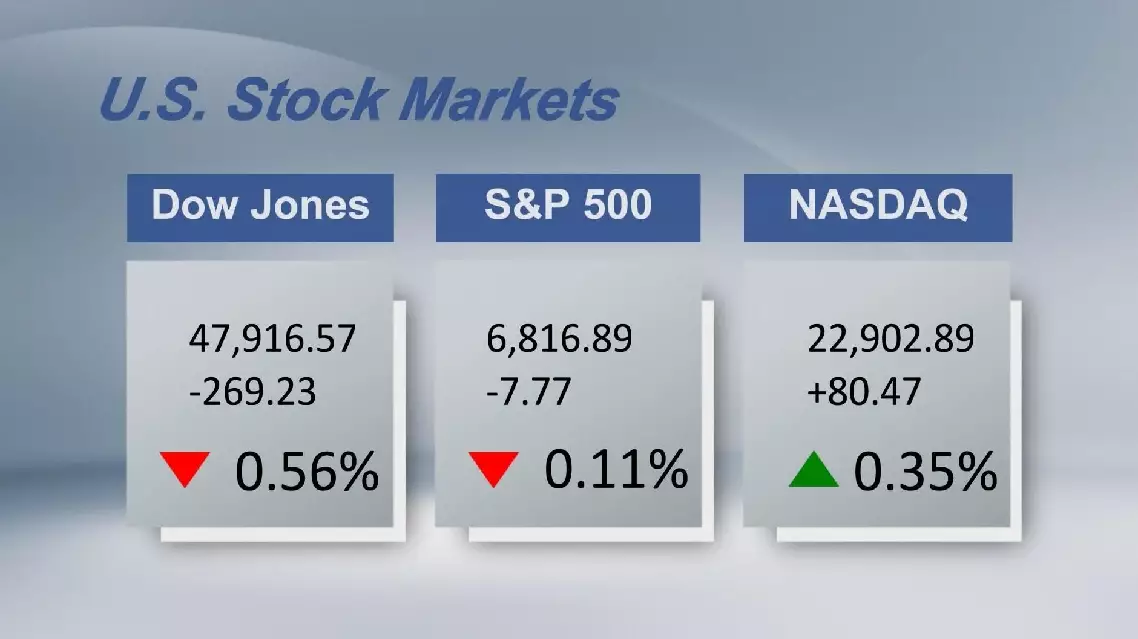
U.S. stocks ended mixed on Friday as investors digested hotter-than-expected inflation data amid ongoing geopolitical uncertainties.

The Dow Jones Industrial Average fell 0.56 percent to 47,916.57. The S and P 500 slipped 0.11 percent to 6,816.89. The Nasdaq Composite Index rose 0.35 percent to 22,902.89.

Seven of the 11 primary S and P 500 sectors closed lower. Consumer staples and health care led the declines, falling 1.43 percent and 1.33 percent, respectively. Technology and materials were the top performers, advancing 0.76 percent and 0.64 percent.

The U.S. consumer price index (CPI) jumped 3.3 percent in March from a year earlier, representing nearly a full percentage point increase from February's annual pace, according to the Bureau of Labor Statistics. The energy index surged 10.9 percent in March, propelled by a 21.2-percent jump in gasoline prices, which alone accounted for nearly three quarters of the monthly increase across all items.

The core CPI, which excludes volatile food and energy components to measure underlying inflation, increased more modestly, rising 0.2 percent for the month and 2.6 percent year over year.

White House Deputy Press Secretary Kush Desai stated that the economy "remains on a solid trajectory," while acknowledging that food and gas prices have risen. National Economic Council Director Kevin Hassett described the current situation as "a temporary energy disruption," adding that the economic effects of the Iran conflict are "a temporary distraction that will very, very quickly go away."

However, Kathy Bostjancic, chief economist at Nationwide, argued that even if a long-lasting deal to end the war is reached and the Strait of Hormuz is fully reopened, "it would take months for oil, gasoline, diesel and other commodity supplies to snap back to pre-war levels and thus for prices to settle back to pre-conflict levels."

Meanwhile, the University of Michigan's preliminary April consumer sentiment index fell sharply to a record low of 47.6, down from 53.3 in March and well below analysts' expectations of 52.0, reflecting growing public concern over the impact of the Iran war on household finances.

Shares of the "Magnificent Seven" technology giants were mostly lower on the day. Nvidia stood out as the strongest performer, rising 2.57 percent.

Investors are now turning their attention to the upcoming U.S.-Iran talks scheduled for this weekend.

U.S. stocks close mixed after shocking inflation data

U.S. stocks close mixed after shocking inflation data

Recommended Articles