A Chinese artist drew inspiration from the ancient Zhaozhou Bridge, which is located in today's Hebei Province in north China, and which has a history of over 1,400 years, in creating an art installation in echo with the Belt and Road Initiative (BRI), showing China's unique philosophy of peace and friendship to the rest of the world.
The art installation, created in 2013 when the BRI was proposed, has been exhibited in many countries and regions, with its traditional Chinese cultural connotations resonating with visitors at the sight of it.
Shu Yong, creator of the artwork named "Golden Bridge on Silk Road," said he made the bridge-shaped installation because a bridge always means connectivity, which would endow his work with a meaning of the bridge between different cultures.
"For thousands of years, there has been a cultural consensus on bridges -- a bridge means connectivity. So, I chose to make it a bridge. Its meaning looks more explicit. Meanwhile, the structure and shape of a bridge bear historic meanings in different countries and different cultures," said Shu in an episode of China Media Group's cultural exchange program "Harmony in Diversity," which was aired on Saturday.
Shu said the Zhaozhou Bridge epitomizes fine traditional Chinese culture both in philosophy and in techniques, and his creative transformation of the cultural landmark has proven accessible to foreign visitors.
"The Zhaozhou Bridge is the oldest stone arch bridge in China, and it is a single-arch bridge. It is a great bridge that is very consistent with Chinese philosophy, science and technology. And when I chose it as a prototype in creating a model, I actually achieved a creative transformation and innovative development of fine traditional Chinese culture. So, it is easy to form a kind of empathy and resonance with everyone. When this model 'Golden Bridge' was exhibited in Europe and other countries, it resonated with everyone in an instant. It tells everyone very directly and clearly that we love peace and play a good role in communication with a bridge," he said.
Besides the Zhaozhou Bridge, Shu also integrated some Great Wall elements into his artwork.
"Meanwhile, each cell of the bridge is the same size as a brick of the Great Wall, integrating the design of Great Wall battlements into it. As the Great Wall is also a prominent cultural symbol of China, it represents unity, struggle and solidarity. So, when it was exhibited abroad, some foreign tourists called it a bridge of peace, a bridge of hearts and a bridge of friendship," he said.

BRI-themed artwork inspired by ancient Zhaozhou Bridge resonates with global visitors
A World Health Organization (WHO) medical epidemiologist on Sunday sought to ease public concerns over a hantavirus outbreak linked to a cruise ship, stressing that the virus is not airborne like COVID-19 and that the average person has no reason to worry.
Spain began evacuating passengers the same day from the hantavirus-stricken cruise ship MV Hondius, which had anchored earlier off the Port of Granadilla on the island of Tenerife.
The MV Hondius departed Argentina on April 1 with more than 140 passengers and crew from 23 countries on board. The ship has reported eight infections, including three deaths. Six of the cases have been laboratory-confirmed as Andes virus infections, caused by a rodent-borne hantavirus endemic to South America and the only known hantavirus strain capable of limited human-to-human transmission.
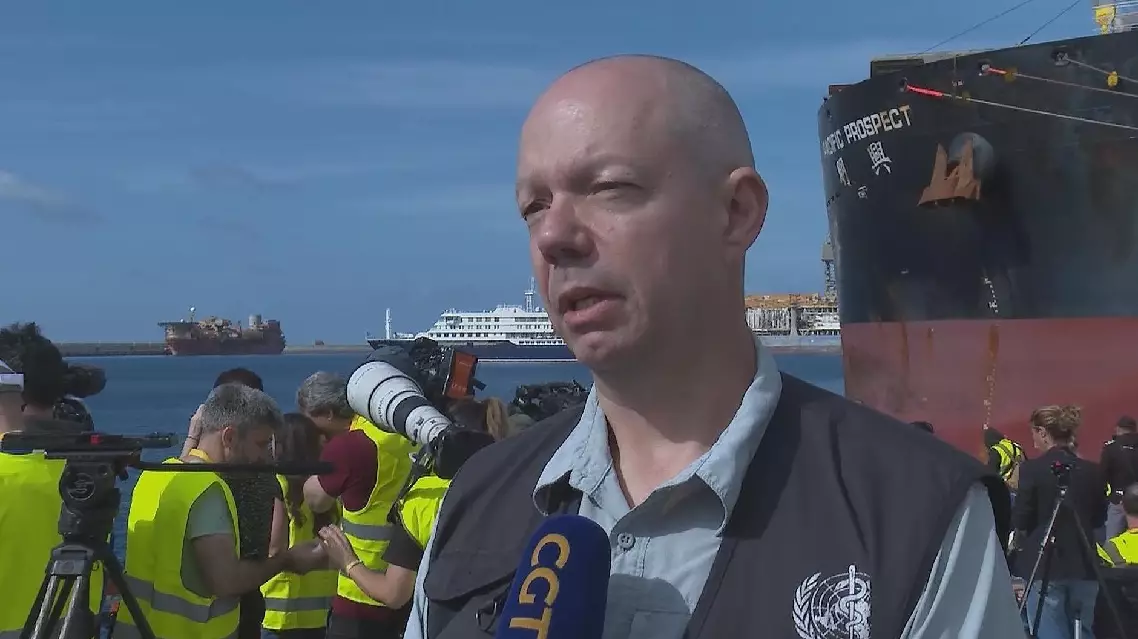
Boris Pavlin, a medical epidemiologist with the WHO, said the cruise ship affected by a hantavirus outbreak had been carefully managed by Spanish authorities and posed little risk to the general public. "This is not COVID. The average person does not need to be worried about hantavirus here in this setting. These folks are being managed very carefully, very deliberately, by the Spanish authorities; they're getting off the ship, they are getting into small boats, they are being spaced apart in the buses so there's no risk to one another. Even if one were to become symptomatic -- we know that none of them were symptomatic as they have been leaving the ship -- they're going straight to their aircraft and they're being taken to their respective national jurisdictions," he said.
Pavlin said the exact source of exposure remained under investigation, but the initial cases appeared to be linked to a pre-cruise land excursion in South America.
"From what we understand of the initial cases, there was -- as one does often on a cruise -- there was a land-side excursion before the cruise in which places were visited that are home to these specific rodents that are associated with the Andes hantavirus. These are not worldwide rodents; the long-tailed rice rat is very specific to the Andes Cordillera region of South America, and that's where people who are exposed to the rodents were. So it was in one of those places they were exposed. We don't know exactly because there are several possibilities, and I believe that the Argentinian authorities are actually even going to look at that and try to do some animal sampling to get to the very bottom of it. But that part's not unexpected at all," he said.
The official praised Spanish authorities' handling of the ship and described the response as a closely coordinated international effort.
"This has been an extremely cooperative, collegial international effort. The Spanish authorities are very diligent and deliberate about what's happening here. There's nothing that would surprise us. I think that somebody might become exposed; we want to obviously make sure that people who are coming off the ship are not newly exposed to one another as they get off and go to their respective places, and we're not seeing that," Pavlin said.
But while the immediate disembarkation process had gone smoothly, he emphasized that health officials were not letting their guard down.
"However, the contact tracing and follow-up of every person who has been in even the lightest contact with the patients will continue until a maximum incubation period. In any case, there are contingency plans should someone become ill, and we know that it doesn't just spread like wildfire, so even if they were to become ill, we don't expect a large outbreak after this," the official said.
Cruise ship hantavirus outbreak "not COVID," poses low public risk: WHO expert