MINNEAPOLIS (AP) — A University of Minnesota graduate business student who's being held by Immigration and Customs Enforcement is suing for his immediate release, saying his arrest violated his rights and he's been given little explanation for why he's being held.
The lawsuit filed this week on behalf of Doğukan Günaydın, 28, a Turkish citizen, says two plainclothes federal officers arrested him on the street outside his St. Paul home while he was on his way to class Thursday.
“Doğukan feared he was being kidnapped as a man in a hooded sweatshirt grabbed him and handcuffed him,” according to his petition.
The lawsuit partially comports with a statement issued Monday by the Department of Homeland Security that he was arrested because he had a conviction for drunken driving on his record. The federal agency said he was not detained for any political activity. His petition says Günaydın has attended no protests and has written no politically driven publications.
His attorney, Hannah Brown, did not immediately respond to messages seeking comment Tuesday, nor did Justice Department and State Department officials in Washington.
Elected officials in Minnesota — including Gov. Tim Walz and U.S. Sens. Amy Klobuchar and Tina Smith — have been demanding an explanation from Homeland Security officials.
“Snatching up students who come here legally to work hard and get an education does not make you tough on immigration,” Walz tweeted. “We need answers.”
Günaydın was in the U.S. on a student visa until the Department of Homeland Security canceled it Thursday. The petition alleges that action was illegal. It says he was held for several hours after his arrest without being told why, except that his F-1 student visa was “retroactively revoked.”
But the petition cites online records showing that his student visa wasn't terminated until roughly seven hours after his arrest, with the only reason listed as “otherwise failing to maintain status,” citing laws that say an alien is deportable if they fail to maintain the immigration status under which they were admitted to the U.S. or whose presence in the U.S. “would have potentially adverse foreign policy consequences.”
The petition says authorities have met none of those legal grounds for terminating his student visa. It says a drunken driving condition is not a legal basis, citing a DHS list of termination reasons.
His petition acknowledges that Günaydın was arrested for drunken driving on June 27, 2023, but says he pleaded guilty, served his sentence and complied with all conditions of his release. It says he has no other criminal convictions or arrests except for a 2021 speeding ticket when he was an undergraduate at St. Olaf College in Northfield.
After his conviction, Günaydın was accepted into the university's Carlson School of Business, awarded a scholarship and maintained a full course load with a high grade-point average, the petition says.
“Importantly, Mr. Günaydın has committed no crime that is cause for termination of his Student Status or that renders him deportable,” his attorney wrote.
After his arrest, Günaydın was taken to the Sherburne County Jail in Elk River, which also holds federal prisoners, and was told he'd get a hearing before an immigration judge April 8, but as of the lawsuit's filing, he hadn't been given any kind of charging document or hearing notice, his petition says.
“Without a charging document, Mr. Günaydın and counsel remain in the dark about the basis for his detention,” his attorney wrote.
The petition asks the court to order Günaydın's immediate release, declare his arrest and continued detention illegal, and restore his student status.
“Even if he is ultimately freed, as long as Doğukan remains in ICE's physical custody, he will be prevented from speaking freely and openly and his unlawful detention will serve to chill others,” his attorney wrote.
State court records show that Günaydın was arrested in Minneapolis in 2023 after a police officer saw him driving erratically. A preliminary breath test showed his blood alcohol level at 0.20%, well above the legal limit of 0.08%. A breath test in jail almost 90 minutes later registered 0.17%.
He pleaded guilty to a gross misdemeanor count of drunken driving, was given credit for four days served in custody and was ordered to perform one day of community service in lieu of further jail time. His fines and court fees totaled $528.
In his plea document, which both Günaydın and his attorney signed, he agreed he understood that, as a noncitizen, his guilty plea could result in deportation.
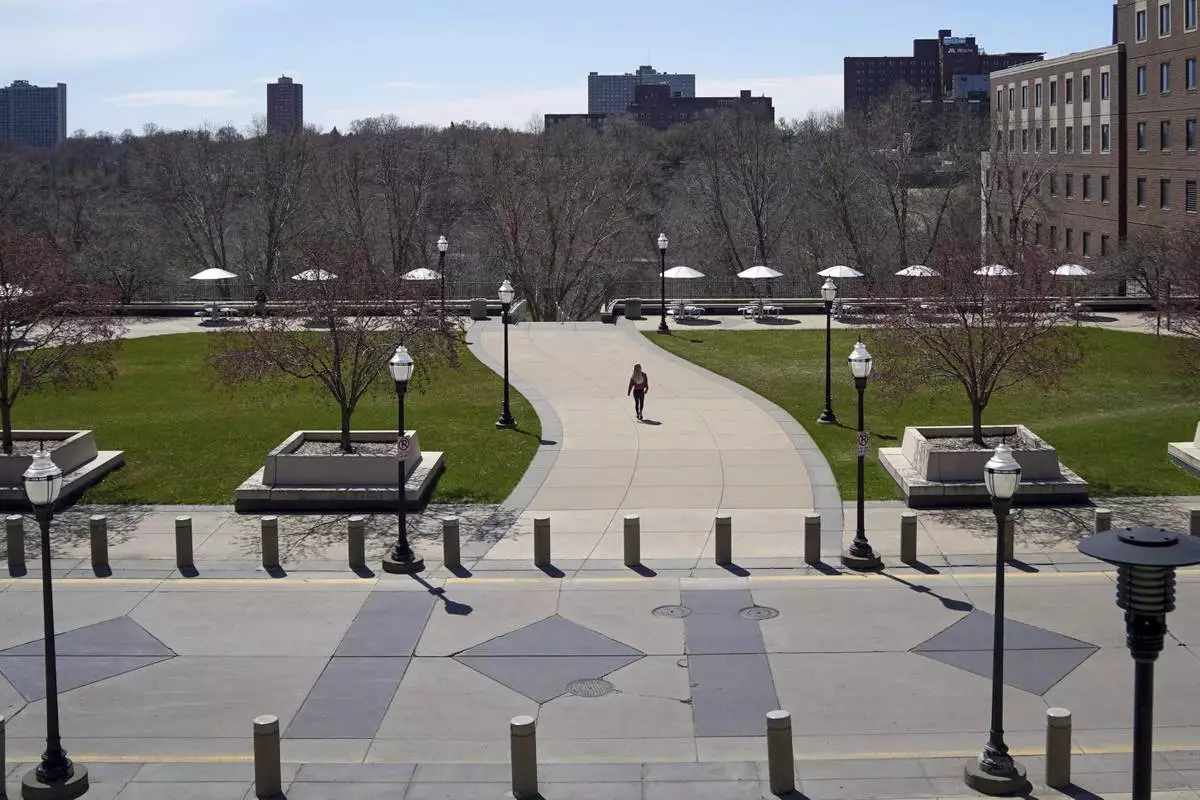
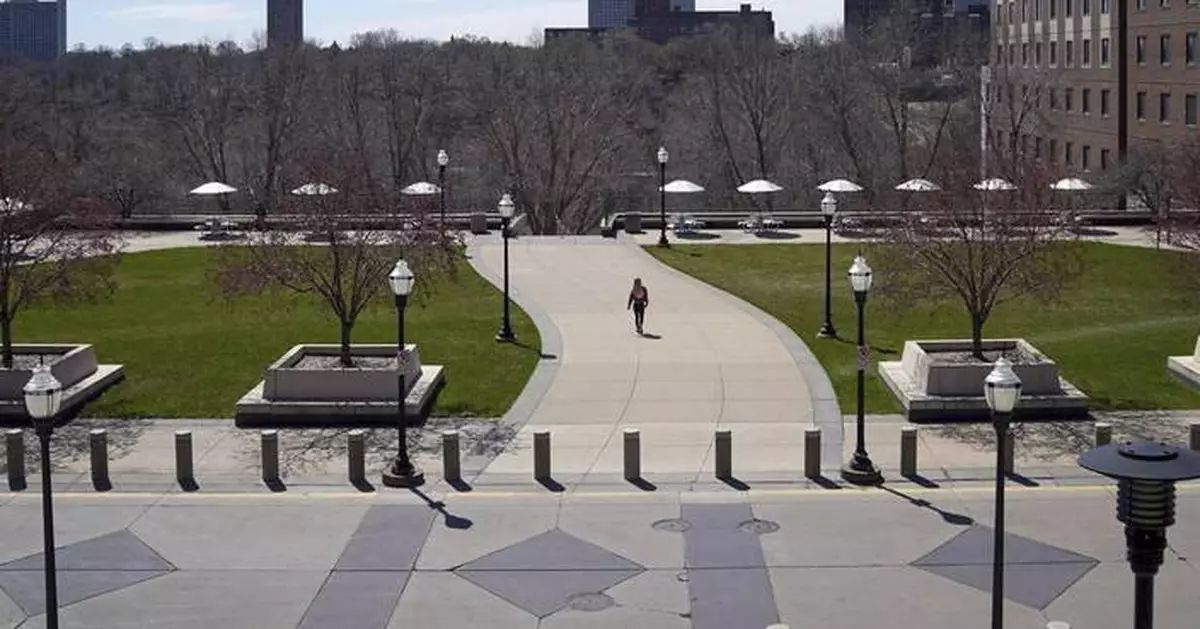
A person walks on campus at University of Minnesota in Minneapolis on April 21, 2020. (Glenn Stubbe/Star Tribune via AP, File)
WASHINGTON (AP) — The Smithsonian Institution gave the White House new documents on its planned exhibits Tuesday in response to a demand to share precise details of what its museums and other programs are doing for America’s 250th birthday.
For months, President Donald Trump has been pressing the Smithsonian to back off “divisive narratives” and tell an upbeat story on the country’s history and culture, with the threat of holding back federal money if it doesn’t. The institution is a cornerstone of American culture, operating 21 museums and a zoo that are among the most popular tourist destinations in Washington.
By Tuesday, the Smithsonian was supposed to provide lists of all displays, objects, wall text and other material dedicated to this year’s anniversary and other purposes. Smithsonian Secretary Lonnie Bunch III told staff, in an email obtained by The New York Times and The Washington Post, that “we transmitted more information in response to that request.”
The White House did not respond to a request for comment, leaving it unclear whether it was satisfied with the material it received. Bunch indicated there was more to come, saying the institution will continue to engage in providing “relevant and appropriate materials.”
The Trump administration’s intent is to ensure Americans get an positive accounting of the country’s history, not one weighted by complexities or shameful episodes of the past.
The ultimatum was laid out in a Dec. 18 letter to Bunch from the White House budget director, Russell Vought, and the domestic policy director, Vince Haley.
“We wish to be assured that none of the leadership of the Smithsonian museums is confused about the fact that the United States has been among the greatest forces for good in the history of the world,” the letter said.
Americans “will have no patience for any museum that is diffident about America’s founding or otherwise uncomfortable conveying a positive view of American history, one which is justifiably proud of our country’s accomplishments and record.”
The Smithsonian is not a federal entity but receives a majority of its money from Congress.
The White House initially asked for all relevant materials in September but said documents turned over by the Smithsonian fell far short of what it requested.
In his March executive order, Trump claimed there had been a “concerted and widespread” effort over the past decade to rewrite American history by replacing “objective facts” with a “distorted narrative driven by ideology rather than truth.”
As part of that, Trump tasked Vice President JD Vance with overseeing efforts to “remove improper ideology” from all areas of the institution. Like other vice presidents, Vance serves on the Smithsonian’s board.
The Smithsonian and the White House did not respond to requests for comment Tuesday afternoon.
The prospect of polishing the historical record to satisfy a president is concerning to many who study the past.
“History is about evidence," said Matthew Delmont, a history professor at Dartmouth College. “It's about welcoming complexity and nuance. It’s not about crafting a single story that needs to make everyone feel happy.”
Jim McSweeney, a retired archivist from the National Archives, said: “Here’s our history. Here’s our shared experience. We have to learn from it and never go back and try to whitewash or change anything based upon your political leanings.”
In the months leading up to Trump’s order in August for an official review of all Smithsonian exhibits, Trump fired the head archivist of the National Archives and said he was firing the National Portrait Gallery’s director, Kim Sajet, who maintained the backing of the Smithsonian’s governing board, but ultimately resigned.
Already, references to Trump’s two impeachments have been removed from his photo portrait display at the Smithsonian’s National Portrait Gallery in its “American Presidents” exhibition, though the text was available online.
Administration officials have couched the accounting as work needed before the nation celebrates the 250th anniversary of the Declaration of Independence on July 4, which the letter calls “a singular opportunity to justify confidence in the operations of America’s leading cultural institutions.”
The Smithsonian review is just one part of Trump's broadside against a culture he deems too liberal.
Trump fired the board of the Kennedy Center, one of the nation’s premier cultural institutions, handpicking a new one that voted to add his name to the storied complex’s exterior. In the months since, a number of artists have withdrawn from performances at the venue, some citing the name change and Trump’s involvement.
At the White House, Trump designed a partisan and subjective “Presidential Walk of Fame” featuring gilded photographs of himself and predecessors, with plaques on what they did. He excludes Democrat Joe Biden, who is represented instead by an autopen to symbolize what Trump has described as a presidency in absentia.
At the time, the White House said Trump was a primary author of the plaques, which praised him as a historically successful figure and described Biden as the worst president in history and one who brought the U.S. to "the brink of destruction.”
This story was first published on Jan. 13, 2026. It was published again on Jan. 14, 2026, to correct that Vice President JD Vance was already on the Smithsonian Board of Regents when President Donald Trump directed him to oversee the removal of “improper ideology” from the institution. Vance was not placed on the board to oversee that effort.
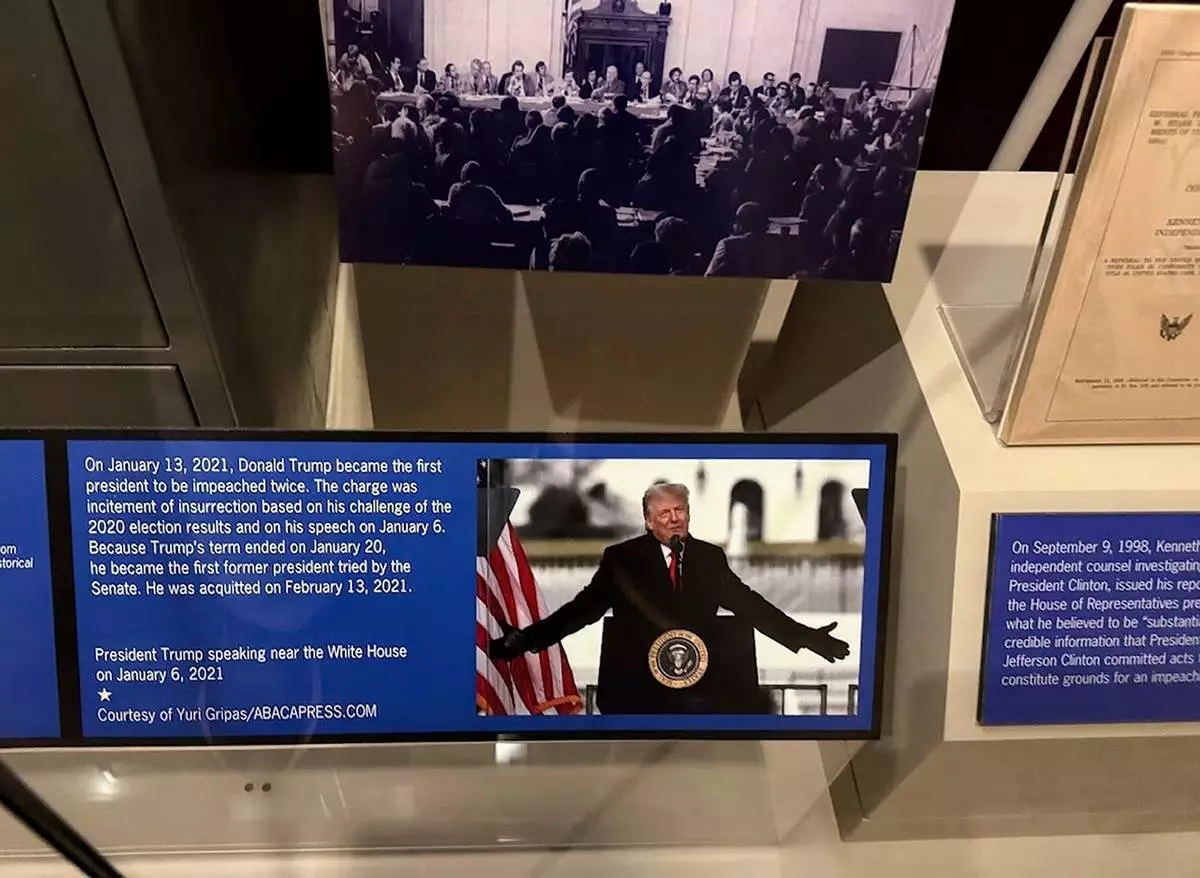
FILE - A new sign at the presidential impeachment exhibit in the Smithsonian's National Museum of American History in Washington, on Aug. 26, 2025, describes the counts against President Donald Trump in his second impeachment trial. The Senate acquitted him in both trials. (AP Photo/Calvin Woodward, File)
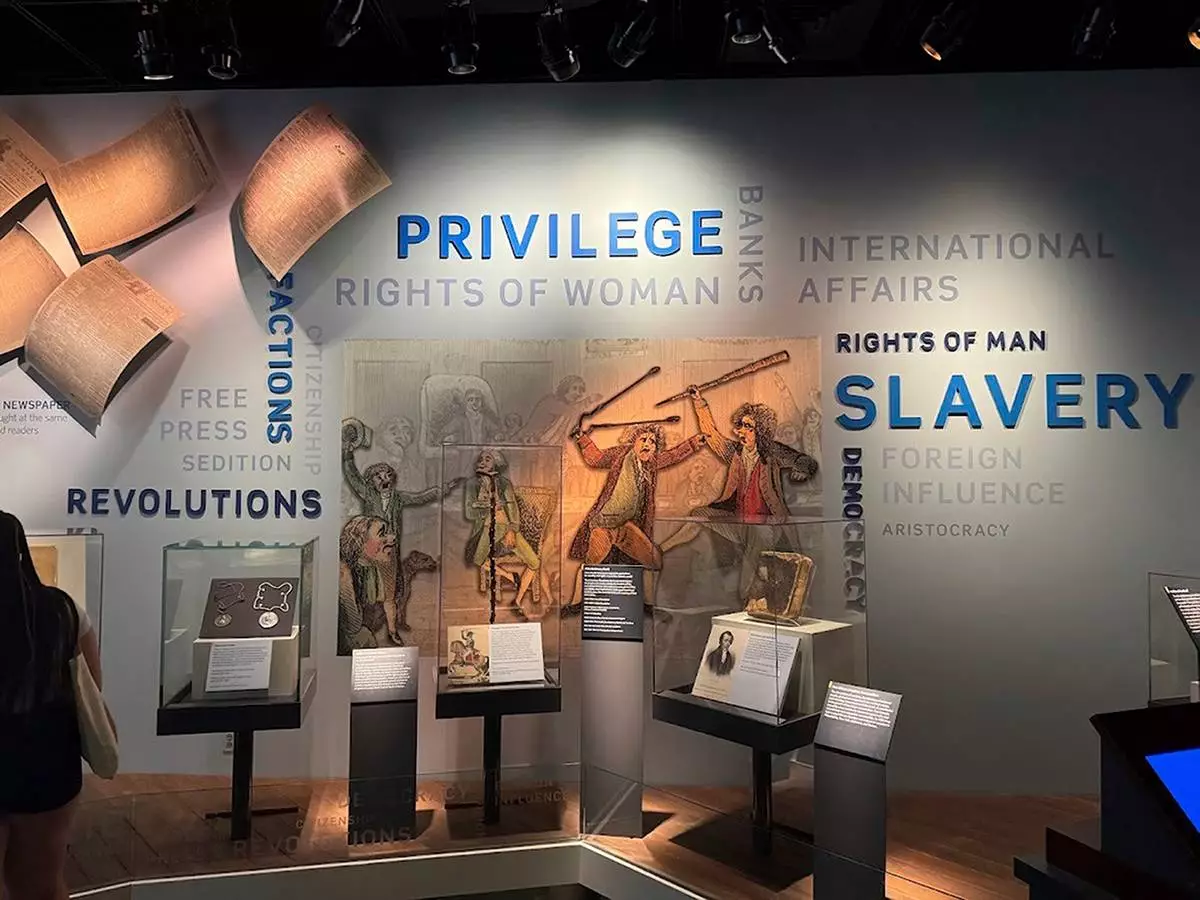
FILE - A display in the "Great Debate" section of a democracy exhibit at the National Museum of American History, seen Aug. 26, 2025, in Washington, reflects some of the issues the nation grapples with. (AP Photo/Calvin Woodward, File)

People react to a photograph of President Donald Trump on display at the Smithsonian's National Portrait Gallery's "American Presidents" exhibit on Sunday, Jan. 11, 2026 in Washington. (AP Photo/Rod Lamkey, Jr.)

A visitor stops to look at a photograph of President Donald Trump and a short plaque next to it are on display at the Smithsonian's National Portrait Gallery's "American Presidents" exhibit on Sunday, Jan. 11, 2026 in Washington. (AP Photo/Rod Lamkey, Jr.)