CAIRO (AP) — Sudan peace efforts resumed in Cairo on Wednesday with Egypt and the United Nations calling on warring parties to agree to a nationwide humanitarian truce, as the war between the army and its rival paramilitary nears the three-year mark.
Egyptian Foreign Minister Badr Abdelatty told reporters that Egypt wouldn't accept the collapse of Sudan or its institutions, or any attempt to undermine its unity or divide its territory, describing such scenarios as “red lines.”
Abdelatty said during a joint news conference with Ramtane Lamamra, the U.N. secretary‑general’s personal envoy for Sudan, that Egypt won't stand idly and won't hesitate to take the necessary measures to help preserve Sudan’s unity.
"There is absolutely no room for recognizing parallel entities or any militias. Under no circumstances can we equate Sudanese state institutions, including the Sudanese army, with any other militias,” he said on the sidelines of the fifth meeting of the Consultative Mechanism to Enhance and Coordinate Peace Efforts. Lamamra said the meeting demonstrated that diplomacy remains a viable path toward peace.
The paramilitary Rapid Support Forces, or RSF, and the military have been at war since April 2023. The conflict that has seen multiple atrocities and pushed Sudan into one of the world’s worst humanitarian crises.
Although repeated attempts at peace talks have failed to end the war, Abdelatty said that there's a regional agreement to secure an immediate humanitarian truce, including certain withdrawals and the establishment of safe humanitarian corridors.
Massad Boulos, the senior U.S. adviser for Arab and African Affairs, also took part in the meeting. He said that more than 1.3 metric tons of humanitarian supplies entered el-Fasher, the capital of North Darfur, on Wednesday, with the help of American-led negotiations, marking the first such delivery since the city was besieged by the RSF 18 months ago, and fell to the paramilitary group in October.
“As we press the warring parties for a nationwide humanitarian truce, we will continue to support mechanisms to facilitate the unhindered delivery of assistance to areas suffering from famine, malnutrition, and conflict-driven displacement,” Boulos posted on X.
Egyptian President Abdel Fattah el-Sissi discussed with Boulos the need to increase coordination between both countries to achieve stability in Sudan, with el-Sissi expressing appreciation to U.S. President Donald Trump’s efforts to end the war.
U.S. and key mediators Saudi Arabia, Egypt and the United Arab Emirates, known as the Quad, proposed a humanitarian truce, which both sides reportedly agreed to, but the conflict has persisted.
“The President emphasized that Egypt will not allow such actions, given the deep connection between the national security of both brotherly countries,” the Egyptian president’s office said in a statement.
The United States has accused the RSF of committing genocide in Darfur during the war, and rights groups said that the RSF committed war crimes during the siege and seizure of el-Fasher, as well as in the capture of other cities in Darfur. The military has also been accused of human rights violations.
The U.N. Office for the Coordination of Humanitarian Affairs (OCHA) said on Tuesday that at least 19 civilians were killed during ground operations in Jarjira in North Darfur on Monday.
A military-allied Darfur rebel group said that it carried out a joint operation with the army in Jarjira, liberating the area and its surroundings and forcing RSF fighters to flee south.
At least 10 others were killed and nine injured also Monday in a drone attack that hit Sinja, the capital of Sennar province, according to OCHA and the Sudan Doctors Network.
The network said in a statement that the drone strike was launched by the RSF and hit several areas in the city. It said that civilians are being deliberately targeted in a “full-fledged war crime.”
The network said that it holds the RSF fully responsible and demands an end to the targeting of civilians and the protection of civilian infrastructure.
Recent violence displaced more than 8,000 people from villages in North Darfur, with some fleeing to safer areas within the province and others crossing into Chad, according to the latest estimate by the International Organization for Migration.

Relatives check names on body bags of victims of Sudan’s two-year conflict after the Sudanese Red Crescent transferred the remains from makeshift graves to a local cemetery in Khartoum, Sudan, Sunday, Jan. 11, 2026. (AP Photo/Marwan Ali)
WASHINGTON (AP) — A federal judge is considering whether to set aside a Trump administration order pausing the construction of a major offshore project for New York, which the developer says could mean the death of a project that’s 60% complete.
The Empire Wind project is designed to power more than 500,000 homes. Norwegian company Equinor said the project was in jeopardy due to the limited availability of specialized vessels, as well as heavy financial losses. It's one of five big offshore wind projects on the East Coast that the administration froze days before Christmas, citing national security concerns. Developers and states have sued seeking to block the order.
The case was heard Wednesday by District Judge Carl J. Nichols, an appointee of President Donald Trump. Nichols ended the hearing without ruling, saying that he needed to think about it but would decide very quickly.
Nichols sharply questioned the government for not responding to key points in Empire Wind’s written court filings, like the accusation the Trump administration didn’t follow the right procedures and acted arbitrarily.
“Your brief doesn’t even include the word arbitrary,” the judge said.
When the government said they were still contesting Empire Wind’s arguments on these points, Nichols responded, “This is not the way we do things.”
Equinor’s hearing is the second of three for these legal challenges this week; on Monday, a judge ruled that a project serving Rhode Island and Connecticut could resume.
Trump has targeted offshore wind from his first days back in the White House, most recently calling wind farms “losers” that lose money, destroy the landscape and kill birds. When his administration cited national security concerns, it gave no detail for those concerns, and at least one expert has said the offshore projects were permitted following years of careful review that included the Department of Defense.
The administration's stance against offshore wind and renewable energy more broadly runs counter to dozens of other countries.
The global offshore wind market is growing, with China leading the world in new installations. Nearly all of the new electricity added to the grid in 2024 was renewable. Experts say the world needs a major buildout of renewable electricity to address climate change. The British government said Wednesday that it secured a record 8.4 gigawatts of offshore wind in Europe’s largest offshore wind auction to date, enough clean electricity to power more than 12 million homes. It said that as Britain races to cut bills and meet growing energy demand, the price for offshore wind agreed to in the auction is 40% cheaper than the cost of building and operating a new gas power plant.
Molly Morris, Equinor’s senior vice president overseeing Empire Wind, said federal officials have not given them any explanation of the national security concerns or how to mitigate them.
A specialized heavy lift vessel, Heerema’s Sleipnir, must begin lifting the topside to the project’s offshore substation off the transport ship and onto its foundation because the Sleipnir is scheduled to depart by Feb. 1 for other commitments, Morris said. The topside weighs more than 3,000 tons and there are few specialized offshore wind installation ships in the world.
“Right now the project is in a critical situation,” Morris said. “Construction must resume by mid-January to avoid cascading delays that could ultimately lead to a cancellation of the project. We have been clear and consistent that we are ready to address any additional security concerns that were not already addressed through our lengthy engagement with various defense agencies.”
Monday's hearing was in the same federal court, with Danish energy company Orsted prevailing. A judge ruled that work on its project, called Revolution Wind, can resume while the administration considers ways to mitigate its national security concerns. Revolution Wind is nearly complete.
After that hearing, White House spokesperson Taylor Rogers said the pause is meant to protect the national security of the American people, and “we look forward to ultimate victory on the issue.”
The Trump administration paused leases for the Vineyard Wind project under construction in Massachusetts, Revolution Wind, Coastal Virginia Offshore Wind, and two projects in New York: Sunrise Wind and Empire Wind. New York’s attorney general sued the Trump administration on Friday over Empire Wind and Sunrise Wind.
The Trump administration previously halted work on both Empire Wind and Revolution Wind. In April, it stopped construction on Empire Wind, accusing the Biden administration of rushing the permits, then allowed work to resume a month later. In August, the administration paused work on Revolution Wind for what it said were national security concerns. A month later, a federal judge ruled the project could resume.
Equinor finalized the federal lease for Empire Wind in March 2017, early in Trump’s first term. The final federal approval was in February 2024. Equinor's limited liability company has spent about $4 billion to develop and construct the project.
McDermott reported from Providence, Rhode Island.
The Associated Press’ climate and environmental coverage receives financial support from multiple private foundations. AP is solely responsible for all content. Find AP’s standards for working with philanthropies, a list of supporters and funded coverage areas at AP.org.
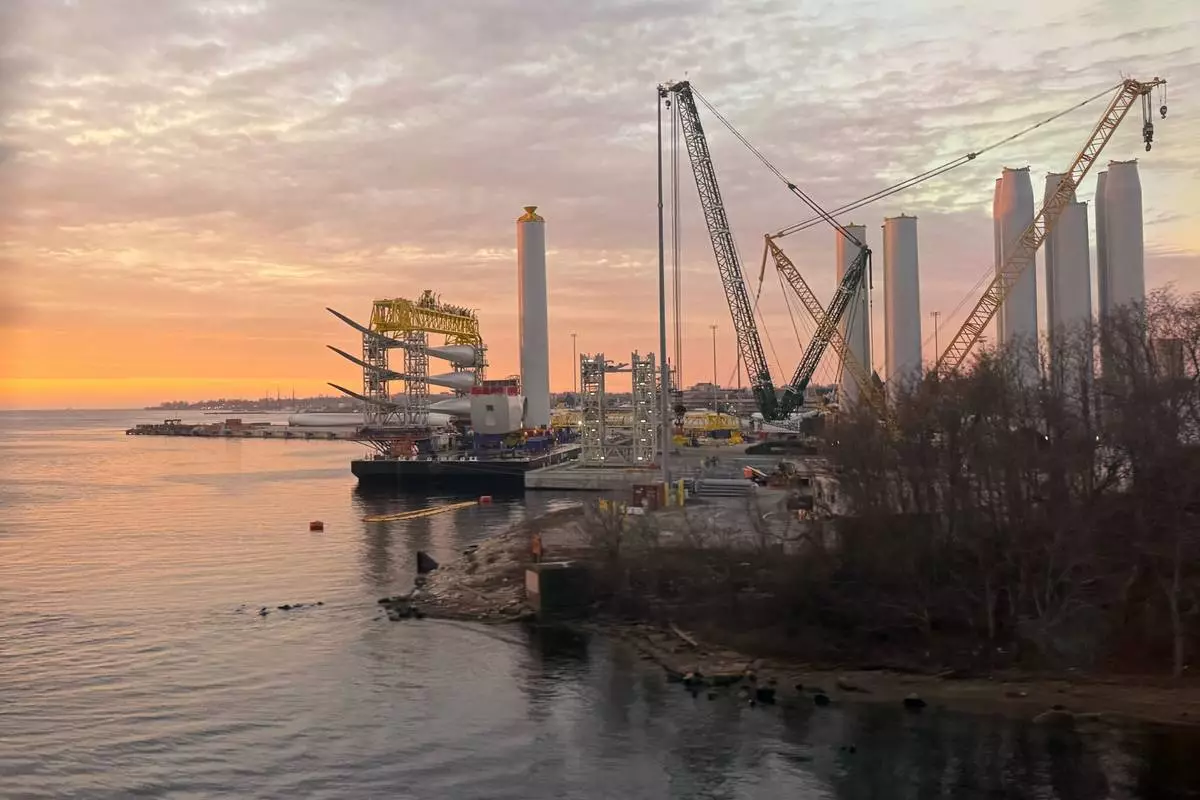
Blades and turbine bases for offshore wind sit at a staging area at New London State Pier, Wednesday, Jan. 14, 2026, in New London, Conn. (AP Photo/Matt O'Brien)
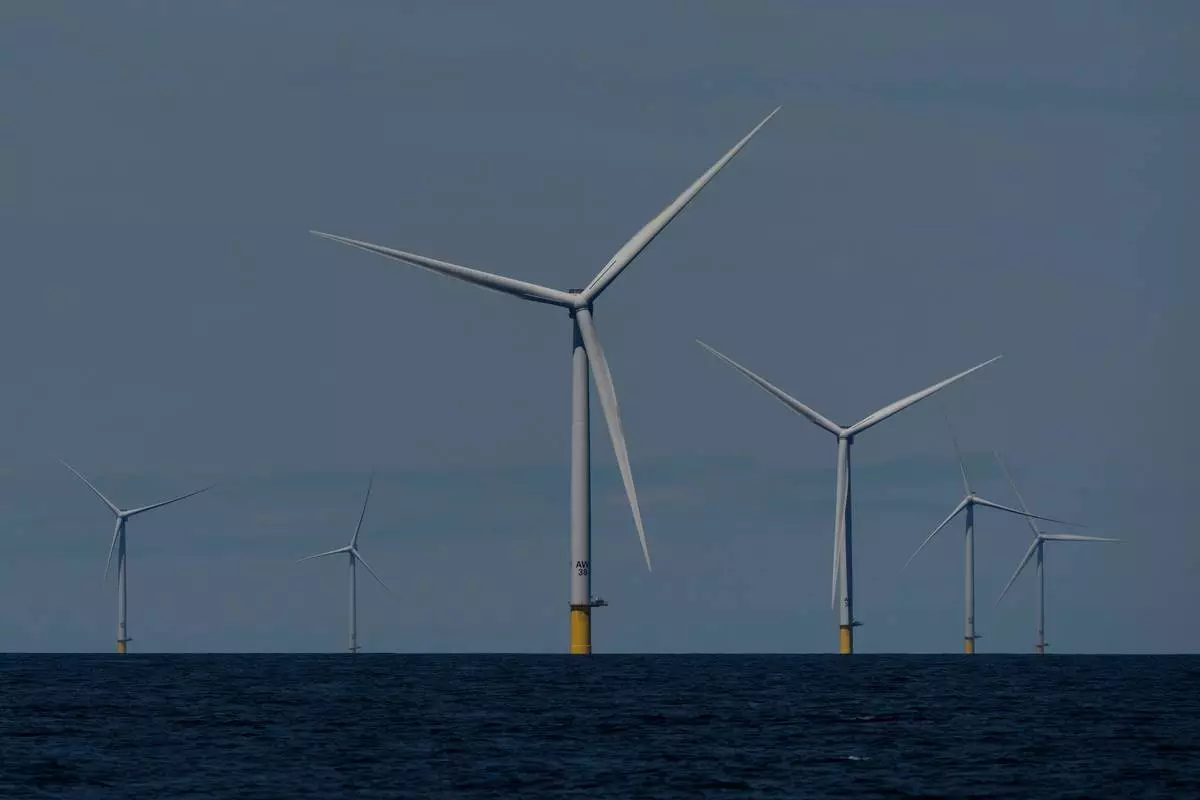
FILE - Wind turbines operate at Vineyard Wind 1 offshore wind farm off the coast of Massachusetts, July 19, 2025. (AP Photo/Carolyn Kaster, File)

FILE - A sign for the company Equinor is displayed on Oct. 28, 2020, in Fornebu, Norway. (Håkon Mosvold Larsen/NTB Scanpix via AP, File)