The U.S. Olympic & Paralympic Committee has fired a coach and a director after The Associated Press reported that the coach was accused of sexually abusing a young biathlete, causing her so much distress that she attempted suicide.
“Following our thorough internal evaluation, we can confirm that Gary Colliander and Eileen Carey are no longer affiliated with the USOPC," spokesman Jon Mason told the AP. He refused to provide a reason, saying only that Colliander was put on administrative leave from the Paralympic team in December — days after the AP report on the alleged misconduct. The two were fired on March 14.
Colliander was accused of sexually abusing Grace Boutot, a biathlete he coached at the Maine Winter Sports Center over four years beginning in 2006 when she was 15, the AP reported. Colliander quit the job after Boutot's October 2010 suicide attempt and was later hired by the U.S. Paralympic Nordic team.
Carey was the Maine center's vice president at the time of the abuse and had discussed it with Boutot’s mother. After leaving the center in December 2010, Carey was hired as a coach and later promoted to director of the Paralympic team. She was there when Colliander came onboard.
Mason declined to say whether Carey hired Colliander or how the Paralympic team vets the coaches they hire. The U.S. Center for SafeSport, created to investigate sex-abuse allegations in Olympic sports in the aftermath of the Larry Nassar U.S. Gymnastics scandal, launched an investigation into Colliander in December.
“Please note that Mr. Colliander’s case remains active with SafeSport,” Mason told the AP.
Colliander's lawyer, Simone Montoya, said officials did not tell Colliander why he was fired and he “adamantly denies any wrongdoing or inappropriate behavior, as alleged.”
Colliander "is committed to full and transparent cooperation into this matter,” Montoya told the AP in an email. “He denies any conduct in violation of the SafeSport Code or applicable laws and policies and maintains that he has always upheld professional standards throughout his career.”
AP phone and email messages seeking comment from Carey were not immediately returned.
Boutot was among a half-dozen Olympians and other biathletes who came forward after the AP reported last year that Olympian Joanne Reid was sexually abused and harassed for years, according to SafeSport findings. Biathlon is a winter sport that combines cross-country skiing with target shooting.
The AP generally does not identify victims of sexual abuse except in cases where they publicly identify themselves or share their stories openly.
Boutot, 34, told the AP that when Colliander began coaching her, he gave her a lot of attention, including inappropriate touching. The conduct escalated after she turned 18 to “kissing, sexual fondling and oral sex,” according to a treatment summary by her therapist, Jacqueline Pauli-Ritz, shared with the AP.
Boutot said she begged Colliander to stop but he ignored her. She became severely depressed and started cutting herself, according to the therapist’s notes. In September 2010, Pauli-Ritz contacted Colliander and told him Boutot was suffering from major depression and he should stop coaching her, the treatment summary said.
“He did not do this until after the suicide attempt,” Pauli-Ritz wrote, referring to Boutot’s Oct. 7, 2010, overdose on antidepressants during a Utah training camp.
Colliander resigned the next day. He took a coaching job in Colorado and was hired in December 2016 by the U.S. Paralympic team. He was associate director of high performance for U.S. Paralympics Nordic Skiing before being fired.
Boutot tried to keep racing but faced discrimination by the center's staff and teammates, who blamed her for his departure, according to a letter she wrote to the Maine Sports Center's board in January 2011.
Boutot's mother, Karen Gorman, had repeated discussions and email exchanges with Carey and the center's CEO, Andy Shepard, about the abuse her daughter suffered, Gorman told the AP.
In an Oct. 22, 2010, email, Gorman told them, “the issue of any coach-athlete relationships ... must be scrutinized" by the Maine sports center.
Carey responded that she was “working really hard” to make that happen. “I am very supportive of having positive things come out of this situation for everyone involved,” she said in an Oct. 25, 2010, email.
But, Boutot told the AP, no investigation was ever conducted.
In a 2011 complaint she filed with the Maine Human Rights Commission, Boutot accused the Maine sports center of failing to prevent Colliander’s sexual misconduct and retaliating against her when she reported it — denying her coaching and ending financing of equipment, travel, athlete housing and other U.S. Biathlon competition-related expenses.
The center settled for $75,000 in September 2011 and Boutot quit racing.
EDITOR’S NOTE — This story includes discussion of suicide. If you or someone you know needs help, the national suicide and crisis lifeline in the U.S. is available by calling or texting 988. There is also an online chat at 988lifeline.org
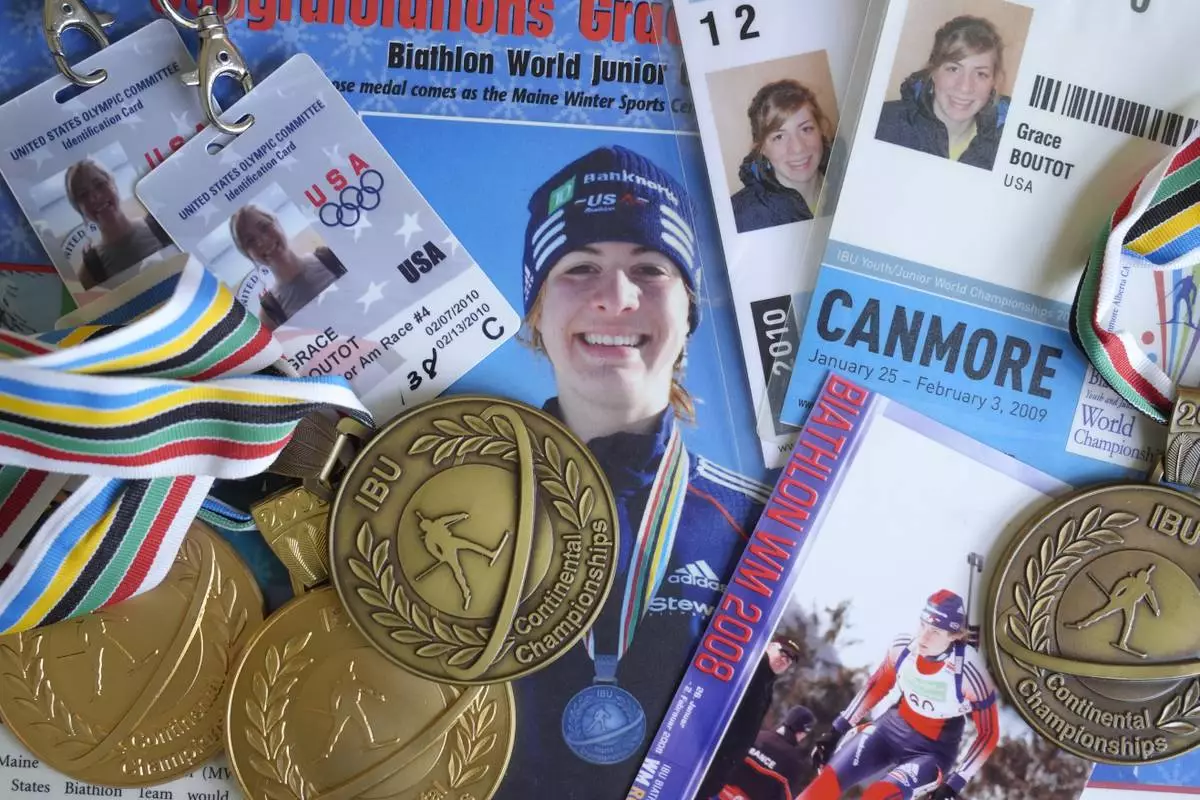
FILE - Biathlon competition medals, credentials and media clippings belonging to Grace Boutot, silver medalist in Youth World Championships in 2009, are displayed for a photograph at her home on Oct. 17, 2024, in Boston. (AP Photo/Steven Senne, File)

FILE - Grace Boutot, who won a silver medal at the 2009 Youth World Championships, stands for a photograph in her home, Dec. 8, 2024, in Boston. (AP Photo/Steven Senne, File)
KAMPALA, Uganda (AP) — Uganda’s presidential election was plagued by widespread delays Thursday in addition to a days-long internet shutdown that has been criticized as an anti-democratic tactic in a country where the president has held office since 1986.
Some polling stations remained closed for up to four hours after the scheduled 7 a.m. start time due to “technical challenges," according to the nation's electoral commission, which asked polling officers to use paper registration records to ensure the difficulties did not “disenfranchise any voter.”
President Yoweri Museveni, 81, faces seven other candidates, including Robert Kyagulanyi, a musician-turned-politician best known as Bobi Wine, who is calling for political change.
The East African country of roughly 45 million people has 21.6 million registered voters. Polls were expected to close at 4 p.m., but voting was extended one hour until 5 p.m. local time. Results are constitutionally required to be announced in 48 hours.
In the morning, impatient crowds gathered outside polling stations expressing concerns over the delays. Umaru Mutyaba, a polling agent for a parliamentary candidate, said it was “frustrating” to be waiting outside a station in the capital Kampala.
“We can’t be standing here waiting to vote as if we have nothing else to do," he said.
Wine, the candidate, alleged electoral fraud, noting that biometric voter identification machines were not working at polling places and claiming that there was “ballot stuffing.”
Wine wrote in a post on X that his party's leaders had been arrested. “Many of our polling agents and supervisors abducted, and others chased off polling stations,” the post said.
Museveni told journalists he was notified that biometric machines weren't working at some stations and that he supported the electoral body's decision to revert to paper registration records. He did not comment on allegations of fraud.
Ssemujju Nganda, a prominent opposition figure and lawmaker seeking reelection in Kira municipality, told The Associated Press he had been waiting in line to vote for three hours.
Nganda said the delays likely would lead to apathy and low turnout in urban areas where the opposition has substantial support. "It’s going to be chaos,” he said.
Nicholas Sengoba, an independent analyst and newspaper columnist, said delays to the start of voting in urban, opposition areas favored the ruling party.
Emmanuel Tusiime, a young man who was among dozens prevented from entering a polling station in Kampala past closing time said the officials had prevented him from participating.
“My vote has not been counted, and, as you can see, I am not alone," he said he was left feeling “very disappointed.”
Uganda has not witnessed a peaceful transfer of presidential power since independence from British colonial rule six decades ago.
Museveni has served the third-longest term of any African leader and is seeking to extend his rule into a fifth decade. The aging president’s authority has become increasingly dependent on the military led by his son, Muhoozi Kainerugaba.
Museveni and Wine are reprising their rivalry from the previous election in 2021, when Wine appealed to mostly young people in urban areas. With voter turnout of 59%, Wine secured 35% of the ballots against Museveni’s 58%, the president’s smallest vote share since his first electoral campaign three decades ago.
The lead-up to Thursday's election produced concerns about transparency, the possibility of hereditary rule, military interference and possible vote tampering.
Uganda's internet was shut down Tuesday by the government communications agency, which cited misinformation, electoral fraud and incitement of violence. The shutdown has affected the public and disrupted critical sectors such as banking.
There has been heavy security leading up to voting, including military units deployed on the streets this week.
Amnesty International said security forces are engaging in a “brutal campaign of repression,” citing a Nov. 28 opposition rally in eastern Uganda where the military blocked exits and opened fire on supporters, killing one person.
Museveni urged voters to come out in large numbers during his final rally Tuesday.
“You go and vote, anybody who tries to interfere with your freedom will be crushed. I am telling you this. We are ready to put an end to this indiscipline,” he said.
The national electoral commission chairperson, Simon Byabakama, urged tolerance among Ugandans as they vote.
“Let us keep the peace that we have,” Byabakama said late Wednesday. “Let us be civil. Let us be courteous. Let’s be tolerant. Even if you know that this person does not support (your) candidate, please give him or her room or opportunity to go and exercise his or her constitutional right."
Authorities also suspended the activities of several civic groups during the campaign season. That Group, a prominent media watchdog, closed its office Wednesday after the interior ministry alleged in a letter that the group was involved in activities “prejudicial to the security and laws of Uganda.”
Veteran opposition figure Kizza Besigye, a four-time presidential candidate, remains in prison after he was charged with treason in February 2025.
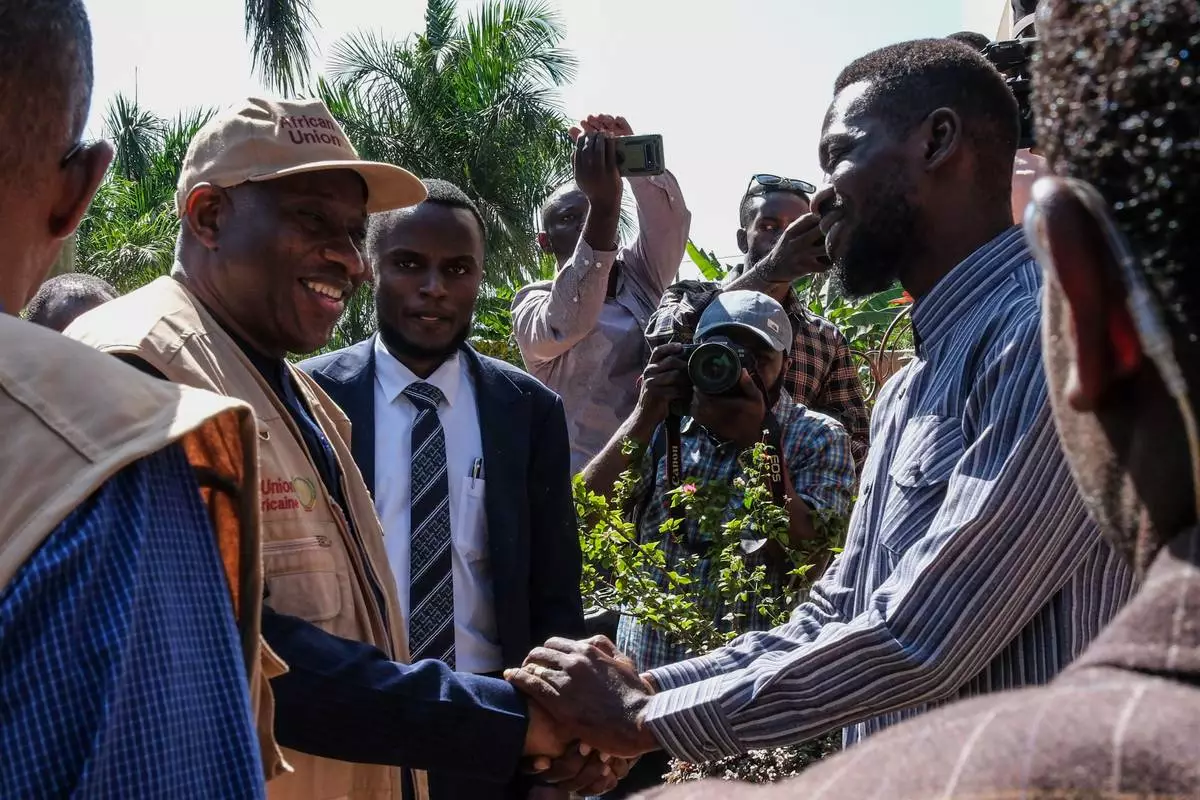
Uganda opposition presidential candidate Robert Kyagulanyi Ssentamu, known as Bobi Wine, right, greets election observers, including former Nigerian President Goodluck Jonathan, at his home in Magere village on the outskirts of Kampala, Uganda, Wednesday, Jan. 14, 2026. (AP Photo/Hajarah Nalwadda)

Billboards of Uganda President and National Resistance Movement (NRM) presidential candidate Yoweri Museveni are seen in Kampala, Uganda, Tuesday, Jan. 13, 2026. (AP Photo/Samson Otieno)
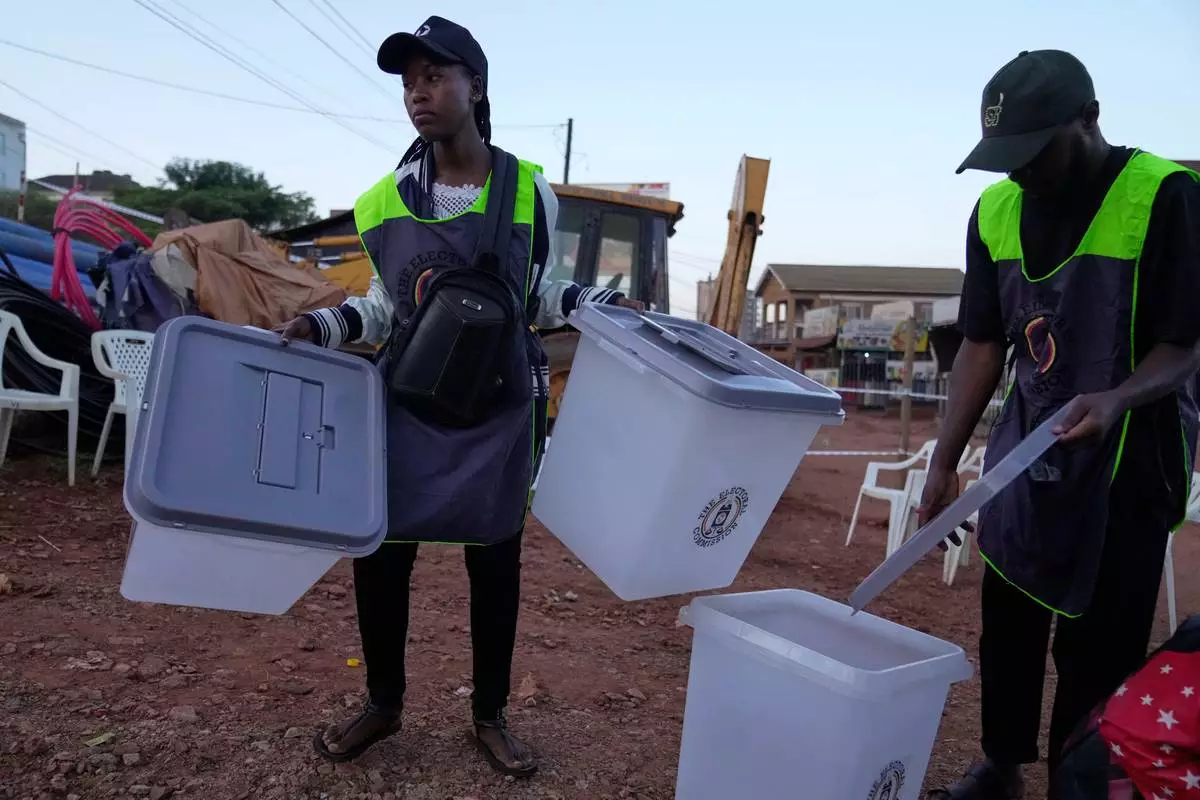
Electoral workers deliver ballot boxes to a polling station during presidential election in Kampala, Uganda, Thursday, Jan. 15, 2026. (AP Photo/Brian Inganga)
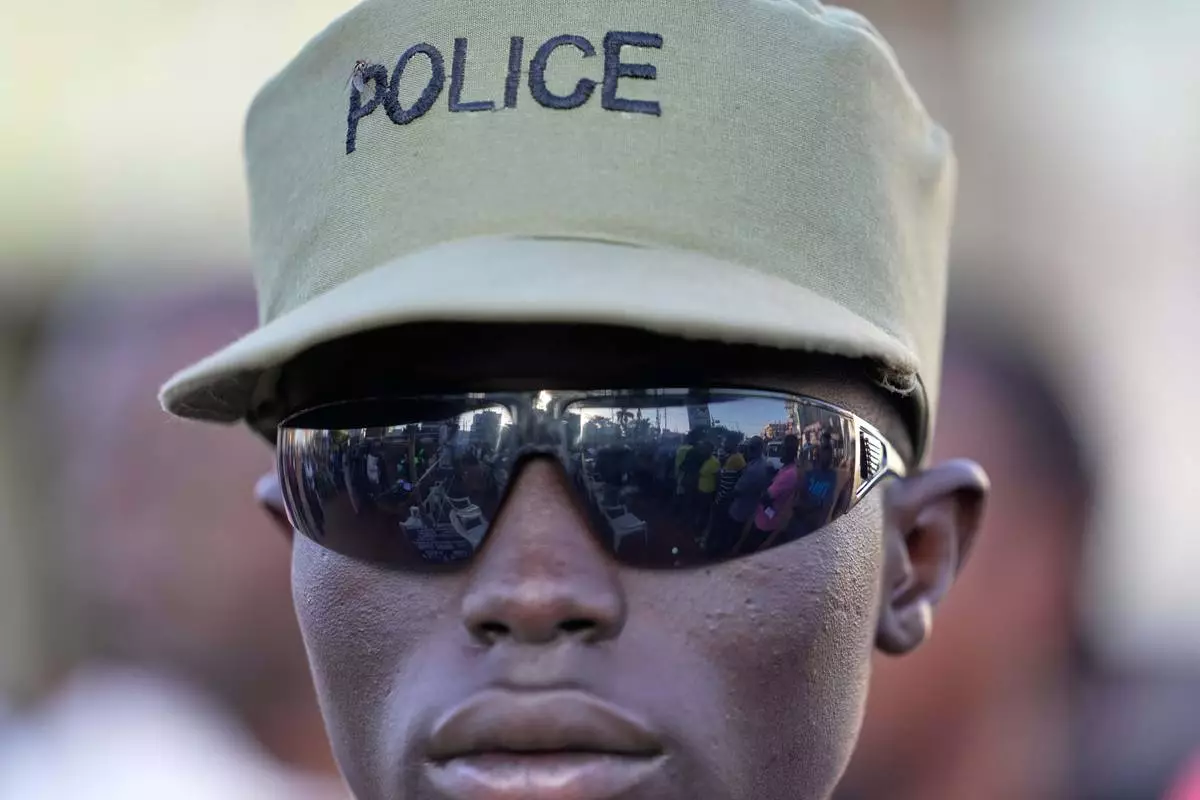
Voters are reflected in a police officer's sunglasses as they wait in line after voting failed to start on time due to system failures during presidential election in Kampala, Uganda, Thursday, Jan. 15, 2026. (AP Photo/Brian Inganga)
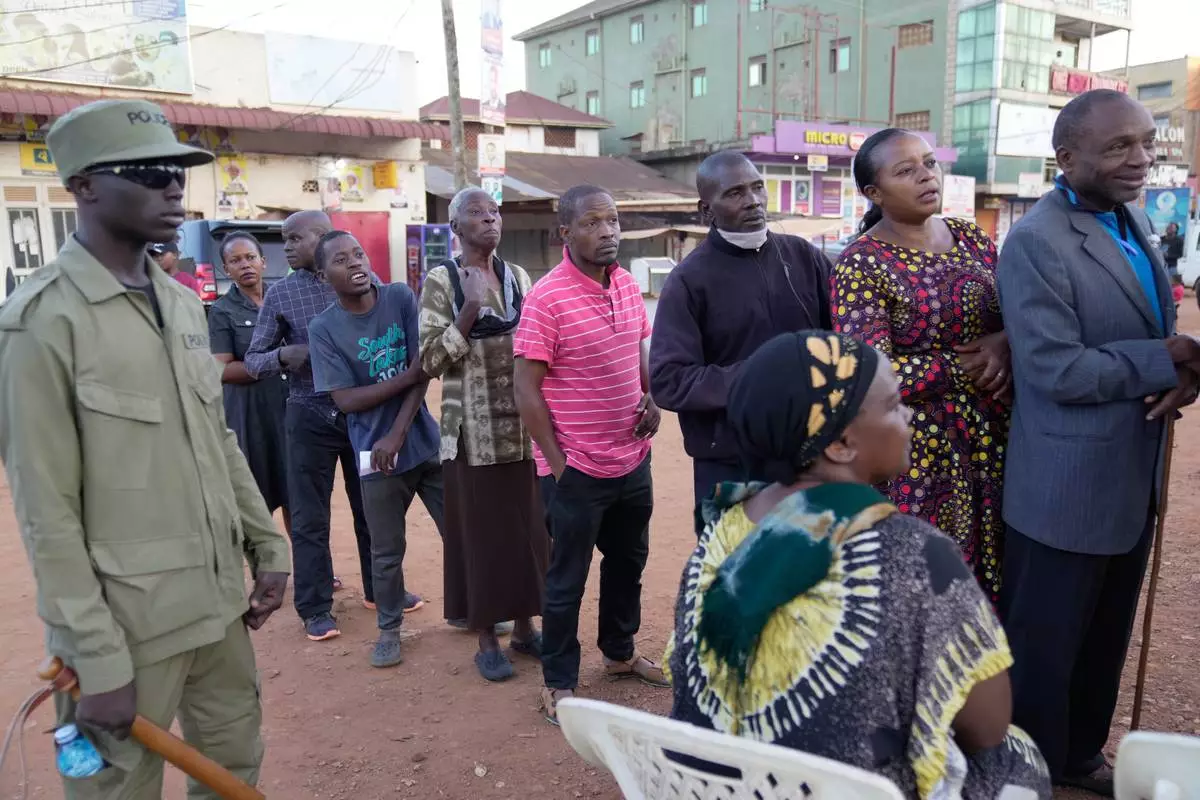
Voters wait to cast their ballots during the presidential election in Kampala, Uganda, Thursday, Jan. 15, 2026. (AP Photo/Brian Inganga)