The U.S. threat to impose higher antidumping duties on softwood lumber from Canada could increase the tax burden on the Canadian lumber sector while making it harder for the U.S. construction industry to access high-quality, low-cost wood, said a Canadian forest resources expert.
For years, the U.S. has been one of the primary export destinations for Canadian lumber, with imported softwood from Canada, much of it used for residential and commercial structures, making up a significant share of the U.S. softwood market.
Last month, the U.S. Department of Commerce announced the preliminary results of its sixth administrative review of the antidumping duty order on imports of certain Canadian softwood lumber products. While the preliminary margin rates have not yet taken effect, they could increase to 20.07 percent, up from the 7.66 percent determined in the previous administrative review.
Gary Bull, Professor Emeritus at the Department of Forest Resources Management at the University of British Columbia in Vancouver, explained that higher tariffs could severely impact Canada's lumber sector.
"When it looks like we will get tariffs April 2nd - could take our total burden for our lumber industry from anywhere from fourteen percent up to sixty percent in British Columbia because since we represent half of the industry in Canada in B.C. alone. And then of course the rest of Canada also will suffer equally," said the professor.
However, high lumber tariffs could backfire for the U.S. According to reports from the Canadian Broadcasting Corporation (CBC), the U.S. currently meets only about 70 percent of its homebuilding lumber needs domestically, relying on Canadian lumber for the remaining 30 percent.
"Some of the smaller to medium sized companies they have an interest in - it's to their benefit to have - a stoppage of lumber coming from Canada because then they can of course make more money. So if you look at the National Association of Home Builders, on the other hand, want our number because they want better quality wood and they want a lower price," Bull said.
The U.S. Department of Commerce has held six rounds of administrative reviews of the anti-dumping duty order on Canadian softwood imports, whose results should inform final tariff decisions, but Bull said they had found no evidence to support the idea that Canada is dumping products into the U.S. market.
"The tariffs are in two categories of the anti-dumping and the countervailing duty. And from my point of view, the anti-dumping duty in particular makes absolutely no sense because I see no evidence in the data that suggests that we are dumping product into the U.S. market," Bull added.

U.S. tariff threat on Canadian lumber could chop export market, U.S. construction: expert
Colombians are heading to the polls on Sunday to elect their next president. The country's constitution prevents the current President, Gustavo Petro, from running for a second term.
Yet, many see this election as a referendum on the policies of Gustavo Petro, Colombia's first leftist president.
There are 14 candidates on Sunday's ballot, but the polls show it will likely be a tight three-way race.
The frontrunner is Ivan Cepeda, a 63-year-old three-term senator, representing President Gustavo Petro's party, the Historic Pact coalition. Cepeda has vowed to defend and deepen Petro's progressive reforms and social justice policies to reduce inequality. He also promises to continue the government's controversial "Total Peace" strategy to negotiate the disarmament of remaining guerrilla groups and criminal gangs.
"True prosperity comes from equality, from access to rights, and from transforming the peripheral and excluded territories of the rural world," Cepeda said at a campaign rally.
Running as a political outsider and independent is Abelardo de la Espriella, a 47-year-old lawyer, nicknamed "The Tiger." He has presented himself as the "authority and order" candidate who will reduce state spending by up to 40 percent in the next four years.
"(First,) we must fight insecurity. Colombia is suffering today from a pandemic of insecurity. Crime is out of control: extortion, cattle theft, smuggling, drug trafficking," he said to his supporters at an election event.
According to polls, the third candidate with strong support is Paloma Valencia. The 48-year-old senator represents the Democratic Center party led by popular former President Alvaro Uribe Velez. Her candidacy is backed by politicians and economists who are concerned with growing levels of public debt. They want to see a return to more conservative fiscal policies.
"I don't want to be a president who governs alone, locked away in glass offices. I want to be a president who stands with citizens, who embraces them, who reaches out to them, who has a team, and who governs to transform Colombia," the candidate said at the campaign event
According to polls earlier in the year, many voters are expressing concerns about unemployment, rising living costs, corruption, and, above all, public security.
The election comes after a turbulent year that the International Committee of the Red Cross has called "the worst humanitarian consequences of armed conflict over the past decade."
"(We arrive at this election in a tense atmosphere - tense) because of the economic situation, because of the security situation, and because of the narratives that have been built around the country's main problems. On top of that, emotions, ideas and social media have all helped raise (the tone,)" said Eduardo Velosa, associate professor from International Studies Javeriana University.
If no candidate receives 50 percent of the vote, a runoff election will be held between the top two finishers on June 21st.
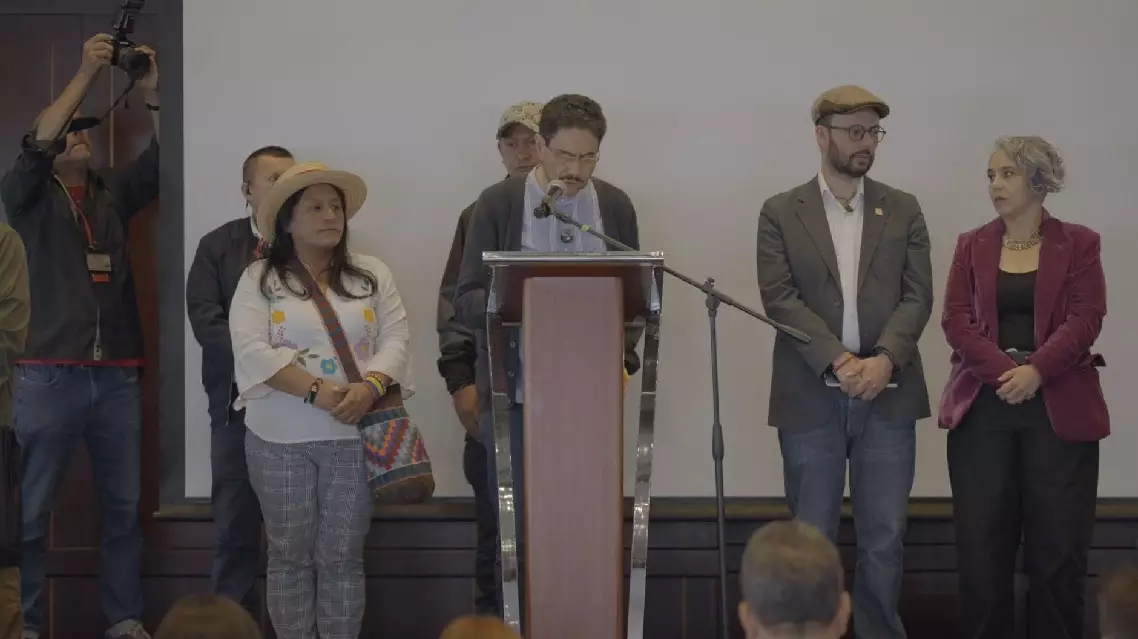
Colombians prepare to choose their next president