East China's Jiangsu Province is striving to restructure new industrial competitive edges through technological breakthroughs and innovative scenarios, and developing new quality productive forces at a faster pace.
Benefiting from the rapid development of China's new energy industry and low-altitude economy, Nanjing Movelaser Co., Ltd doubled its production of several wind lidar apparatus and intelligent monitoring devices in the first quarter of this year.
The company's director said that in the past, similar foreign products had an annual sales volume of only about a hundred units in China. However, in 2024, the sales volume of the company reached close to 20,000 units.
Jiangsu has been systematically laying out new development pathways, aiming to tackle 100 major cutting-edge technologies, establish 100 future scientific innovative demonstration enterprises, set up 100 future industry parks for science and technology innovation, create 100 application scenarios for advanced technology, and develop 100 future industry standards and specifications.
"[We'll focus on] advanced technology research and development and incubation, the cultivation of major business formats, and the development of key scenarios. [We are] making layouts in some key areas and tracks, so technology, business formats and scenarios can be coordinated and key directions can be captured in an timely manner. We'll strengthen research and development efforts, so that Jiangsu will be among the first to achieve breakthroughs and to promote applications, truly enpowering new quality productivity a strategic and driving force," said Xu Guanghui, director of the Jiangsu Provincial Department of Science and Technology.
The province recently issued the Action Plan on Supporting and Promoting High-tech Zones to Accelerate the Development of New Quality Productive Forces, proposing that the province's high-tech zones will pioneer 20 domestically leading new development pathways by 2027, nurture 80 unicorn companies, 38,000 high-tech enterprises, and achieve a high-tech industry output value accounting for 65 percent of the total.

China's Jiangsu restructures new industrial competitive edges, develops new quality productive forces
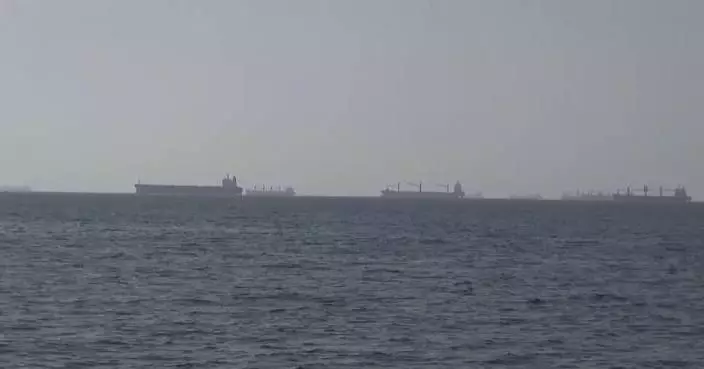
The Navy of Iran's Islamic Revolution Guards Corps (IRGC) said that the Strait of Hormuz has been blocked since Saturday evening and will not reopen until the United States lifts its naval blockade on the waterway.
In a statement carried by its official news outlet Sepah News, the IGRC said that the move came after the United States violated its commitments under the two-week ceasefire, which took effect on April 8, and failed to end its naval blockade against Iranian vessels and ports.
The IRGC Navy called on all vessels and their owners to follow official updates via its channel and VHF Channel 16, the international maritime distress, safety, and calling frequency. The statements by U.S. President Donald Trump hold no credibility in the strait and the Gulf, it added.
The IRGC warned that no vessel should move from its anchorage in the Gulf or the Gulf of Oman, and any approach to the strait would be deemed "cooperation with the enemy" and targeted accordingly.
Tehran's political leadership echoed the IRGC's firm position. Parliament Speaker Mohammad Bagher Ghalibaf asserted that the Strait of Hormuz is under Iran's control, revealing that during previous negotiations, Iran had firmly countered U.S. attempts to carry out minesweeping operations, which Tehran viewed as a ceasefire violation.
He said the situation had come close to conflict, but the U.S. had eventually backed off.
Calling the U.S. maritime blockade "reckless and ignorant," Ghalibaf warned that passage through the strait would certainly be restricted if Washington does not lift the blockade.
Underpinning these public announcements, Iran's Supreme National Security Council on Saturday affirmed the country's resolve to exercise control and supervision over traffic through the Strait of Hormuz until the war is definitively ended and lasting peace is achieved in the region.
For its part, the United States pressed ahead with its own military measures.
The U.S. Central Command (CENTCOM) said in a statement on Saturday that the U.S. military is imposing a maritime blockade on ships entering and exiting Iranian ports and nearby coastal areas. Since the blockade began on April 13, 23 ships have complied with U.S. directions to turn around.
Meanwhile, the U.S. military is preparing in the coming days to board Iran-linked oil tankers and seize commercial ships in international waters, The Wall Street Journal reported on Saturday, citing U.S. officials.
The move will enable the U.S. to take control of Iran-linked vessels around the world, including ships carrying Iranian oil that are already sailing outside the Persian Gulf and those carrying arms that could support Tehran, the report said.
Iran's IRGC says Strait of Hormuz blocked, demands end to US naval blockade