WELLINGTON, New Zealand (AP) — New Zealand lawmakers dealt an overwhelming defeat Thursday to a controversial proposed law seeking to redefine the country’s founding treaty between Māori tribes and the British Crown.
The Principles of the Treaty of Waitangi bill was rejected by Parliament in a 112 to 11 vote in Wellington, halting its progress to a third and final vote. Cheers and applause erupted before lawmakers and the public sang a waiata — a traditional Māori song — after the result was announced.
The sweeping reinterpretation of the 1840 treaty signed by British representatives and 500 Māori chiefs during New Zealand’s colonization was never expected to become law. But the measures provoked a fraught debate about Indigenous rights and last November prompted the biggest race relations protest in the country’s history.
But its defeat did not spell the end for scrutiny of Māori rights in New Zealand law.
The Treaty guides the relationship between the government and Māori, with its meaning established through decades of legislation and court rulings. It promised tribes broad rights to retain their lands and protect their interests in return for ceding governance to the British.
But two versions of the document were signed – one in English and one in Māori — and while both promised Māori the rights and privileges of British citizens, the documents differed on what authority the chiefs were ceding. Crown breaches of both created steep disenfranchisement for Māori, who still face stark inequities.
Since an Indigenous protest movement surged in the 1970s, Treaty considerations have been a growing part of New Zealand law. Redress efforts have bolstered a dwindling Māori language and culture — now experiencing a resurgence — and resulted in billion-dollar settlements for stolen Māori land.
The bill sought to end the 185-year conversation about the Treaty’s meaning by enacting in law particular definitions for each clause and specifying that any rights should apply to all New Zealanders. Its author -- libertarian lawmaker David Seymour, who is Māori – has decried what he said were special rights and privileges on the basis of race.
In his speech to lawmakers Thursday, Seymour said New Zealanders should all have "the same rights and duties.”
He urged lawmakers outside his party to break ranks and endorse the bill. None did.
Parliamentary opposition leader Chris Hipkins lambasted the bill as “a stain on this country” and accused its supporters of spreading “the myth of Māori special privilege.” He cited the disadvantage of Māori on almost every metric — including higher rates of poverty and ill-health and lower life expectancy.
The Treaty of Waitangi “is not about racial privilege or racial superiority,” said opposition lawmaker Willie Jackson. “It is and always has been about legal rights Māori have in their contract with the Crown.”
Parliament received 300,000 written submissions from members of the public — more than a proposed law had ever received before — 90% of them opposed to the measures.
“This bill has been absolutely annihilated,” said Hana-Rāwhiti Maipi-Clarke, an opposition lawmaker from Te Pāti Māori, the Māori political party.
Maipi-Clarke faces disciplinary proceedings at Parliament for her protest of the bill’s first vote last November, when she tore up a copy of the measures while performing a haka — a Māori chant of challenge — as she and colleagues walked towards Seymour. The lawmakers refused to attend a hearing on their conduct this month, because they said Parliament does not respect tikanga — Māori cultural protocols.
Despite its unpopularity, the proposed law passed its first vote due to a quirk of New Zealand’s political system that allows tiny parties to negotiate outsized influence for their agendas.
Prime Minister Christopher Luxon agreed his lawmakers would endorse the bill at its first reading to fulfil a political deal with Seymour that handed Luxon power. Without enough seats to govern after the 2023 election, Luxon negotiated support from two minor parties, including Seymour's, in return for political concessions.
They included Luxon's early support for the Treaty Principles bill, although the New Zealand leader always said he would later oppose it. Luxon's opponents on Thursday derided his political dealings.
The Treaty Principles Bill was not the only measure Luxon agreed to that will scrutinize the Treaty’s influence on New Zealand law and policy. Another of Seymour's initiatives, already enacted, directed public agencies to stop targeting policies to specifically redress Māori inequities.
Luxon also agreed to consider and either replace or repeal mentions of the Treaty of Waitangi throughout most New Zealand laws.
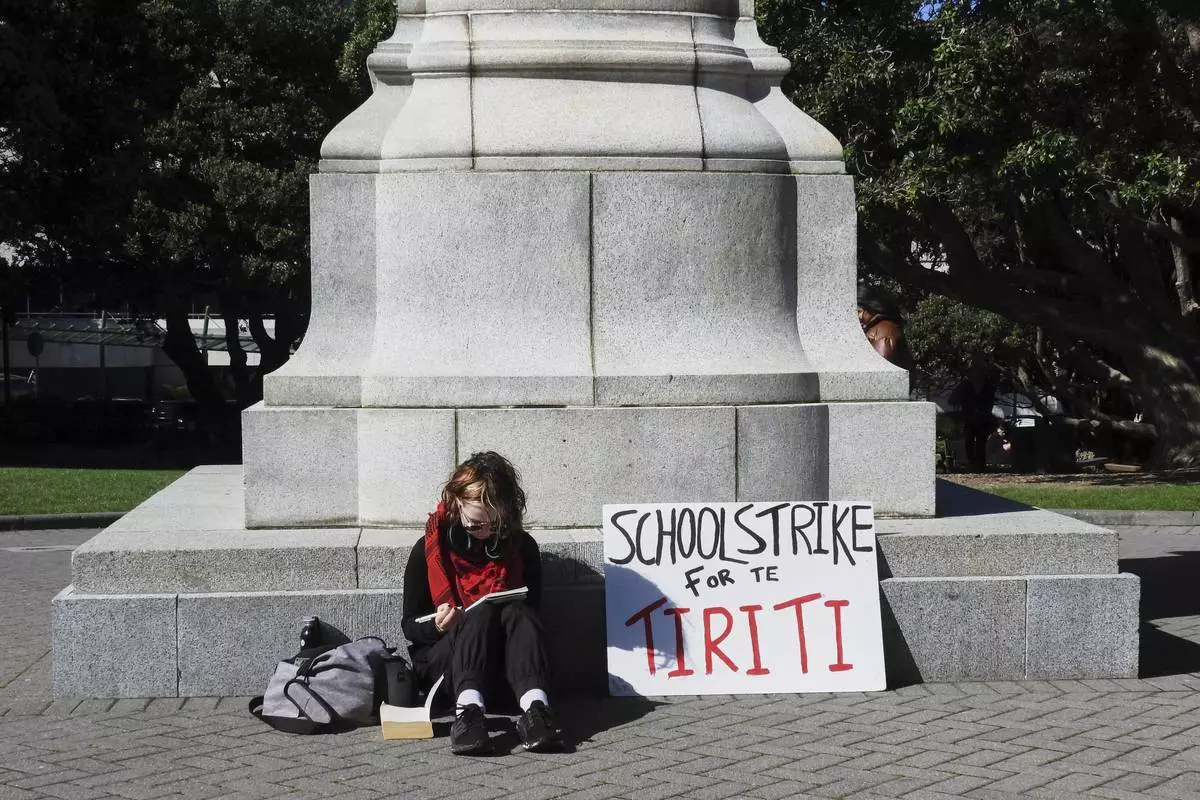
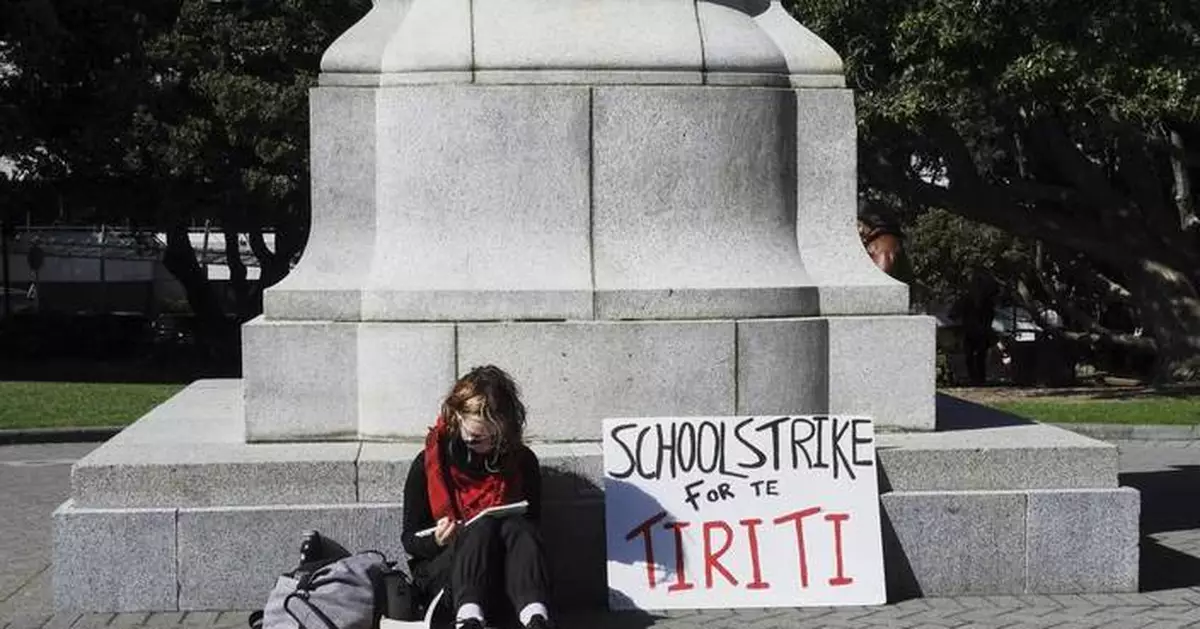
A student opposing the Principles of the Treaty of Waitangi Bill sits outside New Zealand's Parliament in Wellington, New Zealand, Thursday, April 10, 2025.(AP Photo/ Charlotte Graham-McLay)
U.S. President Donald Trump says Iran has proposed negotiations after his threat to strike the Islamic Republic as an ongoing crackdown on demonstrators has led to hundreds of deaths.
Trump said late Sunday that his administration was in talks to set up a meeting with Tehran, but cautioned that he may have to act first as reports mount of increasing deaths and the government continues to arrest protesters.
“The meeting is being set up, but we may have to act because of what’s happening before the meeting. But a meeting is being set up. Iran called, they want to negotiate,” Trump told reporters on Air Force One on Sunday night.
Iran did not acknowledge Trump’s comments immediately. It has previously warned the U.S. military and Israel would be “legitimate targets” if America uses force to protect demonstrators.
The U.S.-based Human Rights Activists News Agency, which has accurately reported on past unrest in Iran, gave the death toll. It relies on supporters in Iran cross checking information. It said at least 544 people have been killed so far, including 496 protesters and 48 people from the security forces. It said more than 10,600 people also have been detained over the two weeks of protests.
With the internet down in Iran and phone lines cut off, gauging the demonstrations from abroad has grown more difficult. Iran’s government has not offered overall casualty figures.
The Latest:
China says it opposes the use of force in international relations and expressed hope the Iranian government and people are “able to overcome the current difficulties and maintain national stability.”
Chinese Foreign Ministry spokesperson Mao Ning said Monday that Beijing “always opposes interference in other countries’ internal affairs, maintains that the sovereignty and security of all countries should be fully protected under international law, and opposes the use or threat of use of force in international relations.”
German Chancellor Friedrich Merz condemned “in the strongest terms the violence that the leadership in Iran is directing against its own people.”
He said it was a sign of weakness rather than strength, adding that “this violence must end.”
Merz said during a visit to India that the demonstrators deserve “the greatest respect” for the courage with which “they are resisting the disproportional, brutal violence of Iranian security forces.”
He said: “I call on the Iranian leadership to protect its population rather than threatening it.”
Iran’s Foreign Ministry spokesman on Monday suggested that a channel remained open with the United States.
Esmail Baghaei made the comment during a news conference in Tehran.
“It is open and whenever needed, through that channel, the necessary messages are exchanged,” he said.
However, Baghaei said such talks needed to be “based on the acceptance of mutual interests and concerns, not a negotiation that is one-sided, unilateral and based on dictation.”
The semiofficial Fars news agency in Iran, which is close to the paramilitary Revolutionary Guard, on Monday began calling out Iranian celebrities and leaders on social media who have expressed support for the protests over the past two weeks, especially before the internet was shut down.
The threat comes as writers and other cultural leaders were targeted even before protests. The news agency highlighted specific celebrities who posted in solidarity with the protesters and scolded them for not condemning vandalism and destruction to public property or the deaths of security forces killed during clashes. The news agency accused those celebrities and leaders of inciting riots by expressing their support.
Canada said it “stands with the brave people of Iran” in a statement on social media that strongly condemned the killing of protesters during widespread protests that have rocked the country over the past two weeks.
“The Iranian regime must halt its horrific repression and intimidation and respect the human rights of its citizens,” Canada’s government said on Monday.
Iran’s foreign minister claimed Monday that “the situation has come under total control” after a bloody crackdown on nationwide protests in the country.
Abbas Araghchi offered no evidence for his claim.
Araghchi spoke to foreign diplomats in Tehran. The Qatar-funded Al Jazeera satellite news network, which has been allowed to work despite the internet being cut off in the country, carried his remarks.
Iran’s foreign minister alleged Monday that nationwide protests in his nation “turned violent and bloody to give an excuse” for U.S. President Donald Trump to intervene.
Abbas Araghchi offered no evidence for his claim, which comes after over 500 have been reported killed by activists -- the vast majority coming from demonstrators.
Araghchi spoke to foreign diplomats in Tehran. The Qatar-funded Al Jazeera satellite news network, which has been allowed to work despite the internet being cut off in the country, carried his remarks.
Iran has summoned the British ambassador over protesters twice taking down the Iranian flag at their embassy in London.
Iranian state television also said Monday that it complained about “certain terrorist organization that, under the guise of media, spread lies and promote violence and terrorism.” The United Kingdom is home to offices of the BBC’s Persian service and Iran International, both which long have been targeted by Iran.
A huge crowd of demonstrators, some waving the flag of Iran, gathered Sunday afternoon along Veteran Avenue in LA’s Westwood neighborhood to protest against the Iranian government. Police eventually issued a dispersal order, and by early evening only about a hundred protesters were still in the area, ABC7 reported.
Los Angeles is home to the largest Iranian community outside of Iran.
Los Angeles police responded Sunday after somebody drove a U-Haul box truck down a street crowded with the the demonstrators, causing protesters to scramble out of the way and then run after the speeding vehicle to try to attack the driver. A police statement said one person was hit by the truck but nobody was seriously hurt.
The driver, a man who was not identified, was detained “pending further investigation,” police said in a statement Sunday evening.
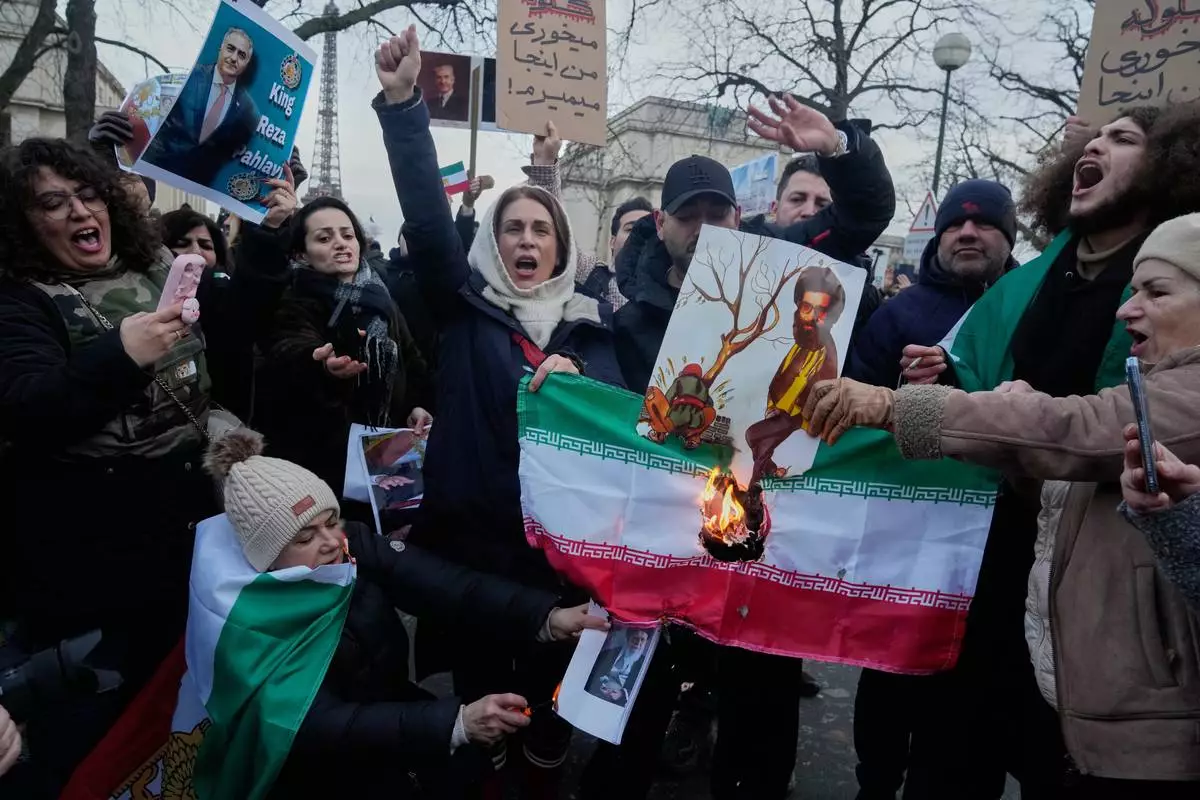
Protesters burn the Iranian national flag during a rally in support of the nationwide mass demonstrations in Iran against the government in Paris, Sunday, Jan. 11, 2026. (AP Photo/Michel Euler)