As friendly neighbors, Laos and China share a traditional friendship with sincerity and mutual support, Lao Prime Minister Sonexay Siphandone said.
In an interview with China Central Television (CCTV), Sonexay highlighted the significance of China-Laos ties by referring to China's contribution in the founding of his country.
"Speaking of Laos-China relations, we are very pleased to see that as a major political and economic power, China is not only a neighbor to Laos, but also a partner who shares the same socialist ideals with Laos. On this basis, the two parties, the two governments and the two peoples enjoy a beautiful traditional friendship. For example, during Laos' war for national salvation, the brotherly Communist Party of China, the Chinese government and the Chinese people gave sincere support to the Lao People's Revolutionary Party, the Lao government and the Lao people without asking for anything in return, helping Laos achieve victory in its revolutionary cause and found today's Lao People's Democratic Republic," Siphandone noted.
Then he talked about his understanding on building a community with a shared future between the two nations.
"Laos and China are not only neighbors, but also long-term stable friendly partners who adhere to the spirit of good neighbors, good friends, good comrades and good partners. The concept of a community with a shared future for Laos and China fits in with the Global Development Initiative proposed by China. President Xi Jinping has pointed out a new direction for cooperation between the two countries, especially in jointly building the Belt and Road Initiative. For now, Laos has been actively conducting policy communication with China, and building a community with a shared future between Laos and China so as to take Laos-China relations to a new level," the prime minister said.

Laos, China enjoy traditional friendship with sincerity, mutual support: Lao PM

Laos, China enjoy traditional friendship with sincerity, mutual support: Lao PM

Laos, China enjoy traditional friendship with sincerity, mutual support: Lao PM
U.S. stocks ended mixed on Friday as investors digested hotter-than-expected inflation data amid ongoing geopolitical uncertainties.
The Dow Jones Industrial Average fell 0.56 percent to 47,916.57. The S and P 500 slipped 0.11 percent to 6,816.89. The Nasdaq Composite Index rose 0.35 percent to 22,902.89.
Seven of the 11 primary S and P 500 sectors closed lower. Consumer staples and health care led the declines, falling 1.43 percent and 1.33 percent, respectively. Technology and materials were the top performers, advancing 0.76 percent and 0.64 percent.
The U.S. consumer price index (CPI) jumped 3.3 percent in March from a year earlier, representing nearly a full percentage point increase from February's annual pace, according to the Bureau of Labor Statistics. The energy index surged 10.9 percent in March, propelled by a 21.2-percent jump in gasoline prices, which alone accounted for nearly three quarters of the monthly increase across all items.
The core CPI, which excludes volatile food and energy components to measure underlying inflation, increased more modestly, rising 0.2 percent for the month and 2.6 percent year over year.
White House Deputy Press Secretary Kush Desai stated that the economy "remains on a solid trajectory," while acknowledging that food and gas prices have risen. National Economic Council Director Kevin Hassett described the current situation as "a temporary energy disruption," adding that the economic effects of the Iran conflict are "a temporary distraction that will very, very quickly go away."
However, Kathy Bostjancic, chief economist at Nationwide, argued that even if a long-lasting deal to end the war is reached and the Strait of Hormuz is fully reopened, "it would take months for oil, gasoline, diesel and other commodity supplies to snap back to pre-war levels and thus for prices to settle back to pre-conflict levels."
Meanwhile, the University of Michigan's preliminary April consumer sentiment index fell sharply to a record low of 47.6, down from 53.3 in March and well below analysts' expectations of 52.0, reflecting growing public concern over the impact of the Iran war on household finances.
Shares of the "Magnificent Seven" technology giants were mostly lower on the day. Nvidia stood out as the strongest performer, rising 2.57 percent.
Investors are now turning their attention to the upcoming U.S.-Iran talks scheduled for this weekend.
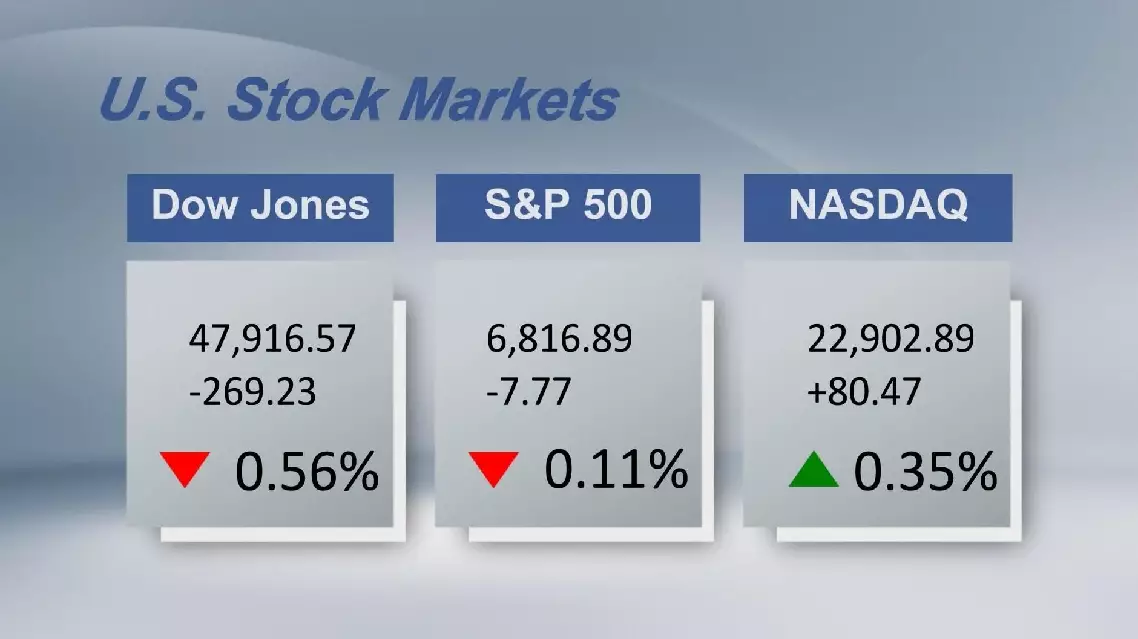
U.S. stocks close mixed after shocking inflation data