Gabriel Landeskog and his surgically repaired knee — the one that's caused him to miss nearly three years — take another big step forward by playing in a second straight game for the Colorado Eagles of the American Hockey League on Saturday night.
The longtime Colorado Avalanche captain Landeskog is on loan to the Eagles as part of a conditioning assignment. He's trying to get up to speed in his bid to possibly join the Avalanche for a playoff run.
The organization announced Landeskog would be in the lineup once again Saturday when the Eagles play the Henderson Silver Knights at Blue Arena in Loveland, Colorado. Landeskog logged nearly 15 minutes, took two shots and spent time in the penalty box during the Eagles' 2-0 win Friday in front of a crowd cheering for No. 92.
Before Friday, Landeskog hadn't played in a professional game since he helped the Avalanche win the Stanley Cup in 2022 because of a knee injury and subsequent surgeries.
"Physically, I feel great,” Landeskog said Friday of his return. “It’s the first game in a long time so I've got plenty of things to work on and get better at but, yeah, it was a lot of fun.”
Landeskog’s injury stems from the 2020 “bubble” season when he was sliced above the knee by the skate of Cale Makar in a playoff game against Dallas. Landeskog eventually underwent a cartilage transplant procedure on May 10, 2023, and has been on long-term injured reserve.
The procedure was similar to the one performed on Chicago Bulls point guard Lonzo Ball in March 2023. Ball returned to the court for a preseason game in October, which hinted at a possible timeline for Landeskog’s return.
Landeskog’s comeback has been the subject of a documentary series called “A Clean Sheet: Gabe Landeskog” that’s airing on TNT and TruTV.
“I’ve been thinking about this for a long time and envisioning this, and envisioning being in a competitive hockey game again,” Landeskog said. “Obviously, there were times where I didn’t know if that was ever going to happen. So it felt great being in the battle again — on the bench, in the room, on the ice, all the nuances of a hockey game. Really fun being back.”
Should all go smooth with his conditioning assignment, the 32-year-old forward from Sweden might very well be activated for Colorado’s first-round playoff series. The Avalanche enter the postseason as the Central Division’s No. 3 seed and will open on the road.
AP NHL: https://apnews.com/hub/nhl

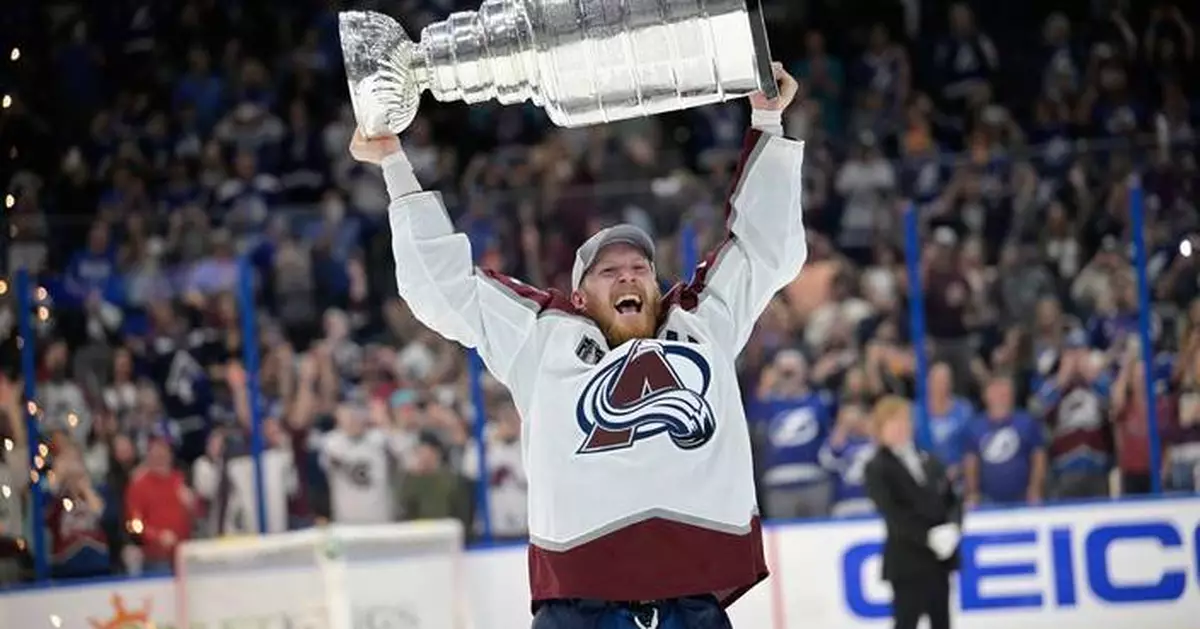
FILE - Colorado Avalanche left wing Gabriel Landeskog (92) lifts the Stanley Cup after the team defeated the Tampa Bay Lightning in Game 6 of the NHL hockey Stanley Cup Finals on Sunday, June 26, 2022, in Tampa, Fla. (AP Photo/Phelan M. Ebenhack, file)
Tennessee Titans coach Robert Saleh confirmed Wednesday that defensive tackle Jordan Elliott was released after pulling a gun in the parking lot of the team facility but said it was a "terrible lapse in judgment that I recognize as a call for help more than a criminal act.”
The Titans had announced Tuesday that Elliott was released, saying only that it came after his involvement in an unspecified incident at the team’s facility five days earlier.
A person briefed on the incident told The Associated Press on Wednesday that Elliott had a gun in his car and went to the parking lot to retrieve it after a dispute with another player. The person spoke to the AP on condition of anonymity because the incident is being reviewed.
Elliott's agent, Malki Kawa, could not be reached for comment.
The NFL prohibits league personnel from taking a firearm to club facilities, stadiums and team hotels and on team planes or buses.
The Titans promptly notified the league of the incident involving Elliott, which is being reviewed, the NFL said.
Speaking to reporters, Saleh defended Jordan's character.
“Unfortunately, rules are rules with regard to guns on property, and sometimes it’s far greater than the knee-jerk reaction of kicking somebody when they’re down,” the coach said.
“He’s a good man. Made a terrible, had a terrible lapse in judgment that I recognize as a call for help more than a criminal act,” Saleh added. "He’s never committed a crime in his entire life and he pulled a gun, in the parking lot.”
Right tackle JC Latham, who was involved in the altercation with Elliott on the practice field, called the episode an unfortunate situation.
“I don’t really have too much to say about it," Latham said Wednesday. “There ain’t never been no bad blood between us two. We were here on the summer getting treatment. Before that, we hung out whenever we were in the same city together. We actually had never had an argument leading up to it."
Elliott appeared in five games this season with one start and had 11 tackles. He followed Saleh to Nashville after a two-year stint with the San Francisco 49ers, where he played in 31 games with 29 starts.
The 6-foot-4 defensive tackle was selected by the Cleveland Browns in the third round of the 2020 draft. He spent his first four seasons in Cleveland before signing a two-year, $7 million deal with San Francisco.
Tennessee added him as a free agent in the offseason on a two-year, $8 million deal.
AP Pro Football Writer Rob Maaddi in Tampa, Florida, contributed to this report.
See AP’s full NFL coverage here
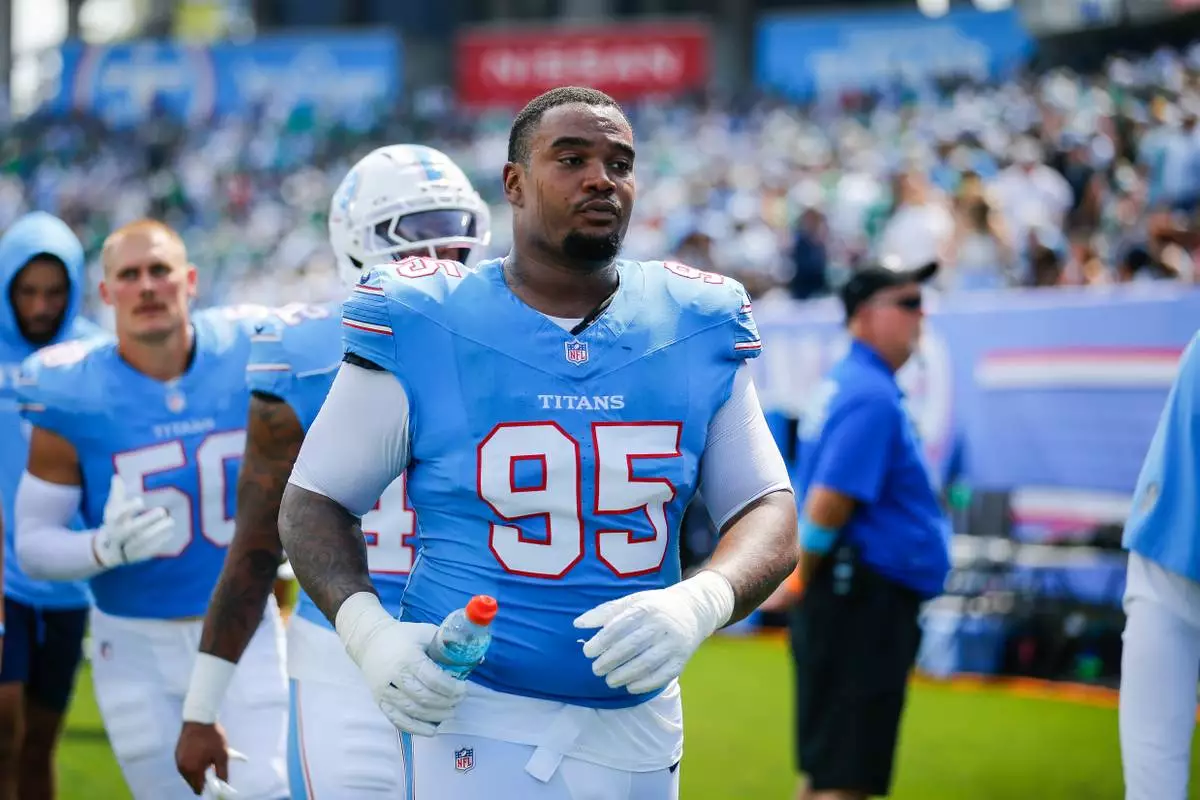
FILE - Tennessee Titans defensive lineman Jordan Elliott (95) walks to the locker room at halftime of an NFL football game against the Philadelphia Eagles in Nashville, Tenn., Sept. 20, 2026. (AP Photo/Stew Milne, File)