SYDNEY (AP) — More than 500 people are feared dead after reports that two boats carrying members of Myanmar’s persecuted Rohingya minority have capsized in the Bay of Bengal, officials said Thursday.
According to preliminary information, the two boats left Myanmar’s western state of Rakhine in late June carrying mostly Rohingya passengers, including some who had traveled from refugee camps across the border in Bangladesh, according to a statement from the International Organization for Migration and the United Nations High Commissioner for Refugees.
One boat, believed to have been carrying around 250 people, lost contact shortly after departure. A second boat, reportedly carrying 280 people, is believed to have sunk off Myanmar’s Ayeyarwady coast on July 8.
″While the incidents and casualty figures have yet to be officially confirmed, UNHCR and IOM are gravely concerned by the potentially devastating loss of life,” the agencies said.
The Rohingya, who have in recent years fled both Myanmar and Bangladesh’s squalid refugee camps by the thousands, typically avoid such boat journeys at this time of year, when monsoons are frequent and conditions at sea are particularly dangerous. The UNHCR and IOM noted this in their statement, saying that recent torrential rain and flooding across the region would have made such journeys especially risky.
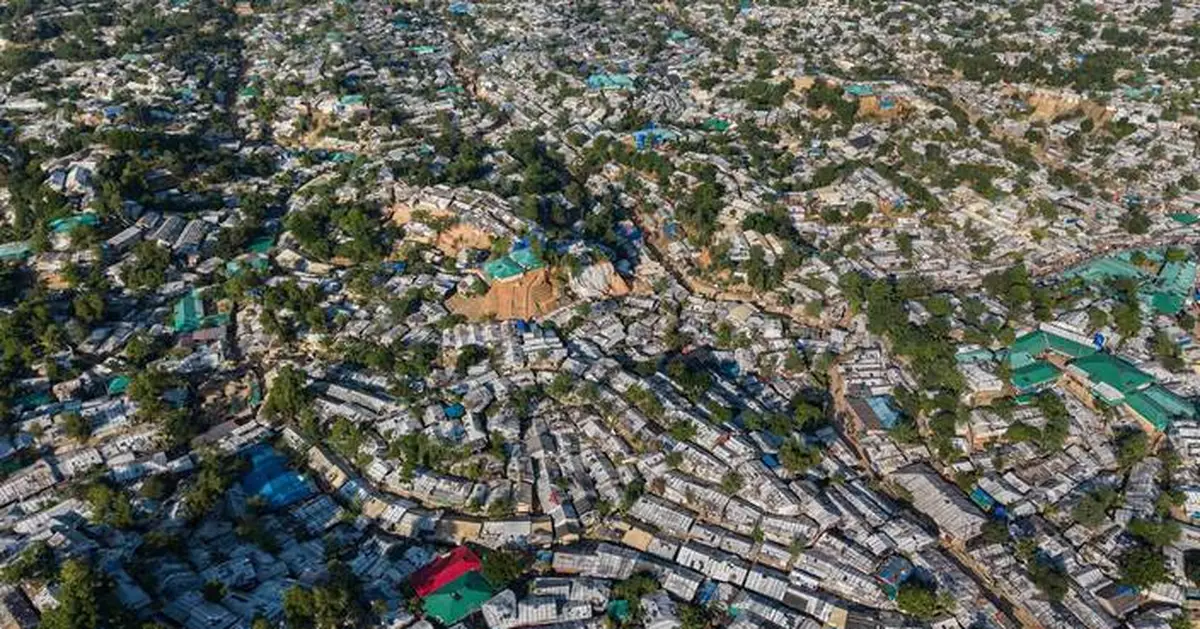
Around 1.2 million stateless, predominantly Muslim Rohingya remain trapped in overcrowded refugee camps in Bangladesh after fleeing waves of violence by Myanmar’s security forces.
The refugees have no way to safely return to Myanmar, where the military that killed thousands of Rohingya in 2017 during what the United States declared a genocide remains in charge of their homeland. The Rohingya still living in Myanmar face severe restrictions and many are confined to internment camps.
Steep cuts to foreign aid by the U.S. and other countries have led to ration cuts in Bangladesh’s refugee camps, while the ruling military and an ethnic armed organization in Rakhine have fought for control of the region.
The unrest has led to an increasing number of Rohingya attempting to make the dangerous ocean crossing to Malaysia on rickety boats. Thousands have died in the process, including babies, children and pregnant women. Local maritime authorities have frequently abandoned the Rohingya at sea, often ignoring reports of boats in distress.
The IOM and UNHCR said on Thursday that the latest potential tragedy at sea underscores the continued lack of sustainable solutions for the Rohingya, and urged the international community to support those trapped in Bangladesh’s camps.
“Stronger regional and international efforts are needed to prevent further loss of life along one of the world’s deadliest maritime routes, including through enhanced search and rescue efforts, access to asylum and protection, and actions against smuggling and trafficking networks,” the agencies said.
More than 6,500 Rohingya fled and nearly 900 were reported dead or missing in 2025, the deadliest year for Rohingya who tried to leave by boat. The figure represents the highest mortality rate of any major route for refugee and migrant sea journeys in the world, the UNHCR said.
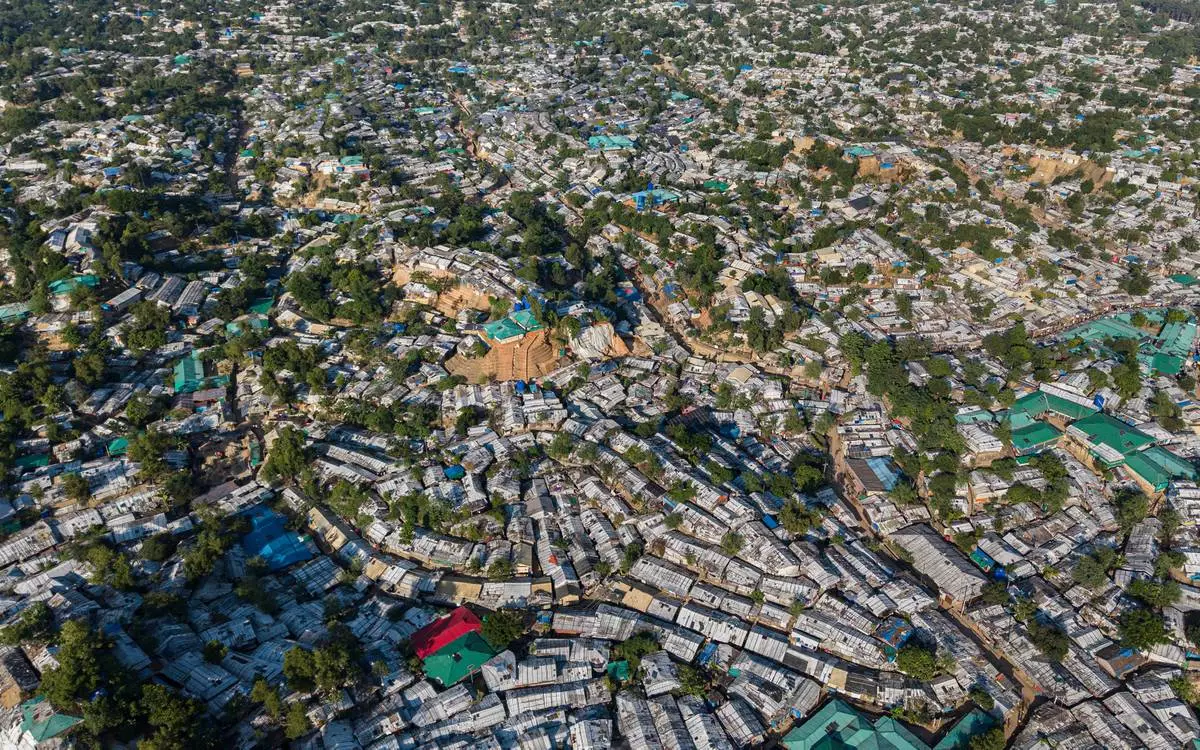
FILE - An aerial view of a Rohingya refugee camp, home to over a million of Myanmar's persecuted Rohingya minority, in Cox's Bazar, Bangladesh, Nov. 25, 2025. (AP Photo/Mahmud Hossain Opu, File)
MILAN (AP) — Family members of the 43 people killed when Genoa’s Morandi highway bridge collapsed nearly eight years ago are expected to pack a courtroom Thursday for verdicts in the trial of 57 defendants charged in a disaster that exposed deep failures in the maintenance of Italy’s infrastructure.
The defendants include former executives of highway operator Autostrade per L’Italia, experts from its engineering company SPEA and former officials from Italy’s Infrastructure Ministry.
Most face charges, including negligent disaster and multiple counts of manslaughter stemming from alleged failures to maintain the bridge, which was part of a main route linking northern Italy with the French Riviera.
On the morning of Aug. 14, 2018, a 200-meter (650-foot) section of the bridge gave way during a rainstorm, sending dozens of vehicles plunging to the ground.
Images of the collapsed bridge were seen around the world and shocked Italians on one of Italy’s busiest travel days, as millions headed out for the traditional Aug. 15 Ferragosto holiday that marks the peak summer vacation season.
Prosecutors have argued that years of maintenance neglect led to the collapse, and demanded combined sentences totaling nearly 400 years for all of the defendants. The defendants deny wrongdoing and say the fault was caused by a construction defect.
The verdicts and sentencing will cap a trial that spanned more than 280 hearings over four years.
“Our expectation is to feel our pain recognized ... and to have it acknowledged that this did not happen by chance, but because of serious failures in maintenance,” said Raffaele Caruso, one of the lawyers representing victims.
Considered an engineering marvel when it opened in 1967, the Morandi featured three A-shaped concrete pylons and concrete-encased stay cables.
Caruso, who represents the family members of three victims, said that the trial showed that warning signs about defects in the pylon that collapsed had existed for decades. He cited maintenance on the other two starting in 1993 that was never extended to the third.
“From 1993 onward, the problem was known. We had three identical pylons. Two had already shown the same defect, and no one seriously asked whether the third one had it as well,” Caruso said.
The current Autostrade chief executive, Arrigo Giana, issued a public apology Thursday in an open letter published in major Italian dailies.
“The actions and decisions of some people left indelible scars,’’ said Giana, who joined Autostrade as CEO last year. “Offering today the apology that was not made then is, for us, a moral imperative that goes beyond establishing legal responsibility and the course of justice toward the truth.”
Autostrade and its subsidiary reached a deal on corporate liability earlier in the proceedings, paying roughly 30 million euros ($34 million) in financial penalties. The agreement spared the companies from a trial as corporate defendants and potentially much harsher sanctions, including exclusion from public contracts.
The settlements were reached after the companies adopted new compliance procedures aimed at preventing similar crimes, and after victims were compensated.
A new bridge designed by Genoa-born Italian architect Renzo Piano opened in 2020, spanning a memorial to the victims of the Morandi Bridge collapse.
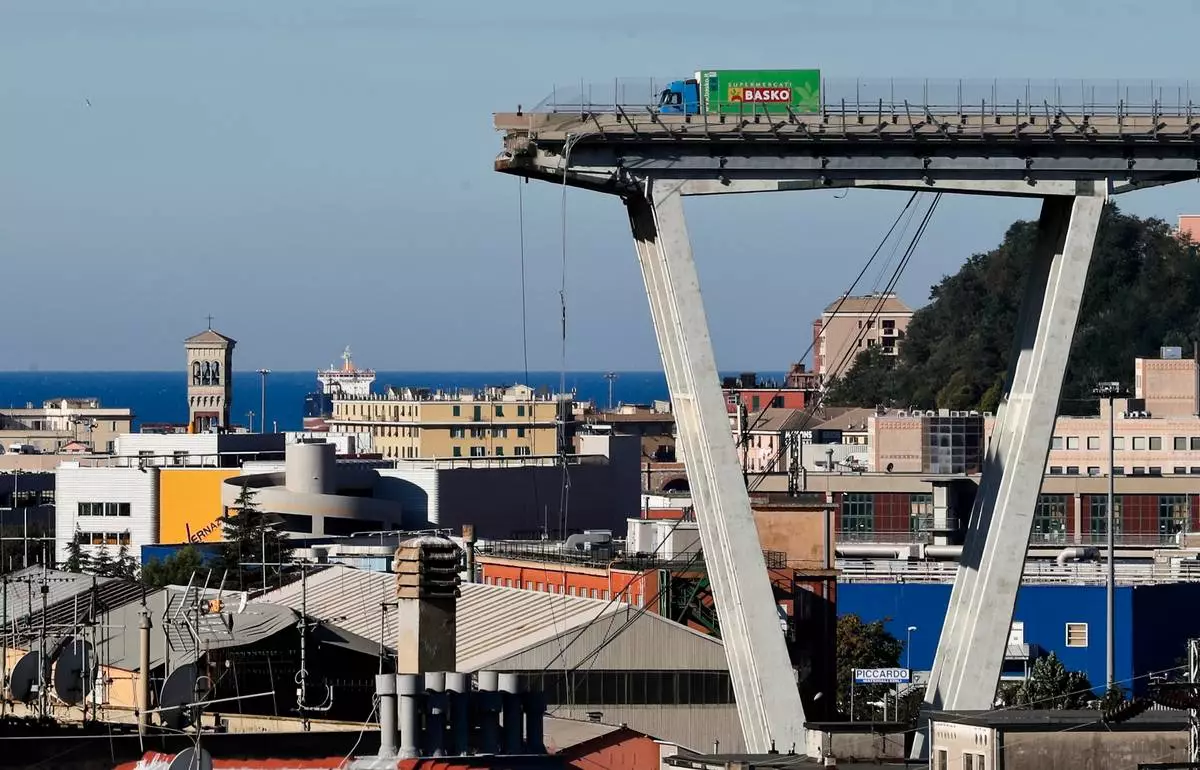
FILE - A vehicle sits short of a section of the Morandi highway bridge that collapsed on Aug. 15, 2018, in Genoa, northern Italy. (AP Photo/Antonio Calanni, File)
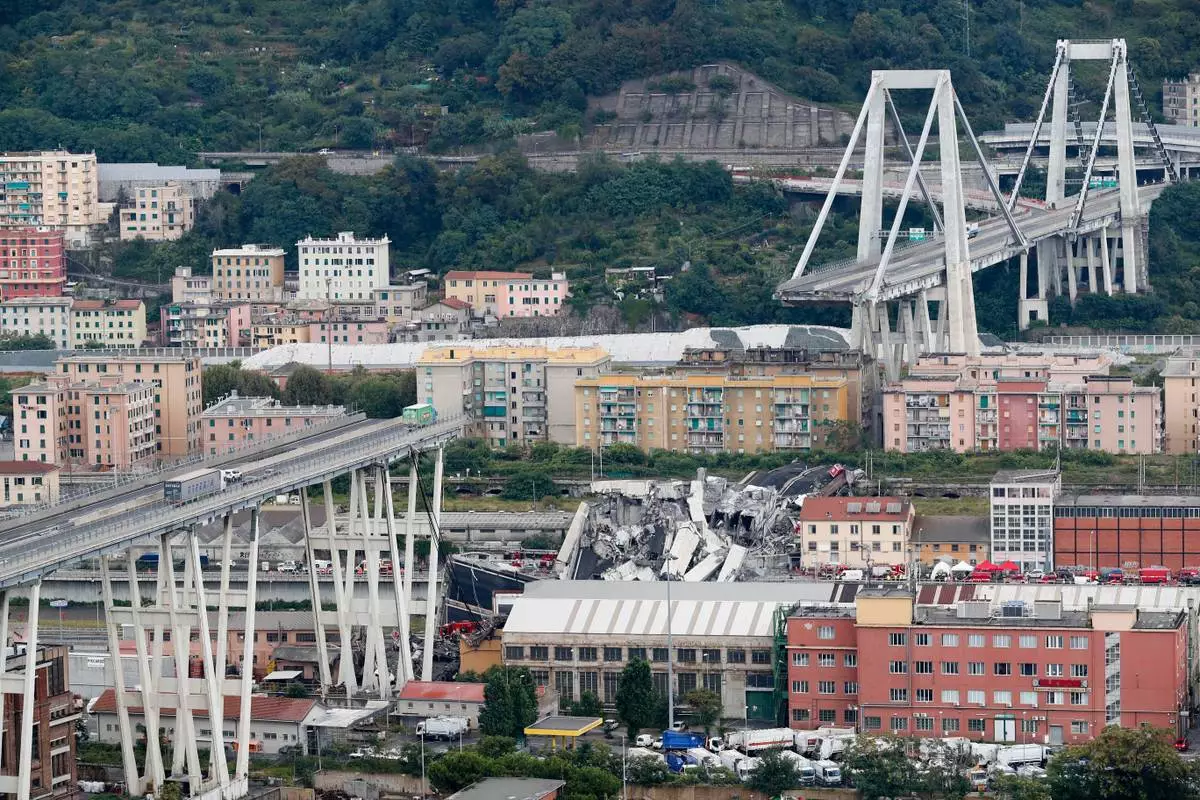
FILE - Cars are blocked on the Morandi highway bridge after a section of it collapsed, Aug. 14, 2018, in Genoa, northern Italy. (AP Photo/Antonio Calanni, File)