SAN JOSE, Calif.--(BUSINESS WIRE)--Apr 15, 2025--
Impossible Metals, a pioneering US-based deep-sea mining company, has submitted a request to commence a leasing process for exploration and potential mining of critical minerals in the deep sea off the coast of American Samoa. Impossible Metals is the first company to request a lease of critical minerals under the Outer Continental Shelf Lands Act of 1953, which is regulated by the U.S. Bureau of Ocean Energy Management (BOEM), part of the U.S. Department of the Interior.
This press release features multimedia. View the full release here: https://www.businesswire.com/news/home/20250415874964/en/
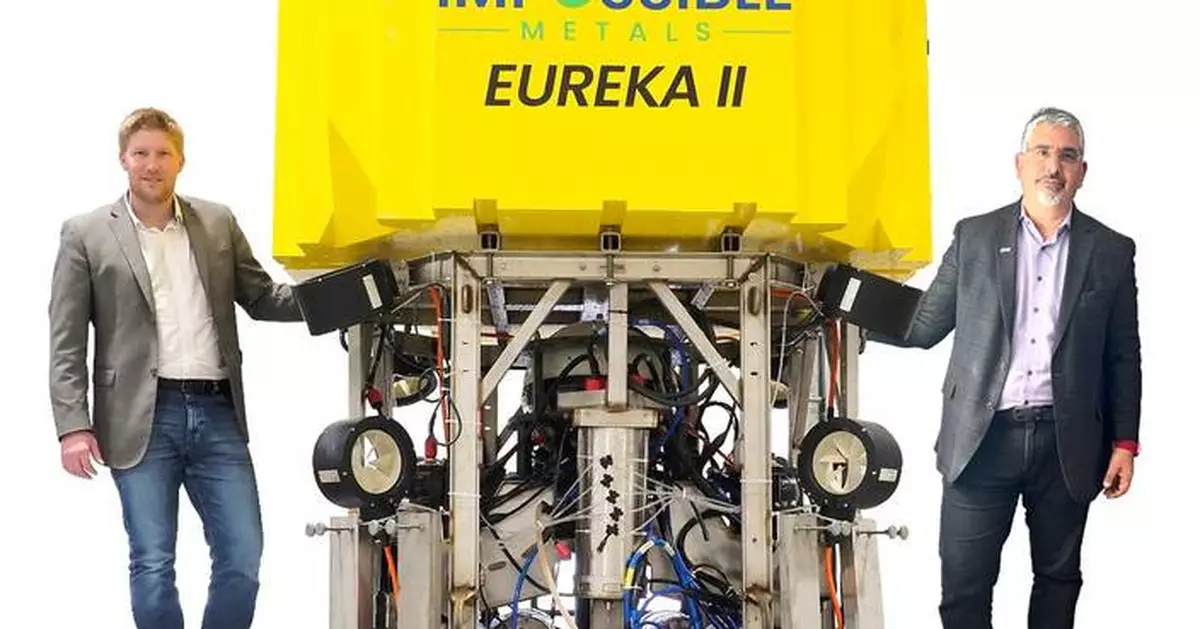
Impossible Metals has developed the only autonomous underwater robot (AUV) for selective harvesting. The novel underwater robot uses advanced robotics, AI, and a buoyancy engine to hover above the seabed, accurately identifying and avoiding nodules with visible life while minimizing disruption to the habitat and native biodiversity. This method will have the lowest environmental impact and cost among land and deep-sea mining approaches, setting a new standard for responsible resource collection.
The area identified for exploration is believed to contain a rich deposit of critical minerals, including nickel, cobalt, copper, magnesium, and rare earths. Establishing a secure domestic supply of these critical minerals is imperative to compete with global powers such as China and to ensure the nation can access materials vital for developing clean energy technologies and defense capabilities.
“Impossible Metals’ innovative approach to selective harvesting of minerals from the deep sea will revolutionize the mining industry and ensure that the United States remains a leader in sustainability, technology, and clean energy,” said Oliver Gunasekara, CEO and Co-Founder of Impossible Metals
Impossible Metals will work closely with the people and leaders of American Samoa, the Department of the Interior, Congress, scientists, the environmental community, and the public to ensure high environmental and safety standards, attention to local communities' needs, and responsible stewardship of ocean resources.
"American Samoa welcomes the start of a deep-sea minerals industry that will bring significant economic growth, support national security, and create jobs,” said John Wasko, Executive Director, American Samoa Economic Development Council.
About Impossible Metals. Impossible Metals‘ (YC W22, Public Benefit Corporation) vision is accelerating clean energy by delivering responsible critical metals. We are developing autonomous underwater vehicles (AUVs) to harvest critical metals from the seabed while protecting the environment. Headquartered in California and with a robotics lab in Canada, Impossible Metals is committed to the UN Sustainable Development Goals.
Impossible Metals Media Kit

Impossible Metals Eureka II underwater robot with the two Co-Founders Oliver Gunasekara (right) CEO, Jason Gillham (left) COO.
DALLAS (AP) — Sen. John Cornyn stood in the shadow of the U.S.-Mexico border wall for a campaign event, but the Texas Republican didn’t offer the kind of diatribe about illegal immigration that stokes his party’s core and fueled Donald Trump’s rise to the White House.
Instead, Cornyn, in his courtly Houston drawl, politely thanked Trump for billions in federal dollars to reimburse Texans for work on the wall, praising “the president of the United States, to whom I am very grateful.”
Cornyn's characteristic calm and measured comments betrayed the urgency of the moment for the four-term senator. He's facing the political fight of his long career against two Republicans who claim closer ties to Trump and his MAGA movement and tend more toward fiery rhetoric. Now, Cornyn could become the first Republican Texas senator to lose renomination in a race that may reflect what GOP primary voters are looking for in their elected officials — and what it takes to survive in Trump’s Republican Party.
Some say the 73-year-old former Texas Supreme Court justice represents a bygone era in the GOP. Still, Cornyn, supporters and the Senate’s Republican leadership are fighting aggressively for an edge in the March 3 primary. They have spent tens of millions of dollars, much of it against his opponents, Attorney Gen. Ken Paxton and Rep. Wesley Hunt — both self-styled Trump Republicans.
“We’ve got enough performance artists here in Washington,” Cornyn told The Associated Press, “people who think serving as a representative in the world’s most distinguished representative body — that what qualifies them — is they are loud, they are active on social media and they get a lot of attention.”
Paxton entered the race in April, having emerged from legal troubles that had shadowed his political rise, including beating a 2023 impeachment trial on corruption charges and reaching a deal to end a long-running securities fraud case.
The three-term attorney general has portrayed the investigations against him as persecution by the political establishment, much like Trump has. He contends Cornyn has “completely lost touch with Texas.”
Hunt is still working to raise his profile in Texas. The two-term House member often touts his early endorsement of Trump's 2024 comeback campaign.
Of Cornyn, Hunt recently said, “His moment has passed.”
Hunt's entry in the race last fall made it more likely that no candidate will win at least 50% of the primary vote, sending the top two finishers to a May runoff. The nominee would face the winner of the Democratic primary between Rep. Jasmine Crockett and state Rep. James Talarico.
Mike Fleming, an 80-year-old retired sales manager who attended a recent Hunt campaign event, said Cornyn is a good man but has spent “a lot of his time trying to run for head of the Senate.” Cornyn unsuccessfully ran for Senate majority leader after the 2024 elections.
“If he was the only guy, I would vote for him,” Fleming said.
Cornyn and aligned super PACs have heavily outspent Paxton and Hunt, investing more than $30 million since last summer on television advertising, much of it criticizing his rivals, according to the ad-tracking service AdImpact.
Senate Republican leaders, however, have worried that Paxton, as the nominee, would be costly to defend in the general election. Cornyn's situation is more about a shift in Republican campaign priorities and what candidates need to do to win a GOP primary.
“He plays the part of the distinguished statesman. And that’s what he’s always been,” said Wayne Hamilton, a former executive director of the Texas Republican Party. “But anymore, you have to be very loud about the opposition. And that’s just not him.”
Cornyn also fights a perception among some GOP voters that he’s a moderate.
“He hasn’t been consistent in his conservative representation in his voting,” said Robyn Richardson, 50, from suburban Dallas.
Some Texas conservatives remain angry about Cornyn's work as the GOP’s negotiator on gun restrictions in a 2022 law in the weeks after the shooting at Robb Elementary School in Uvalde, Texas, where 19 students and two teachers were killed. Democrats narrowly controlled Congress and hoped to enact major changes under President Joe Biden.
The measure didn't go as far as Democrats wanted, but the bipartisan bill was the widest-ranging gun measure passed by Congress in decades. Some Republicans wanted any bill blocked, and a week before its passage, some GOP activists booed Cornyn as he took the stage at a state convention.
Some point to Cornyn being dismissive of Trump during his 2016 campaign and before his 2024 campaign and to his dismissal of Trump's claims of widespread election fraud after he lost to Biden in 2020. Those claims by Trump were debunked.
Cornyn was even skeptical early on about the border wall he took credit for helping finance, calling Trump “naive” in proposing it before he sealed the 2016 Republican presidential nomination. Paxton has pointed to that comment, portraying Cornyn as “opposing the border wall.”
The episodes certainly weren't helpful for Cornyn, who has worked to show Texas Republicans where he and Trump agree.
Cornyn aired ads featuring him with Border Patrol agents along the wall, promoting his support to secure $11 billion for Texans' work on it. Another ad promoted Cornyn's 99% support for Trump's agenda, including his three U.S. Supreme Court nominees.
But the disagreements are small compared with the broader shift Cornyn has resisted.
Vinny Minchillo, a veteran Republican consultant in the Dallas area, referred to Cornyn as “an old George W. Bush Republican, which is now a bad thing” since Trump’s rise.
Cornyn was elected attorney general in 1998, winning when a new national conservative figure was rising out of Texas, the newly reelected Gov. George W. Bush, who was elected president two years later.
The Bush name, once a three-generation fixture in Texas politics, quietly disappeared when then-Texas Land Commissioner George P. Bush, grandson and nephew of two presidents, lost his challenge of Paxton for attorney general in 2022.
“I think there is certainly some level of John Cornyn fatigue,” Minchillo said. “He’s been on the ballot in Texas for a long, long time.”
As of last week, Trump had endorsed dozens of Republican lawmakers in Texas. But he is not expected to endorse ahead of the Senate primary, according to people familiar with the White House thinking but who were not authorized to speak publicly.
That would leave Cornyn among only three incumbent Republican senators seeking reelection who have not received Trump's public backing, with Maine's Susan Collins and Louisiana's Bill Cassidy.
Cornyn acknowledged he's “not somebody who cries out for attention at every opportunity.”
Instead, in the final weeks of the primary campaign, he's hoping voters consider which candidate would be the most effective at getting things done — because he believes they'll support him if they do.
“Sometimes people make the distinction between a workhorse and a show horse,” he said. “And I’m happy to be a workhorse.”
——-
Beaumont reported from Des Moines, Iowa. Hanna reported from Topeka, Kan. Maya Sweedler contributed from Washington.

Sen. John Cornyn, R-Texas, walks through the Capitol, Thursday, Jan. 15, 2026, in Washington. (AP Photo/Allison Robbert)

FILE - Sen. John Cornyn, R-Texas, introduces Brooke Rollins during a Senate Agriculture, Nutrition, and Forestry Committee hearing on her nomination for Secretary of Agriculture, Jan. 23, 2025, in Washington. (AP Photo/Jacquelyn Martin, File)