GOTHENBURG, Sweden--(BUSINESS WIRE)--Apr 15, 2025--
Polestar (NASDAQ: PSNY) has published its fourth Annual Sustainability report, announcing significant GHG reductions, updates on the Polestar 0 project and a continued quest for increased transparency and more sustainable materials. Since the Company started measuring in 2020, Polestar has reduced its carbon footprint per sold car with a quarter (24.7%). The most significant contributing factors to this achievement include an increased use of low-carbon aluminium in all models, improvements in battery manufacturing, 100% renewable electricity in the manufacture of all models and more efficient logistics combined with increased use of biofuels on certain ocean routes.
This press release features multimedia. View the full release here: https://www.businesswire.com/news/home/20250415913143/en/
Michael Lohscheller
Michael Lohscheller, Polestar CEO, says: “Polestar has shown that it is possible to decouple growth from climate impact. In simple terms, we aim to continue to cut emissions as we accelerate sales. Even though much in the world seems to be going in the wrong direction, we are doubling down on our commitments. When the world zigs, Polestar zags.”
The Polestar 0 project was launched in 2021, as a moonshot goal to create a climate neutral car, aimed at galvanising a sense of urgency and accelerating collaborative research, supporting Polestar’s goal of becoming climate neutral by 2040. Today, the project partners and Polestar are proud to announce that across the companies’ combined initiatives, important low carbon solutions have been identified, showing the potential to produce a Polestar 2 with a 10 tonnes lower carbon footprint than when the project started*.
The largest contributions are within aluminium and steel manufacturing, key materials for decarbonisation as they represent around 45% of the total cradle-to gate carbon footprint of Polestar 2. Moving into its next stage, the structure of the Polestar 0 project will shift, with areas that require further research serving as input to the Mission 0 House*, a Polestar-initiated but collaboratively driven and funded research centre. Located in Gothenburg, the research hub hosts scientists from academia and engineers from industry, who work side by side, towards elimination of GHG emissions in materials, products and processes. As a key principle, the ambition is to consider commercialisation of future potential solutions developed by the Mission 0 House .
Circularity, Inclusion and Transparency remain key areas. Polestar joined the Initiative for Responsible Mining Assurance (IRMA) and continued the expansion of onsite audits in high-risk regions. Traceability of risk materials was expanded to include the mapping of manganese, among others. Polestar continues its efforts to increase both data availability and share of recycled content from car programs to model year upgrades and Polestar 4 now contains 10% recycled material.
Read Polestar's full Sustainability report here: https://www.polestar.com/dato-assets/11286/1744370504-polestar_sustainability_report_2024.pdf
Notes to editors
*The cradle-to-gate carbon footprint of the 2020 launch edition Polestar 2 Long range Dual motor variant would go from about 26 tonnes to 16 tonnes of CO 2 e by fully incorporating the solutions identified within the partnerships.
*Read more about Mission 0 House in our sustainability report on page 79
About Polestar
Polestar (Nasdaq: PSNY) is the Swedish electric performance car brand with a focus on uncompromised design and innovation, and the ambition to accelerate the change towards a sustainable future. Headquartered in Gothenburg, Sweden, its cars are available in 27 markets globally across North America, Europe and Asia Pacific.
Polestar has three models in its line-up: Polestar 2, Polestar 3, and Polestar 4. Planned models include the Polestar 5 four-door GT (to be introduced in 2025), the Polestar 6 roadster and the Polestar 7 compact SUV. With its vehicles currently manufactured on two continents, North America and Asia, Polestar plans to diversify its manufacturing footprint further, with production of Polestar 7 planned in Europe.
Polestar has an unwavering commitment to sustainability and has set an ambitious roadmap to reach its climate targets: halve greenhouse gas emissions by 2030 per-vehicle-sold and become climate-neutral across its value chain by 2040. Polestar’s comprehensive sustainability strategy covers the four areas of Climate, Transparency, Circularity, and Inclusion.
Forward-Looking Statements
This press release contains statements that are not historical facts, but rather forward-looking statements within the meaning of Private Securities Litigation Reform Act of 1995. Such forward-looking statements include those that address activities, events or developments that Polestar or its management believes or anticipates may occur in the future. All forward-looking statements are based upon, as applicable, our current expectations, various assumptions and data available from third parties. Our expectations and assumptions are expressed in good faith and we believe there is a reasonable basis for them. However, there can be no assurance that such forward-looking statements will materialize or prove to be correct as forward-looking statements are inherently subject to known and unknown risks, uncertainties and other factors which may cause actual future results, performance or achievements to differ materially from the future results, performance or achievements expressed in or implied by such forward-looking statements. Numerous risks, uncertainties and other factors may cause actual results to differ materially from those set out in the forward-looking statements, including those risks and uncertainties set forth in the sections entitled “Risk Factors” and “Cautionary Note Regarding Forward-Looking Statements” in Polestar’s Form 20-F, and other documents filed, or to be filed, with the U.S. Securities and Exchange Commission by Polestar. For any forward-looking statements contained in this or any other document, we claim the protection of the safe harbor for forward-looking statements contained in the Private Securities Litigation Reform Act of 1995, and we assume no obligation to update publicly or revise any such statements in light of new information or future events, except as required by law.

Fredrika Klaren
ATLANTA (AP) — Donald Trump would not be the first president to invoke the Insurrection Act, as he has threatened, so that he can send U.S. military forces to Minnesota.
But he'd be the only commander in chief to use the 19th-century law to send troops to quell protests that started because of federal officers the president already has sent to the area — one of whom shot and killed a U.S. citizen.
The law, which allows presidents to use the military domestically, has been invoked on more than two dozen occasions — but rarely since the 20th Century's Civil Rights Movement.
Federal forces typically are called to quell widespread violence that has broken out on the local level — before Washington's involvement and when local authorities ask for help. When presidents acted without local requests, it was usually to enforce the rights of individuals who were being threatened or not protected by state and local governments. A third scenario is an outright insurrection — like the Confederacy during the Civil War.
Experts in constitutional and military law say none of that clearly applies in Minneapolis.
“This would be a flagrant abuse of the Insurrection Act in a way that we've never seen,” said Joseph Nunn, an attorney at the Brennan Center for Justice's Liberty and National Security Program. “None of the criteria have been met.”
William Banks, a Syracuse University professor emeritus who has written extensively on the domestic use of the military, said the situation is “a historical outlier” because the violence Trump wants to end “is being created by the federal civilian officers” he sent there.
But he also cautioned Minnesota officials would have “a tough argument to win” in court, because the judiciary is hesitant to challenge “because the courts are typically going to defer to the president” on his military decisions.
Here is a look at the law, how it's been used and comparisons to Minneapolis.
George Washington signed the first version in 1792, authorizing him to mobilize state militias — National Guard forerunners — when “laws of the United States shall be opposed, or the execution thereof obstructed.”
He and John Adams used it to quash citizen uprisings against taxes, including liquor levies and property taxes that were deemed essential to the young republic's survival.
Congress expanded the law in 1807, restating presidential authority to counter “insurrection or obstruction” of laws. Nunn said the early statutes recognized a fundamental “Anglo-American tradition against military intervention in civilian affairs” except “as a tool of last resort.”
The president argues Minnesota officials and citizens are impeding U.S. law by protesting his agenda and the presence of U.S. Immigration and Customs Enforcement officers and Customs and Border Protection officers. Yet early statutes also defined circumstances for the law as unrest “too powerful to be suppressed by the ordinary course” of law enforcement.
There are between 2,000 and 3,000 federal authorities in the Minneapolis-St. Paul metro area, compared to Minneapolis, which has fewer than 600 police officers. Protesters' and bystanders' video, meanwhile, has shown violence initiated by federal officers, with the interactions growing more frequent since Renee Good was shot three times and killed.
“ICE has the legal authority to enforce federal immigration laws,” Nunn said. “But what they're doing is a sort of lawless, violent behavior” that goes beyond their legal function and “foments the situation” Trump wants to suppress.
“They can't intentionally create a crisis, then turn around to do a crackdown,” he said, adding that the Constitutional requirement for a president to “faithfully execute the laws” means Trump must wield his power, on immigration and the Insurrection Act, “in good faith.”
Courts have blocked some of Trump's efforts to deploy the National Guard, but he'd argue with the Insurrection Act that he does not need a state's permission to send troops.
That traces to President Abraham Lincoln, who held in 1861 that Southern states could not legitimately secede. So, he convinced Congress to give him express power to deploy U.S. troops, without asking, into Confederate states he contended were still in the Union. Quite literally, Lincoln used the act as a legal basis to fight the Civil War.
Nunn said situations beyond such a clear insurrection as the Confederacy still require a local request or another trigger that Congress added after the Civil War: protecting individual rights. Ulysses S. Grant used that provision to send troops to counter the Ku Klux Klan and other white supremacists who ignored the 14th and 15th amendments and civil rights statutes.
During post-war industrialization, violence erupted around strikes and expanding immigration — and governors sought help.
President Rutherford B. Hayes granted state requests during the Great Railroad Strike of 1877 after striking workers, state forces and local police clashed, leading to dozens of deaths. Grover Cleveland granted a Washington state governor's request — at that time it was a U.S. territory — to help protect Chinese citizens who were being attacked by white rioters. President Woodrow Wilson sent troops to Colorado in 1914 amid a coal strike after workers were killed.
Federal troops helped diffuse each situation.
Banks stressed that the law then and now presumes that federal resources are needed only when state and local authorities are overwhelmed — and Minnesota leaders say their cities would be stable and safe if Trump's feds left.
As Grant had done, mid-20th century presidents used the act to counter white supremacists.
Franklin Roosevelt dispatched 6,000 troops to Detroit — more than double the U.S. forces in Minneapolis — after race riots that started with whites attacking Black residents. State officials asked for FDR's aid after riots escalated, in part, Nunn said, because white local law enforcement joined in violence against Black residents. Federal troops calmed the city after dozens of deaths, including 17 Black residents killed by local police.
Once the Civil Rights Movement began, presidents sent authorities to Southern states without requests or permission, because local authorities defied U.S. civil rights law and fomented violence themselves.
Dwight Eisenhower enforced integration at Central High School in Little Rock, Arkansas; John F. Kennedy sent troops to the University of Mississippi after riots over James Meredith's admission and then pre-emptively to ensure no violence upon George Wallace's “Stand in the Schoolhouse Door” to protest the University of Alabama's integration.
“There could have been significant loss of life from the rioters” in Mississippi, Nunn said.
Lyndon Johnson protected the 1965 Voting Rights March from Selma to Montgomery after Wallace's troopers attacked marchers' on their first peaceful attempt.
Johnson also sent troops to multiple U.S. cities in 1967 and 1968 after clashes between residents and police escalated. The same thing happened in Los Angeles in 1992, the last time the Insurrection Act was invoked.
Riots erupted after a jury failed to convict four white police officers of excessive use of force despite video showing them beating a Rodney King, a Black man. California Gov. Pete Wilson asked President George H.W. Bush for support.
Bush authorized about 4,000 troops — but after he had publicly expressed displeasure over the trial verdict. He promised to “restore order” yet directed the Justice Department to open a civil rights investigation, and two of the L.A. officers were later convicted in federal court.
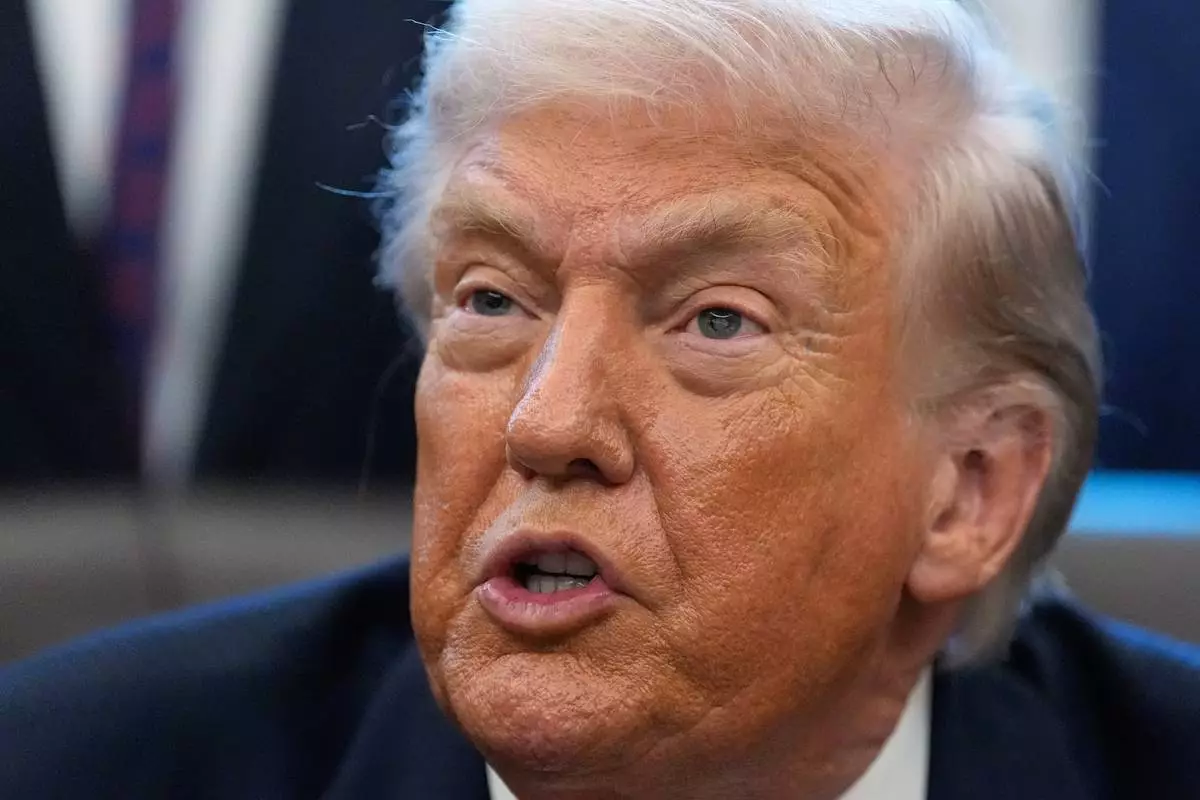
President Donald Trump answers questions after signing a bill that returns whole milk to school cafeterias across the country, in the Oval Office of the White House, Wednesday, Jan. 14, 2026, in Washington. (AP Photo/Alex Brandon)