Skip to Content Facebook Feature Image

Boréas Technologies’ Haptic Module Drives Industry-Breakthrough Touch in New NIO ET9

News

Boréas Technologies’ Haptic Module Drives Industry-Breakthrough Touch in New NIO ET9
News

News

Boréas Technologies’ Haptic Module Drives Industry-Breakthrough Touch in New NIO ET9

2025-04-15 19:51 Last Updated At:20:01

BROMONT, Québec--(BUSINESS WIRE)--Apr 15, 2025--

Boréas Technologies — a pioneer in third-generation, piezo-based haptics for automotive, consumer and mobile applications — today announced that NIO, the global company for smart electric vehicles in the premium segment, has integrated Boréas’ powerful automotive haptic module into TUI Bar, the touch area in NIO ET9. This makes NIO ET9, the company’s Smart Electric Executive Flagship, the world’s first tech-luxury EV to offer highly responsive, tactile feedback in an automotive infotainment system.

This press release features multimedia. View the full release here: https://www.businesswire.com/news/home/20250415826950/en/

“NIO ET9’s TUI Bar touch area is a benchmark achievement in user interface design,” said Felix Wu, Head of Digital Space Experience Team & Expert, Experience Manager in Digital Product Experience Department, NIO. “Enabled by Boréas’ automotive haptic module, it’s an ultra-responsive, richly textured platform that enhances the overall feeling of luxury you experience when you’re driving NIO ET9.

“Instead of using older LRA technology, which produces a mushy tactile sensation at best, NIO’s TUI Bar uses Boréas’ piezo haptic technology to best advantage, rendering crisp and reassuring touch feedback that rapidly confirms driver-selected functionality through an elegant touch interface,” added Mr. Wu.

“NIO is the worldwide leader in developing and adopting the most technologically advanced functionality in tech-luxury EVs,” said Simon Chaput, President & Founder, Boréas Technologies. “By integrating Boréas’ automotive haptic module into TUI Bar in NIO ET9, NIO has taken haptic feedback in cars — and user satisfaction — to a phenomenal new level. In doing so, NIO is also promoting safer driving because drivers who experience realistic tactile confirmation on a touch platform keep their eyes on the road instead of on a screen. NIO has proved that it’s possible to achieve exceptional user experience, outstanding industrial design, and a safe driving experience in the same car. By doing so, they’ve set a new high point in the future of automotive interior design.”

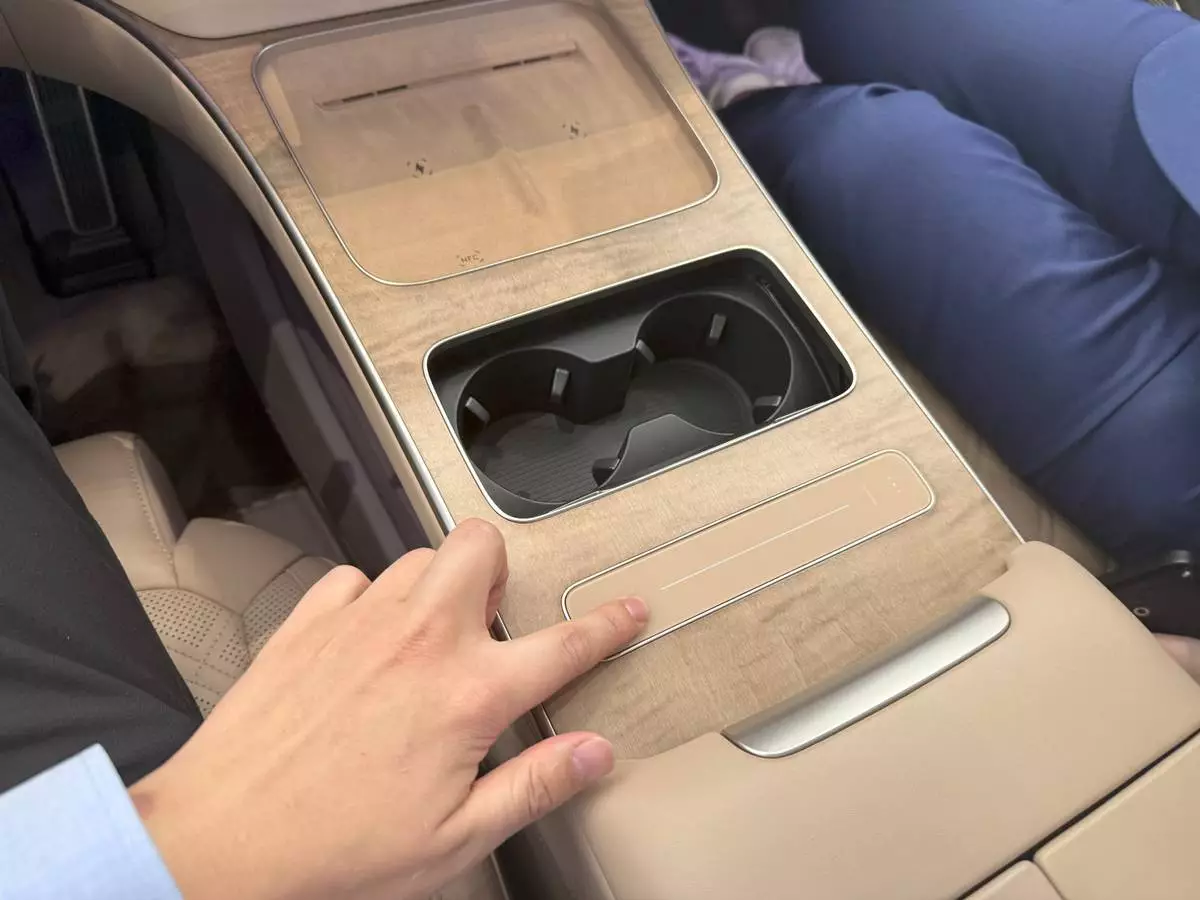
NIO ET9’s TUI Bar supports a compelling set of user experiences: Its three-zone design is multi-faceted, with the left and right zones controlling the driver and passenger Skyline screens respectively, while the middle zone interacts with the ICS central control screen. Drivers and passengers can use the central control screen in a variety of ways, such as adjusting the progress of songs, selecting media, and controlling the volume.

TUI Bar also supports tapping for rewind or fast-forward as well as different functionality for one-, two- and even three-finger usage.

About Boréas’ Automotive Haptic Module

Boréas’ automotive haptic module leverages piezoelectric (piezo) design to offer dramatic improvements in quality and feedback response time over other haptic technologies, such as linear resonant actuators (LRAs). Boréas thereby allows automotive OEMs and integrators to provide the reassuring tactile feedback that satisfies the human need for intuitive touch.

Featuring Boréas CapDrive® Technology, a patented, scalable, ultra-low-power architecture that promotes responsive localized haptic feedback and integrated force sensing in a wide range of applications, Boréas’ automotive haptic module includes the BOS1211, its powerful piezo haptic driver IC that is AEC-Q100 Grade 2 qualified for the automotive market.

About Boréas Technologies

Boréas Technologies Inc. is an award-winning fabless semiconductor company commercializing ultra-low-power piezo IC platforms in automotive, consumer and industrial markets. With origins in research conducted at Harvard University, Boréas is based in Bromont, Québec and is supported by a global distribution network. The company’s CapDrive ICs are ideal for automotive environments, PC trackpads, smartwatches and fitness trackers, smartphones, VR game controllers and peripherals, and Internet of Things (IoT) devices. Connect with Boréas on LinkedIn or email: info@boreas.ca.

About NIO

NIO Inc. is a pioneer and a leading company in the global smart electric vehicle market. Founded in November 2014, NIO aspires to shape a sustainable and brighter future with the mission of “Blue Sky Coming.” NIO envisions itself as a user enterprise where innovative technology meets experience excellence. NIO designs, develops, manufactures and sells smart electric vehicles, driving innovations in next-generation core technologies. NIO distinguishes itself through continuous technological breakthroughs and innovations, exceptional products and services, and a community for shared growth. NIO provides premium smart electric vehicles under the NIO brand, family-oriented smart electric vehicles through the ONVO brand, and small smart high-end electric cars with the FIREFLY brand.

NIO is the first car company listed on the NYSE, HKEX and SGX. The company has R&D and manufacturing facilities in Shanghai, Hefei, Beijing, Nanjing, Shenzhen, Hangzhou, Wuhan, San Jose, Munich, Oxford, Berlin, Budapest, Singapore, and Abu Dhabi. It has also established sales and service networks in China, Norway, Germany, the Netherlands, Sweden, Denmark, and the UAE.

For more information on NIO, visit: https://www.nio.com/

The Boréas logo and CapDrive are registered trademarks of Boréas Technologies Inc. All other product and company names are trademarks or registered trademarks of their respective holders.
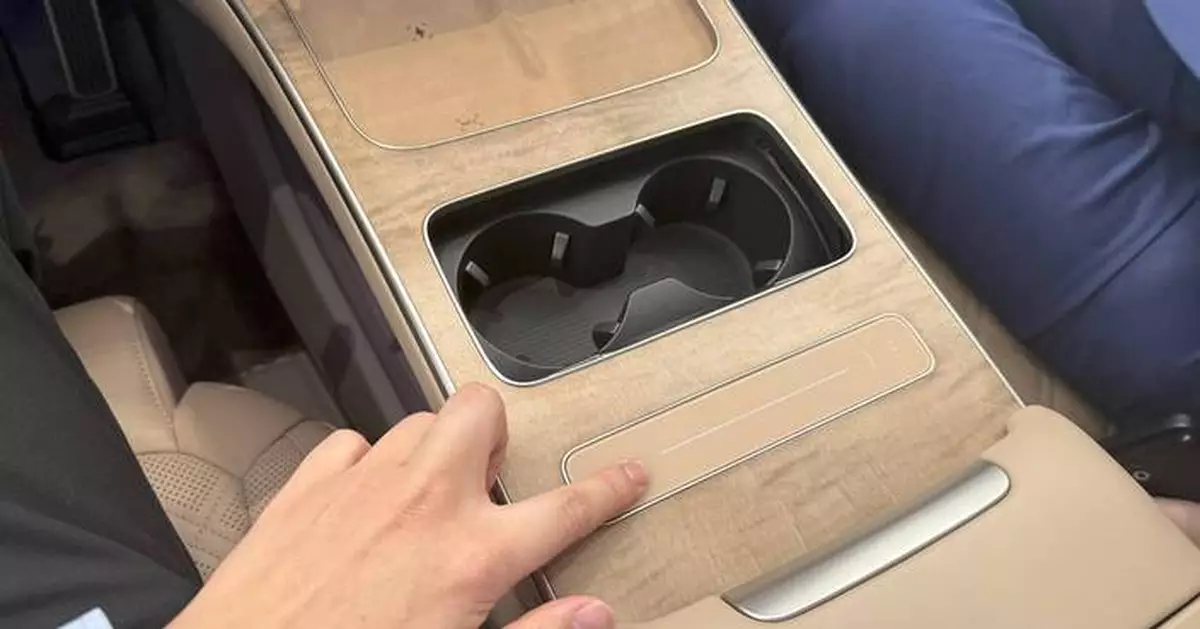
NIO uses Boréas' powerful automotive haptic module to produce highly responsive, tactile feedback in the automotive infotainment system of NIO ET9, its ultra-luxury EV.
NIO uses Boréas' powerful automotive haptic module to produce highly responsive, tactile feedback in the automotive infotainment system of NIO ET9, its ultra-luxury EV.
NEW YORK (AP) — The U.S. stock market is falling from its records Friday and joining a worldwide drop for stocks, as higher oil prices send a shiver through the bond market. Stocks that had been caught up in the euphoria around artificial-intelligence technology led the way lower.

The S&P 500 fell 1.2% from its all-time high set the day before. The Dow Jones Industrial Average was down 426 points, or 0.9%, as of 10 a.m. Eastern time, and the Nasdaq composite was down 1.8% from its own record.

Technology stocks tumbled in a sharp turnaround from their meteoric rises for much of the year, which had carried markets worldwide to records but also raised criticism that they had gone too far.

Nvidia, the stock that quickly became the face of the AI revolution, dropped 4.5% and was the heaviest weight on the S&P 500. It had come into the day with a gain of more than 26% for the year so far.

Applied Materials fell 2.3% even though it reported stronger profit growth for the latest quarter than analysts expected, thanks to the global build out of AI. The company, whose products help make chips and displays, came into the day with a gain of more than 70% for the year so far.

“To us, it looks like markets have pushed into overbought territory,” according to Brian Jacobsen, chief economic strategist at Annex Wealth Management. He said the strong corporate profits and durable U.S. economy that launched U.S. stocks to records remain intact, but “the path is unlikely to be smooth. Periods like this call for discipline more than hope.”

In the meantime, rising oil prices are raising the pressure after already worsening inflation by more than economists had feared. The war with Iran is continuing, and the Strait of Hormuz remains shut to oil tankers, which is preventing them from delivering crude to customers worldwide and driving up oil’s price.

The price for a barrel of Brent crude oil, the international standard, rose 2.7% to $108.57 and is well above its level of roughly $70 from before the war.

Many big U.S. companies have been saying their customers have been able to keep spending on their products and services despite having to pay higher prices for gasoline. But U.S. households have also been telling surveys they’re feeling discouraged about the economy and the pressures building on them because of the war and tariffs.

The worries were most clear Friday in the bond market, where Treasury yields climbed. The yield on the 10-year Treasury rose to 4.57% from 4.47% late Thursday. That’s a notable move for the bond market, and it’s well above its 3.97% level from before the war. The yield on the 30-year Treasury is near its highest level since 2023 after breaking above 5%.

Higher yields can make mortgages and other kinds of loans going to U.S. households and businesses more expensive, which slows the economy. They also tend to push downward on prices for stocks and all kinds of other investments.

Stocks of smaller companies had some of Friday's sharpest drops as yields jumped. Many of them need to borrow cash to grow, which means higher borrowing costs can hurt them more than their big rivals. The Russell 2000 index of the smallest U.S. stocks fell 2.3%.

Yields have been climbing since the war on worries about higher inflation and how it may tie the Federal Reserve’s hands when it comes to short-term interest rates. Not only have traders abandoned virtually all expectations that the Fed will resume its cuts to interest rates this year, they’ve been building some bets that it may even hike rates in 2026, according to data from CME Group.

A couple of reports on the U.S. economy that came in better than expected also helped to lift yields. One said U.S. industrial production improved by more last month than economists expected, while another said manufacturing in New York state is expanding at a faster rate.

In stock markets abroad, indexes fell sharply across Europe and Asia.

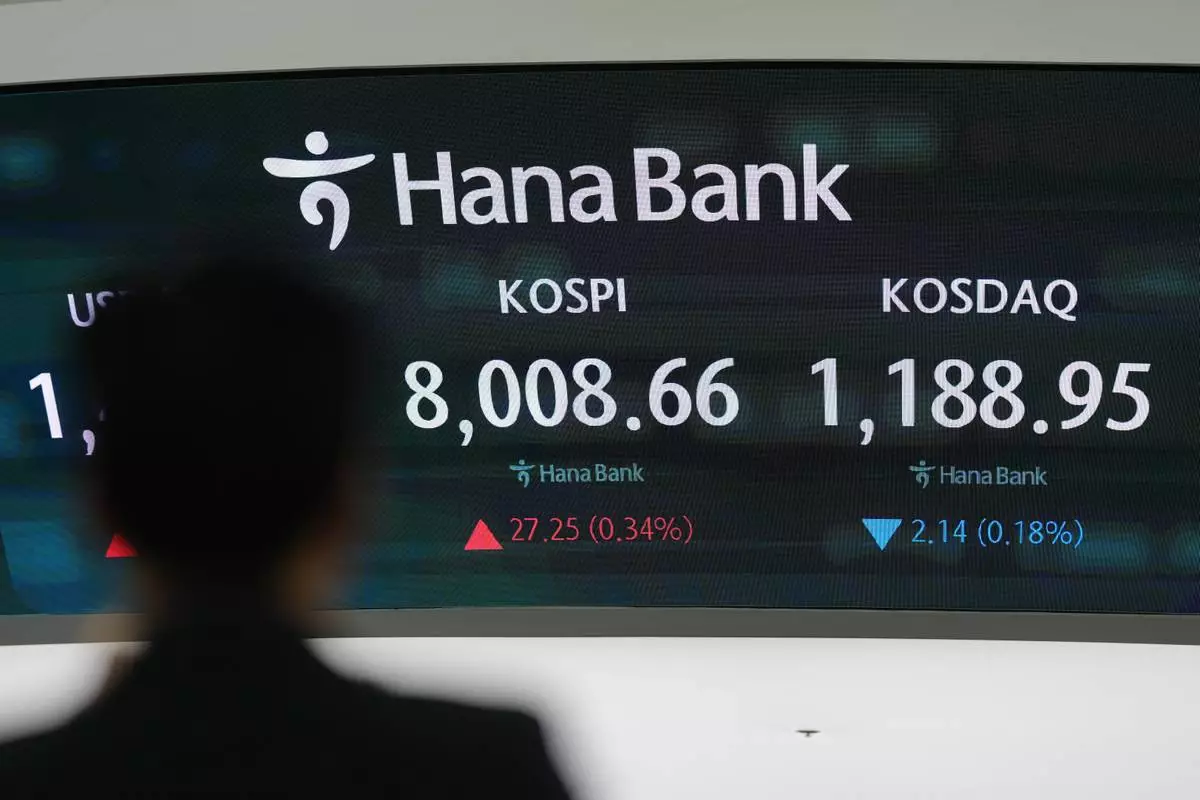
South Korea’s Kospi dropped 6.1% for one of the biggest moves. It had been reaching records this year because of the influence of AI beneficiaries like SK Hynix. But it quickly reversed momentum Friday after briefly topping the 8.000 level for the first time.

Some on Wall Street have been warning about a possible break in momentum for tech stocks in general and AI winners in particular.

“If nothing else this should be a ‘shot across the bow’ for how volatility works both ways,” according to Jonathan Krinsky, chief market technician at BTIG.

AP Business Writer Chan Ho-him contributed.

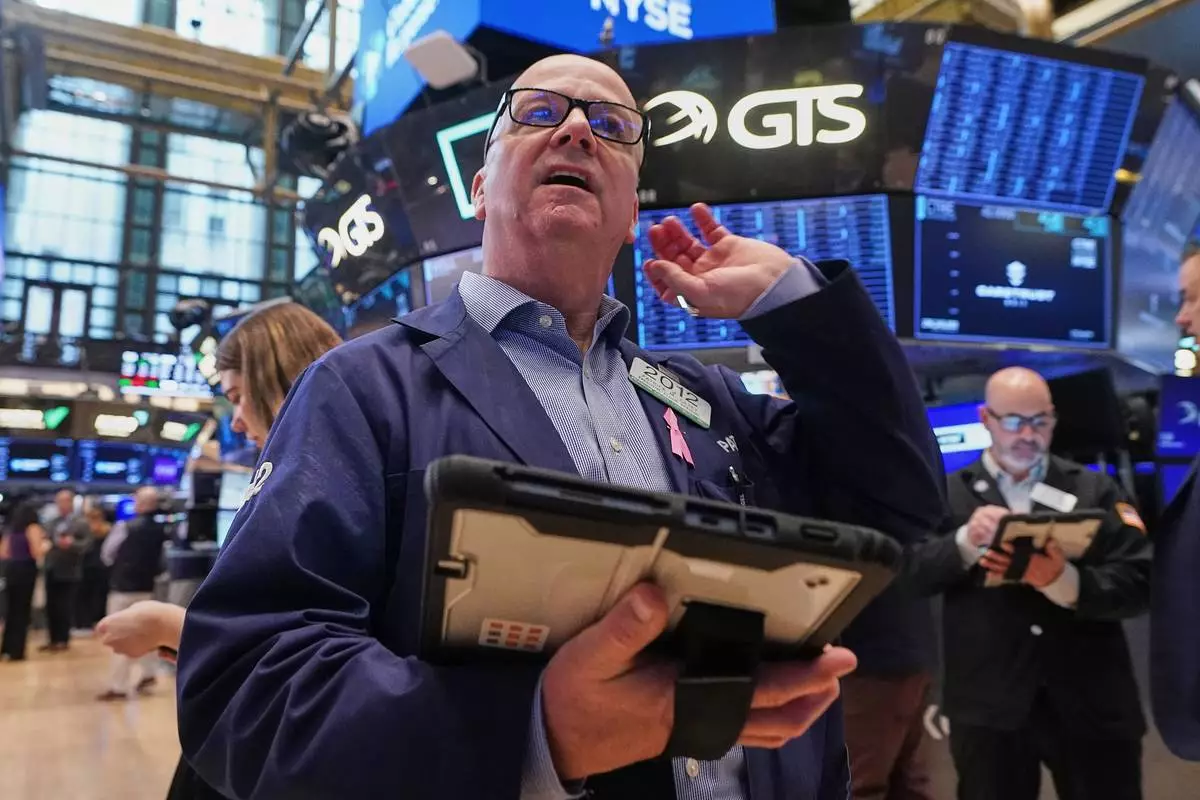
Trader Patrick Casey works on the floor of the New York Stock Exchange, Wednesday, May 13, 2026. (AP Photo/Richard Drew)

Trader Patrick Casey works on the floor of the New York Stock Exchange, Wednesday, May 13, 2026. (AP Photo/Richard Drew)

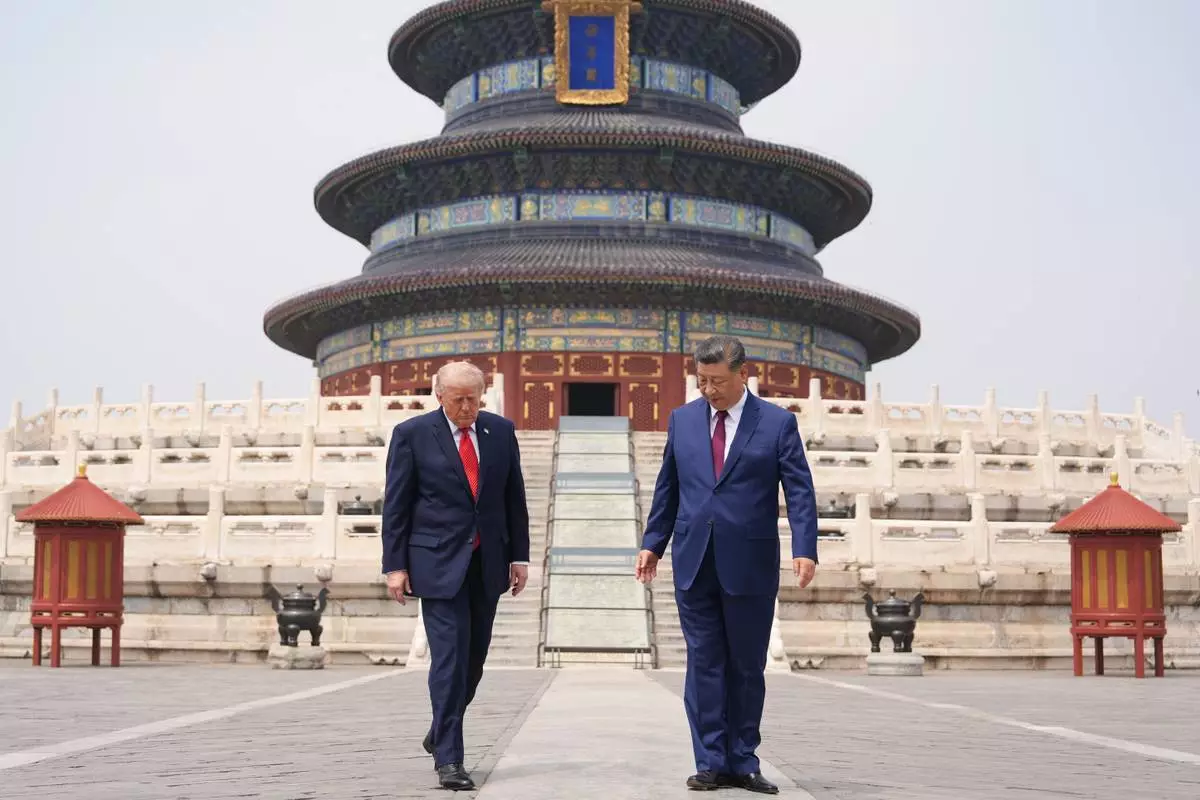
President Donald Trump, left, walks with Chinese President Xi Jinping at the Temple of Heaven on Thursday May 14, 2026, in Beijing. (AP Photo/Mark Schiefelbein)

President Donald Trump, left, walks with Chinese President Xi Jinping at the Temple of Heaven on Thursday May 14, 2026, in Beijing. (AP Photo/Mark Schiefelbein)

A dealer stands near the screens showing the Korea Composite Stock Price Index (KOSPI), and the Korean Securities Dealers Automated Quotations (KOSDAQ) at a dealing room of Hana Bank in Seoul, South Korea, Friday, May 15, 2026. (AP Photo/Lee Jin-man)

A dealer stands near the screens showing the Korea Composite Stock Price Index (KOSPI), and the Korean Securities Dealers Automated Quotations (KOSDAQ) at a dealing room of Hana Bank in Seoul, South Korea, Friday, May 15, 2026. (AP Photo/Lee Jin-man)

Employees of Hana Bank celebrate in a photo-op to mark the Korea Composite Stock Price Index (KOSPI) of over 8,000 points at a dealing room of Hana Bank in Seoul, South Korea, Friday, May 15, 2026. (AP Photo/Lee Jin-man)

Employees of Hana Bank celebrate in a photo-op to mark the Korea Composite Stock Price Index (KOSPI) of over 8,000 points at a dealing room of Hana Bank in Seoul, South Korea, Friday, May 15, 2026. (AP Photo/Lee Jin-man)

Recommended Articles