An exhibit at a Beijing museum is set to reveal how the practice of creating gold masks reflects a shared perspective on life and death among ancient Greek and Chinese civilizations.
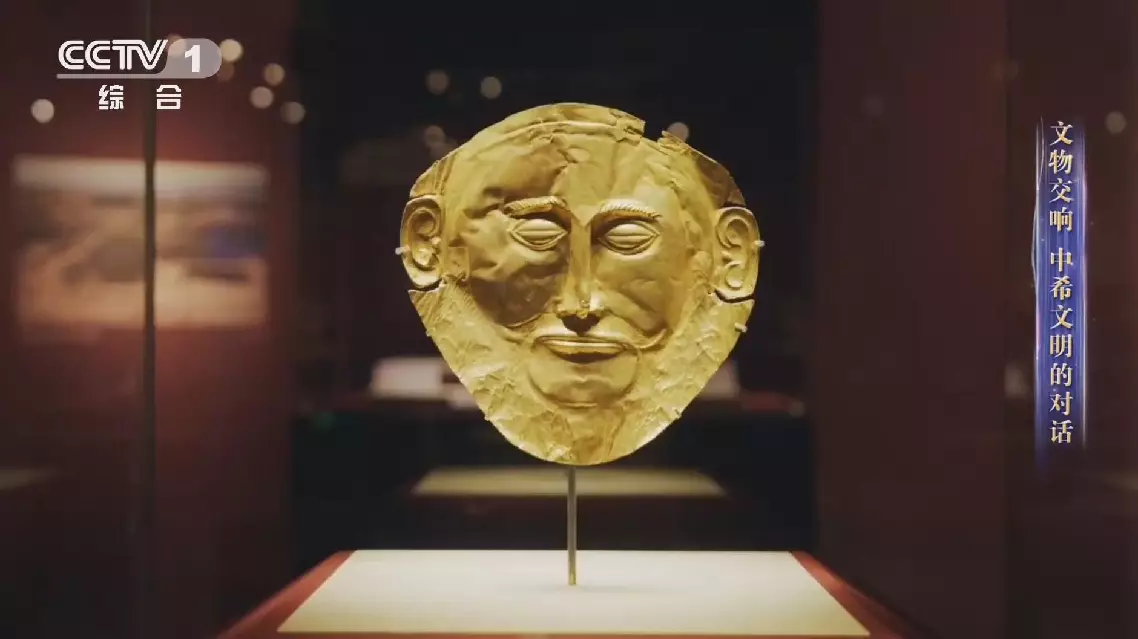
A replica of the "Agamemnon gold mask" is on display at the exhibition "The Greeks: Agamemnon to Alexander the Great" in China's Capital Museum.
Featuring a total of 270 pieces or sets of exhibits from 14 museums across Greece, the exhibition will open to the public on Nov. 21, 2024 and last until May 18, 2025.
"The original piece is not permitted to be displayed overseas, so we can only appreciate a replica in this exhibition - but this replica was crafted over a century ago," said Shao Xinxin, an associate research fellow of Capital Museum.
Shao explained that despite the mask being named after Agamemnon - the legendary king of Mycenae who led the Achaeans in the Trojan War - it did not actually belong to him.
"When German archaeologist Heinrich Schliemann discovered the mask, he believed it best captured the facial features and eyebrows of a heroic figure, and thus concluded it must have belonged to Agamemnon, the most powerful king in Mycenaean legend. However, modern archaeologists have since determined that the tomb [where the mask was found] dates back to an earlier period - several centuries before Agamemnon's supposed era. Therefore, the mask does not belong to Agamemnon himself, though the name 'Agamemnon gold mask' has remained in use," Shao said.
China also has a rich tradition of golden masks, such as one belonging to a princess of the Chen State from the Liao Dynasty (916-1125). Shao noted that the practice of crafting gold masks reflects a shared aspiration among ancient Greek and Chinese civilizations to preserve one's appearance for eternity.
"There are many similarities between the two golden masks in terms of materials and production technology, which suggests that both Eastern and Western civilizations hoped to preserve their appearance eternally through the form of a gold mask. This reflects the concept that ancient Greek civilization, like ancient Chinese society, shared a similar view of life and death," Shao said.
Chinese, Greek ancients' passion for gold masks reflects similar cultural views, exhibit shows