Skip to Content Facebook Feature Image

Bangladesh and Pakistan resume talks after 15 years, seek to mend strained ties

News

Bangladesh and Pakistan resume talks after 15 years, seek to mend strained ties
News

News

Bangladesh and Pakistan resume talks after 15 years, seek to mend strained ties

2025-04-18 00:41 Last Updated At:08:31

DHAKA, Bangladesh (AP) — Foreign ministry officials from Bangladesh's interim government and Pakistan resumed talks on Thursday after a 15-year gap, as the two South Asian Muslim-majority nations attempted to ease strained relations.

Under former Prime Minister Sheikh Hasina, who was ousted in August in a students-led mass uprising, Bangladesh expanded relations with neighboring India in every sector.

More Images
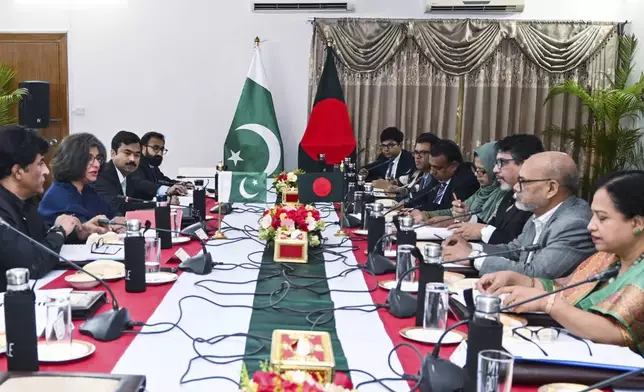
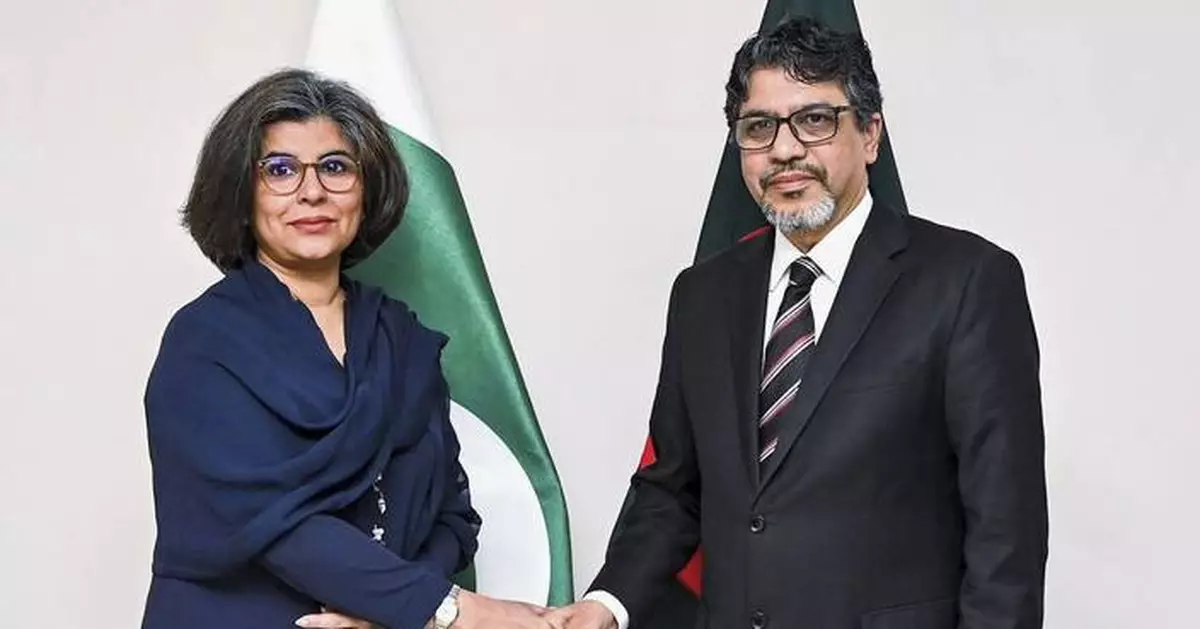
Bangladesh Foreign Secretary Md. Jashim Uddin, center right, and Pakistan Foreign Secretary Amna Baloch, center left, have a bilateral meeting in Dhaka, Thursday, April 17, 2025. (Bangladesh Ministry of Foreign Affairs via AP)
Bangladesh Foreign Secretary Md. Jashim Uddin, center right, and Pakistan Foreign Secretary Amna Baloch, center left, have a bilateral meeting in Dhaka, Thursday, April 17, 2025. (Bangladesh Ministry of Foreign Affairs via AP)

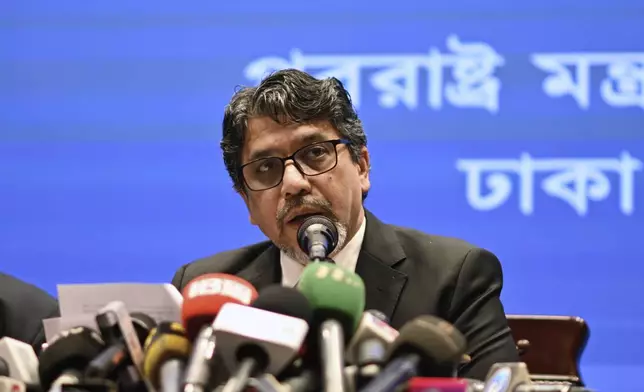
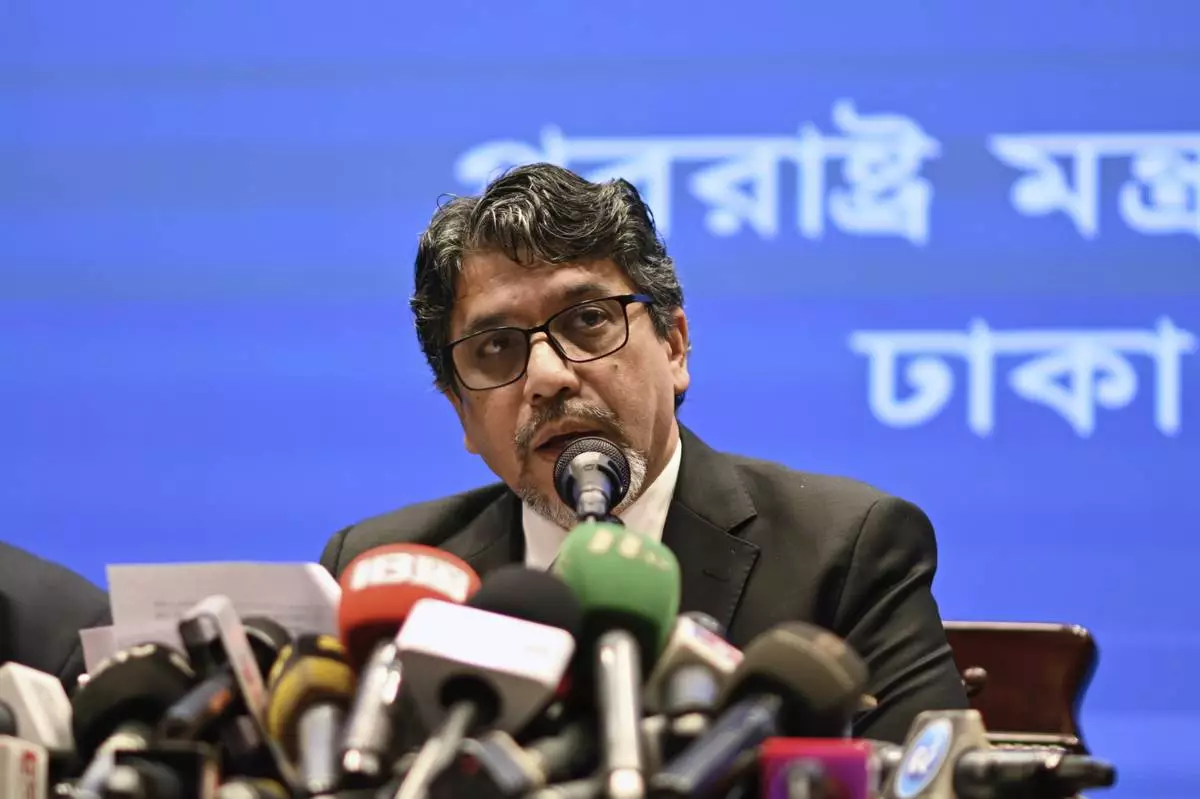
Bangladesh Foreign Secretary Md. Jashim Uddin speaks at a press conference following his bilateral meeting with Pakistan Foreign Secretary Amna Baloch in Dhaka, Bangladesh, Thursday, April 17, 2025. (AP Photo/Mahmud Hossain Opu)
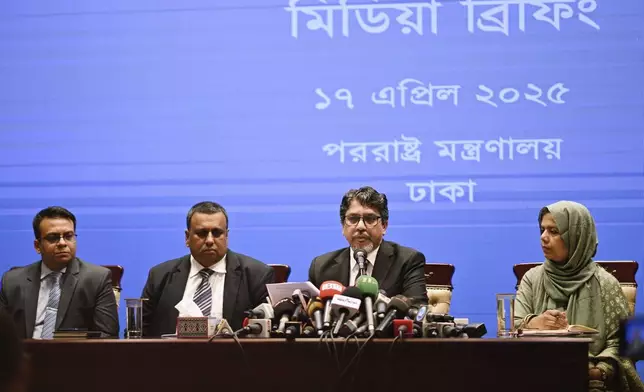
Bangladesh Foreign Secretary Md. Jashim Uddin speaks at a press conference following his bilateral meeting with Pakistan Foreign Secretary Amna Baloch in Dhaka, Bangladesh, Thursday, April 17, 2025. (AP Photo/Mahmud Hossain Opu)
Bangladesh Foreign Secretary Md. Jashim Uddin, second right, speaks at a press conference following his bilateral meeting with Pakistan Foreign Secretary Amna Baloch in Dhaka, Bangladesh, Thursday, April 17, 2025. (AP Photo/Mahmud Hossain Opu)

Bangladesh Foreign Secretary Md. Jashim Uddin, second right, speaks at a press conference following his bilateral meeting with Pakistan Foreign Secretary Amna Baloch in Dhaka, Bangladesh, Thursday, April 17, 2025. (AP Photo/Mahmud Hossain Opu)

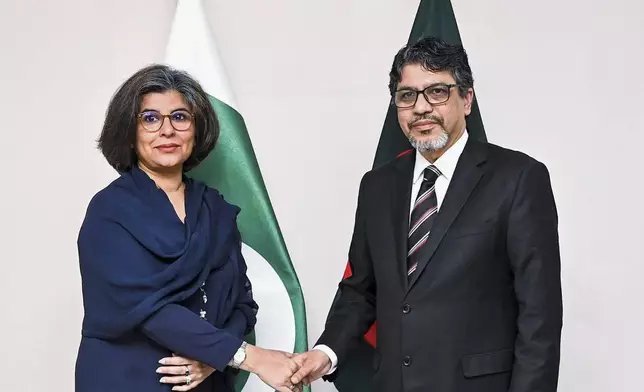
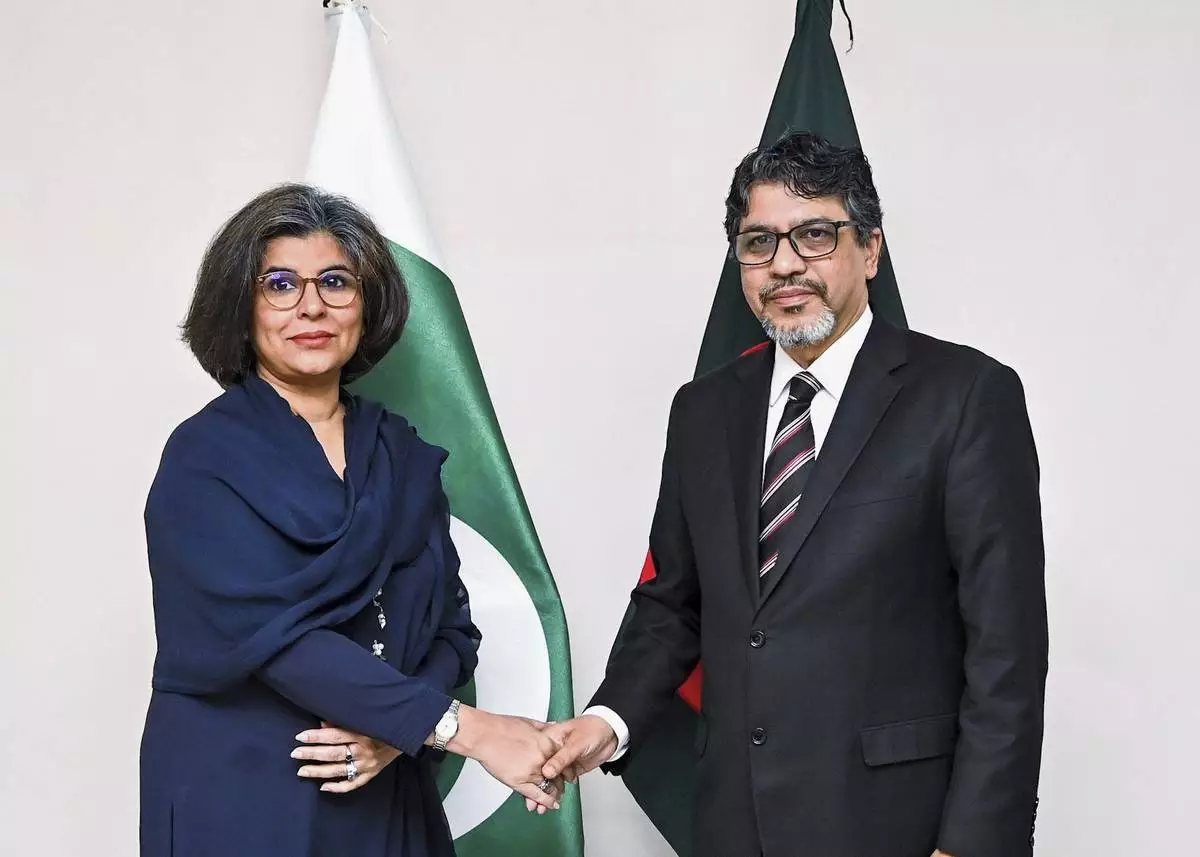
Bangladesh Foreign Secretary Md. Jashim Uddin, right, shakes hands with Pakistan Foreign Secretary Amna Baloch as they pose for a photograph during their bilateral meeting in Dhaka, Thursday, April 17, 2025. (Bangladesh Ministry of Foreign Affairs via AP)

Bangladesh Foreign Secretary Md. Jashim Uddin, right, shakes hands with Pakistan Foreign Secretary Amna Baloch as they pose for a photograph during their bilateral meeting in Dhaka, Thursday, April 17, 2025. (Bangladesh Ministry of Foreign Affairs via AP)

But ties with India have become increasingly tense. Bangladesh’s interim leader, Nobel Peace Prize laureate Muhammad Yunus, has criticized India for sheltering Hasina in the country and sought her extradition without any positive response from India.

Yunus has meanwhile sought to improve relations with Pakistan, India's rival. In recent months he met Pakistan’s Prime Minister Shehbaz Sharif several times, and a high-level Bangladeshi military delegation made a rare visit to Pakistan in January and held talks with Pakistan’s army chief General Asim Munir. In February, Bangladesh's navy took part in a multinational maritime exercise organized by Pakistan off the Karachi coast.

After Hasina’s exit, Bangladesh and Pakistan resumed direct trading for the first time in years. Direct flights between the countries are expected to resume soon and visa procedures have been eased while India stopped visas for Bangladeshis, except for medical emergencies.

Earlier this month, India cancelled a transshipment facility that allowed Bangladesh to export its primarily garment products to third countries using Indian airports and other Indian infrastructure.

The move is expected to impact Bangladesh’s roughly $39 billion annual readymade garment exports by increasing trade costs with the European Union, Nepal, Bhutan, and Myanmar. Bangladesh is the world's second largest garment producer after China.

After Thursday's talks in Dhaka between Bangladesh’s Foreign Secretary Jashim Uddin and his Pakistani counterpart, Uddin said Bangladesh raised historically “unsettled issues” with Pakistan, including a formal public apology for atrocities allegedly committed by Pakistani troops in 1971 during Bangladesh's war of independence.

India helped Bangladesh win independence through a nine-month war against then West Pakistan, now Pakistan. Hasina’s Awami League party regularly criticizes Pakistan for alleged atrocities during the war, when Bangladesh says about 3 million people were killed and about 200,000 women were raped by Pakistani soldiers. Pakistan rejects the claims and has never officially apologized.

Local media reported earlier that Yunus' government was preparing to formally raise its demand for $4.52 billion in financial compensation from Pakistan.

Uddin said the issue of the compensation was raised in Thursday’s meeting.

“These issues need to be resolved for having a solid foundation of our relations,” Uddin said Thursday. The two sides also discussed expansion of trade and commerce and increasing cooperation in agriculture and other sectors, he added.

Yunus’ office said in a statement late Thursday that he held a separate meeting with the Pakistani foreign secretary and emphasized “strengthening ties with Pakistan to boost mutual cooperation and explore trade and business potentials.”

“There are certain hurdles. We have to find ways to overcome those and move forward,” Yunus told Pakistan’s Foreign Secretary Amna Baloch.

The last such consultation between the two countries was held in Islamabad in 2010 after Hasina came to power in a 2008 election with a landslide victory.

Baloch said Bangladesh and Pakistan must find ways to “harness the potentials between the two countries," the statement said.
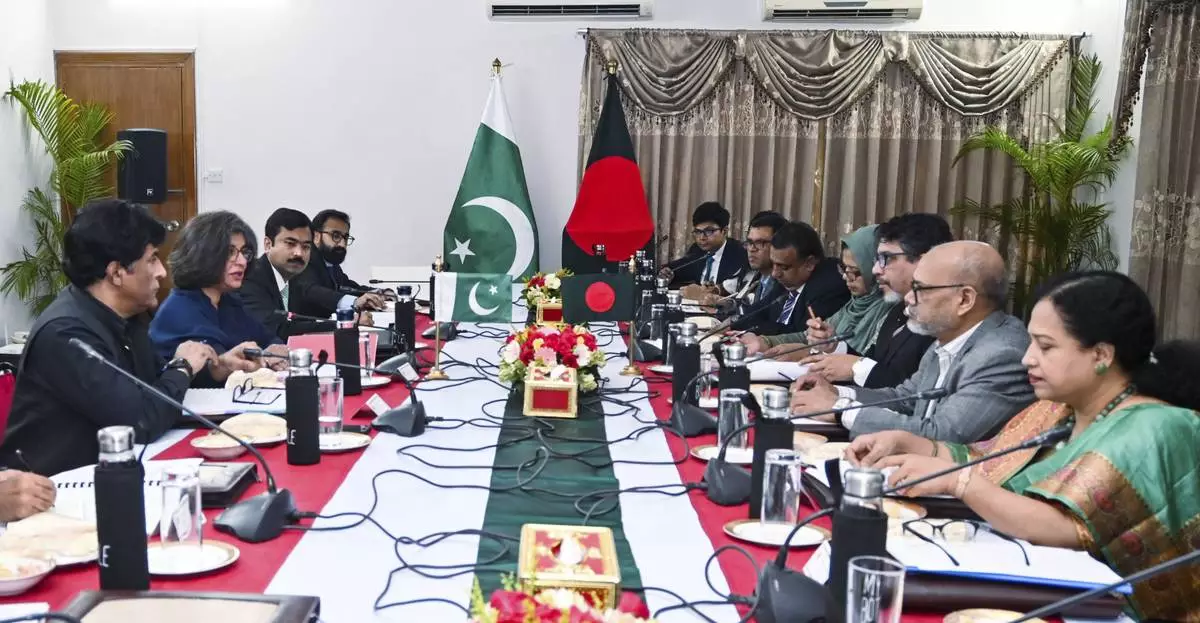
Bangladesh Foreign Secretary Md. Jashim Uddin, center right, and Pakistan Foreign Secretary Amna Baloch, center left, have a bilateral meeting in Dhaka, Thursday, April 17, 2025. (Bangladesh Ministry of Foreign Affairs via AP)
Bangladesh Foreign Secretary Md. Jashim Uddin, center right, and Pakistan Foreign Secretary Amna Baloch, center left, have a bilateral meeting in Dhaka, Thursday, April 17, 2025. (Bangladesh Ministry of Foreign Affairs via AP)

Bangladesh Foreign Secretary Md. Jashim Uddin speaks at a press conference following his bilateral meeting with Pakistan Foreign Secretary Amna Baloch in Dhaka, Bangladesh, Thursday, April 17, 2025. (AP Photo/Mahmud Hossain Opu)
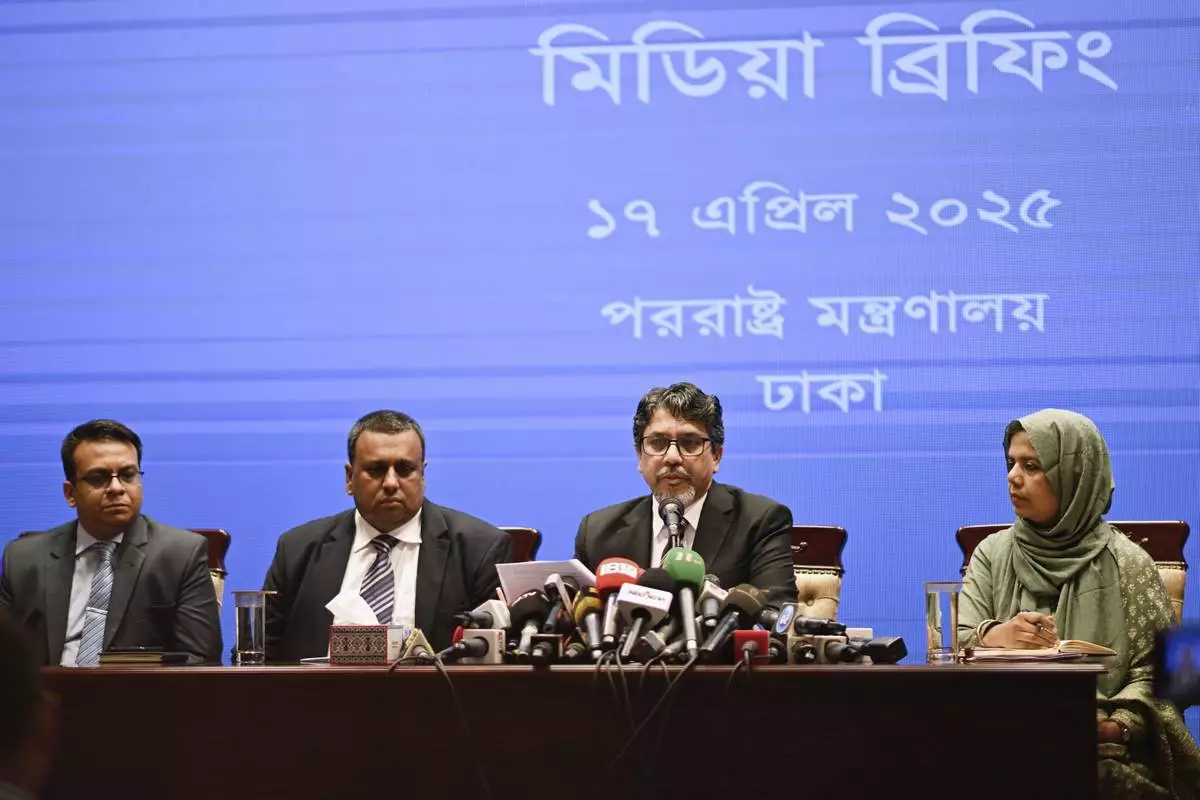
Bangladesh Foreign Secretary Md. Jashim Uddin speaks at a press conference following his bilateral meeting with Pakistan Foreign Secretary Amna Baloch in Dhaka, Bangladesh, Thursday, April 17, 2025. (AP Photo/Mahmud Hossain Opu)
Bangladesh Foreign Secretary Md. Jashim Uddin, second right, speaks at a press conference following his bilateral meeting with Pakistan Foreign Secretary Amna Baloch in Dhaka, Bangladesh, Thursday, April 17, 2025. (AP Photo/Mahmud Hossain Opu)

Bangladesh Foreign Secretary Md. Jashim Uddin, second right, speaks at a press conference following his bilateral meeting with Pakistan Foreign Secretary Amna Baloch in Dhaka, Bangladesh, Thursday, April 17, 2025. (AP Photo/Mahmud Hossain Opu)

Bangladesh Foreign Secretary Md. Jashim Uddin, right, shakes hands with Pakistan Foreign Secretary Amna Baloch as they pose for a photograph during their bilateral meeting in Dhaka, Thursday, April 17, 2025. (Bangladesh Ministry of Foreign Affairs via AP)

Bangladesh Foreign Secretary Md. Jashim Uddin, right, shakes hands with Pakistan Foreign Secretary Amna Baloch as they pose for a photograph during their bilateral meeting in Dhaka, Thursday, April 17, 2025. (Bangladesh Ministry of Foreign Affairs via AP)
BEIJING (AP) — Breaking with the United States, Canada has agreed to cut its 100% tariff on Chinese electric cars in return for lower tariffs on Canadian farm products, Prime Minister Mark Carney said Friday.

Carney made the announcement after two days of meetings with Chinese leaders. He said there would be an initial cap of 49,000 vehicles on Chinese EV exports to Canada, growing to 70,000 over five years. China will reduce its tariff on canola seeds, a major Canadian export, from about 84% to about 15%, he told reporters.

“It has been a historic and productive two days,” Carney said, speaking outside against the backdrop of a traditional pavilion and a frozen pond at a Beijing park. “We have to understand the differences between Canada and other countries, and focus our efforts to work together where we’re aligned.”

Earlier Friday, he and Chinese leader Xi Jinping pledged to improve relations between their two nations after years of acrimony.

Xi told Carney in a meeting at the Great Hall of the People that he is willing to continue working to improve ties, noting that talks have been underway on restoring and restarting cooperation since the two held an initial meeting in October on the sidelines of a regional economic conference in South Korea.

“It can be said that our meeting last year opened a new chapter in turning China–Canada relations toward improvement,” China's top leader said.

Carney, the first Canadian prime minister to visit China in eight years, said better relations would help improve a global governance system that he described as “under great strain.”

He called for a new relationship “adapted to new global realities” and cooperation in agriculture, energy and finance.

Those new realities reflect in large part the so-called America-first approach of U.S. President Donald Trump. The tariffs he has imposed have hit both the Canadian and Chinese economies. Carney, who has met with several leading Chinese companies in Beijing, said ahead of his trip that his government is focused on building an economy less reliant on the U.S. at what he called “a time of global trade disruption.”

A Canadian business owner in China called Carney's visit game-changing, saying it re-establishes dialogue, respect and a framework between the two nations.

“These three things we didn’t have,” said Jacob Cooke, the CEO of WPIC Marketing + Technologies, which helps exporters navigate the Chinese market. “The parties were not talking for years.”

Canada had followed the U.S. in putting tariffs of 100% on EVs from China and 25% on steel and aluminum under former Prime Minister Justin Trudeau, Carney’s predecessor.

China responded by imposing duties of 100% on Canadian canola oil and meal and 25% on pork and seafood. It added a 75.8% tariff on canola seeds last August. Collectively, the import taxes effectively closed the Chinese market to Canadian canola, an industry group has said. Overall, China's imports from Canada fell 10.4% last year to $41.7 billion, according to Chinese trade data.

China is hoping Trump’s pressure tactics on allies such as Canada will drive them to pursue a foreign policy that is less aligned with the United States. The U.S. president has suggested Canada could become America's 51st state.

Carney departs China on Saturday and visits Qatar on Sunday before attending the annual gathering of the World Economic Forum in Switzerland next week. He will meet business leaders and investors in Qatar to promote trade and investment, his office said.

Associated Press business writer Chan Ho-him in Hong Kong contributed to this report.

Canada's Prime Minister Mark Carney, center, arrives to meet with Chinese President Xi Jinping, at the Great Hall of the People in Beijing, China, Friday, Jan. 16, 2026. (AP Photo/Vincent Thian, Pool)

Canada's Prime Minister Mark Carney, center, arrives to meet with Chinese President Xi Jinping, at the Great Hall of the People in Beijing, China, Friday, Jan. 16, 2026. (AP Photo/Vincent Thian, Pool)

Canada's Prime Minister Mark Carney, left, meets with Chinese President Xi Jinping at the Great Hall of the People in Beijing Friday, Jan. 16, 2026. (Sean Kilpatrick/The Canadian Press via AP)

Canada's Prime Minister Mark Carney, left, meets with Chinese President Xi Jinping at the Great Hall of the People in Beijing Friday, Jan. 16, 2026. (Sean Kilpatrick/The Canadian Press via AP)

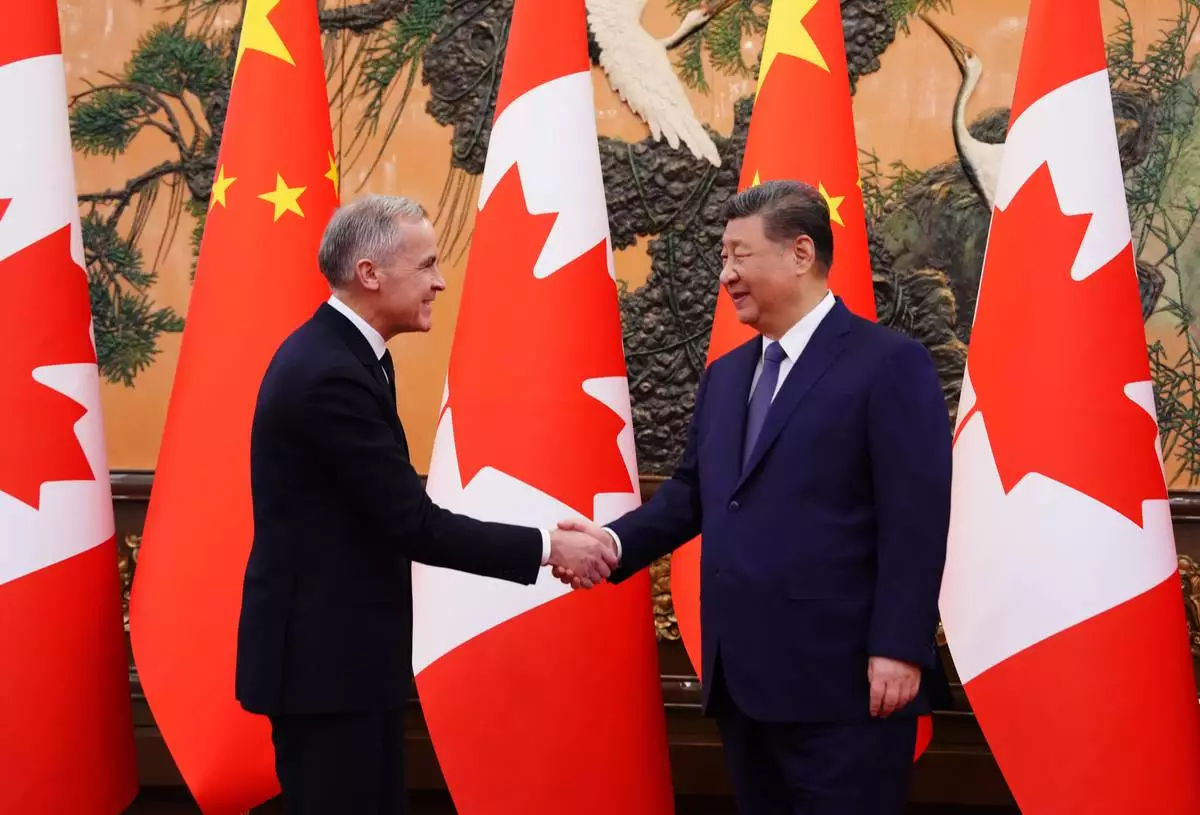
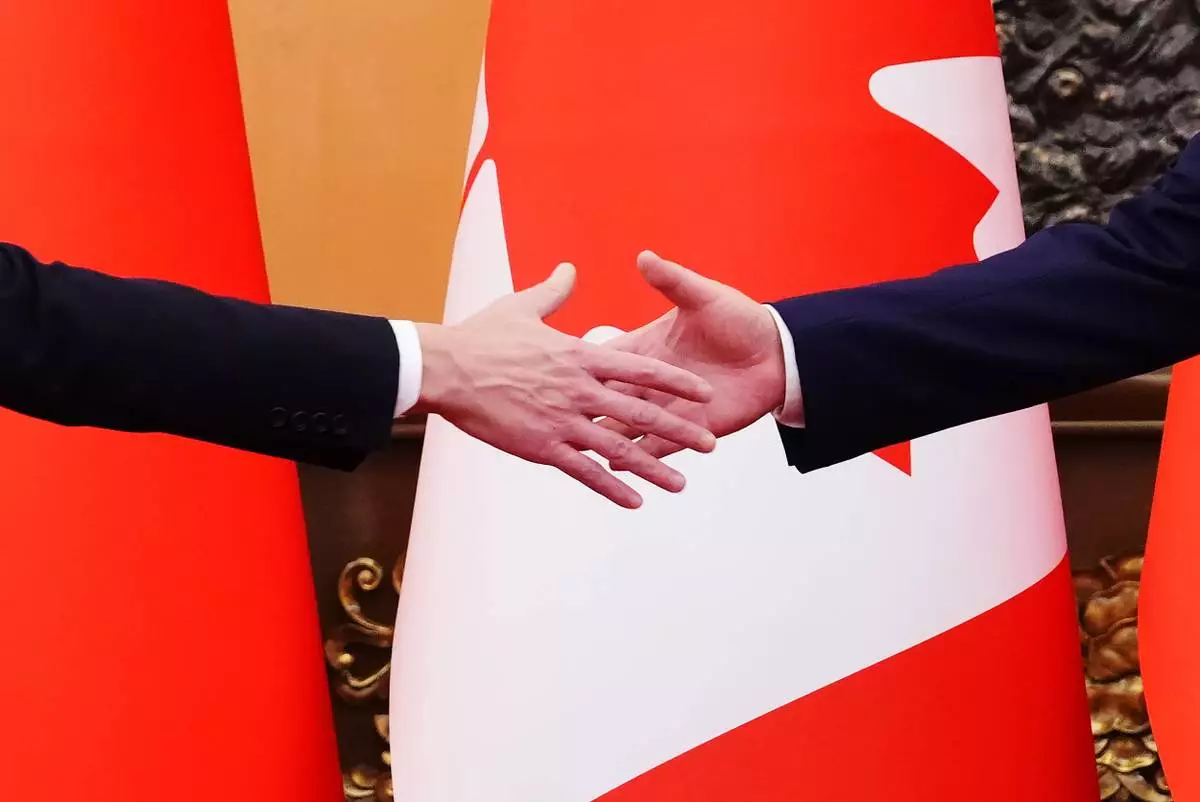
Canada's Prime Minister Mark Carney, left, shakes hands with China's President Xi Jinping at the Great Hall of the People in Beijing Friday, Jan. 16, 2026. (Sean Kilpatrick/The Canadian Press via AP)

Canada's Prime Minister Mark Carney, left, shakes hands with China's President Xi Jinping at the Great Hall of the People in Beijing Friday, Jan. 16, 2026. (Sean Kilpatrick/The Canadian Press via AP)

Recommended Articles