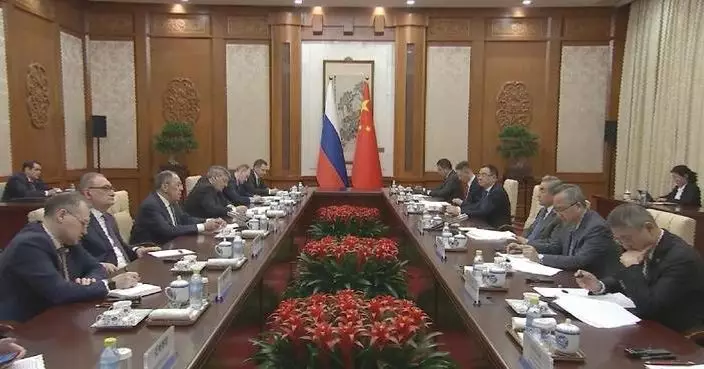
Foreign direct investment (FDI) in the Chinese mainland in actual use climbed by 13.2 percent year on year in March, the Ministry of Commerce said Friday.
In the first three months, FDI in the Chinese mainland in actual use totaled over 269.2 billion yuan (about 37.35 billion U.S. dollars), down 10.8 percent year on year.
According to the ministry, 12,603 new foreign-invested enterprises were established nationwide, representing a year-on-year growth of 4.3 percent.
In terms of sectors, during the January-March period, actual use of FDI in the manufacturing and services industries stood at 71.51 billion yuan and 193.33 billion yuan, respectively.
Meanwhile, actual use of FDI in high-tech sectors in the period came in at 78.61 billion yuan, with FDI in the e-commerce services, biopharmaceutical manufacturing, aerospace vehicle and equipment manufacturing as well as medical equipment industries growing by 100.5 percent, 63.8 percent, 42.5 percent and 12.4 percent, respectively, compared with one year ago.
As for sources of investment, the Association of Southeast Asian Nations (ASEAN)'s actual investment in China increased by 56.2 percent, while the inflow from European Union (EU) countries grew by 11.7 percent.
Also on a yearly basis, investment from Switzerland, the United Kingdom, Japan and the Republic of Korea climbed by 76.8 percent, 60.5 percent, 29.1 percent and 12.9 percent, respectively, said the ministry.
China's FDI inflow rises 13.2 pct in March
The International Monetary Fund (IMF) has lowered its global economic growth forecasts for 2026 to 3.1 percent in the World Economic Outlook (WEO) report published on Tuesday, while keeping its projection for 2027 at 3.2 percent.
This marks a deceleration from the estimated 3.4 percent growth achieved in 2025. Before the outbreak of the Middle East conflict, the bottom-up forecasts for global growth would have been 3.4 percent in 2026 and 3.2 percent in 2027.
The forecast incorporates the impact of the war and assumes that it will be limited in duration, intensity and scope, with disruptions fading by mid-2026.
Under the reference forecast, global headline inflation is expected to increase to 4.4 percent in 2026 and decline to 3.7 percent in 2027.
If the conflict and the ensuing spike in oil prices last longer, global economic growth in 2026 will fall to 2.5 percent, while global inflation will climb to 5.4 percent, according to the report.
In extreme cases, global economic growth in 2026 could drop to two percent, the report warned.
To be specific, the U.S. economy is projected to grow by 2.3 percent in 2026 and 2.1 percent in 2027, although higher trade barriers introduced since April 2025 are expected to continue to weigh on activity.
In the euro area, growth is projected to decline from 1.4 percent in 2025 to 1.1 percent in 2026 before edging up to 1.2 percent in 2027. The forecasts for 2026 and 2027 are each 0.2 percentage point lower than those compared in the January 2026 WEO Update.
The 2026 growth forecast for emerging market and developing economies is revised down by 0.3 percentage point, to 3.9 percent, while the outlook for advanced economies remains broadly unchanged. With risks still tilted to the downside since the January 2026 WEO Update, the IMF suggested a comprehensive policy package combining domestic measures with coordinated international actions to strengthen resilience and foster adaptability.
It also stated in the report that "trade restrictions play a limited role in correcting imbalances but can worsen output," and urged countries to cooperate and take coordinated actions to restore stability to international economic relations.
IMF lowers global growth forecast for 2026 to 3.1 pct