The world's first humanoid robot half-marathon took place on Saturday in the Beijing Economic-Technological Development Area, allowing the diverse field of Chinese robotic engineering to show their true colors.
Among 20 competing teams, Tiangong Ultra from the Tiangong Team claimed victory in the humanoid half marathon, crossing the finish line first with a time of two hours, 40 minutes, and 42 seconds.
Standing approximately 1.8 meters tall and weighing 55 kilograms, Tiangong Ultra has seen its speed increase from 6 km/h to a peak of 12 km/h this year, while its intelligence was also enhanced using the Huisi Kaiwu platform, a universal embodied intelligence system. During the race, Tiangong Ultra maintained a steady pace of 7-8 km/h.
Just last April, Tiangong debuted as the world's first full-size, purely electric-driven humanoid robot, capable of running only a few hundred meters, according to the National and Local Co-built Embodied AI Robotics Innovation Center, formerly known as the Beijing Innovation Center of Humanoid Robotics, who develops the robot.
The Tiangong Ultra completing the half-marathon represents a monumental leap forward, showing the research team's continuous push for technological advancement.
"When we first heard about a robot running this distance, it seemed impossible. We had never seen anything like it," said Zheng Haohan, a testing engineer at the center.
"The entire iteration and optimization process of the robot body has achieved reliability and stability, which is a great benefit for us and the industry," said Xiao Jian, a robot engineer.
"Tiangong is like our child. It couldn't do anything at first. We had to teach it everything, from standing up to walking and then running. Now, it's more like a partner, using its skills to help us," said Zhao Wen, an algorithms engineer.
"The marathon spirit is about overcoming all kinds of challenges. Our engineers, like so many others in China, are constantly tackling complex problems in technological research and development," said Wei Jiaxing, head of public relations at the center.
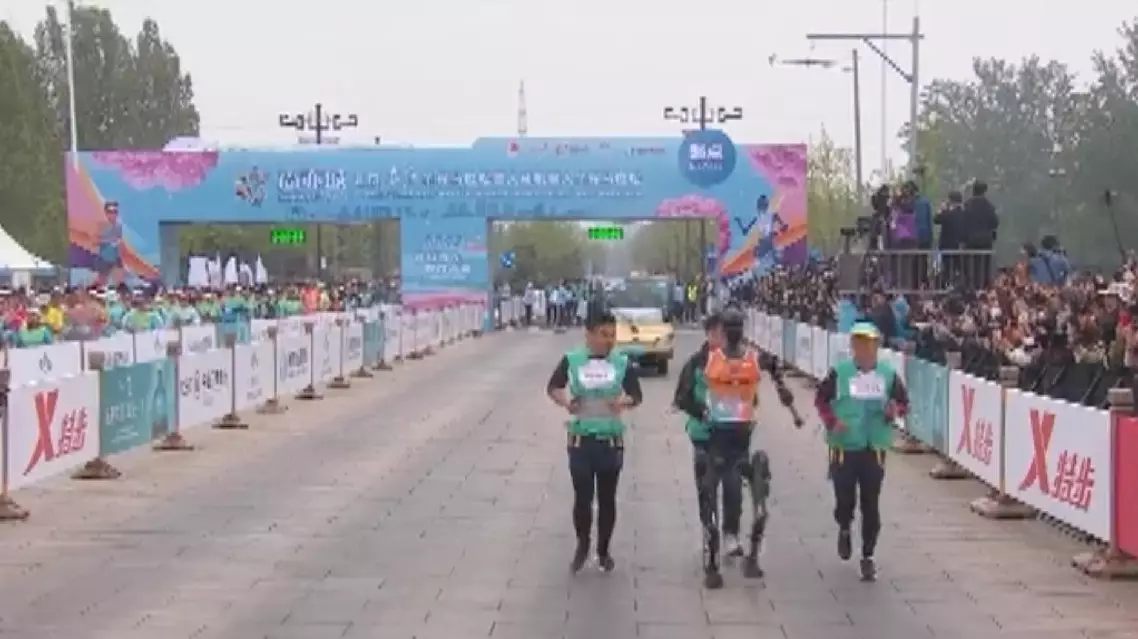
Humanoid robot half-marathon demonstrates Chinese engineers' perseverance, innovative spirit
Commemorations honoring Chinese People's Volunteers (CPV) martyrs were held on the banks of the Yalu River in Dandong, Liaoning Province on Tuesday as part of ongoing tributes to those who fought in the War to Resist U.S. Aggression and Aid Korea (1950-1953).
The event was held to mark the return of the remains of 12 CPV martyrs, who were killed in the war, from the Republic of Korea (ROK) on Wednesday.
This will be the 13th such repatriation of CPV remains following the handover agreement between the two countries. Since 2014, the remains of 1,011 soldiers have been returned to China from the ROK, according to China's Ministry of Veterans Affairs.
More than 170 representatives, including veteran CPV soldiers, relatives of the martyrs, active-duty personnel, students, and other from various sectors of society, attended the event.
People boarded a ferry which slowly sailed down the Yalu River. Inside the cabin, all present stood in solemn silence as the national anthem of the People's Republic of China was played, and observed a moment of silence in honor of the CPV martyrs.
Then, they walked to the ship's railings one by one and scattered flower petals into the river to pay tribute to the martyrs.
"We, the CPV, went abroad to fight to defend our motherland, the people, and our good life and to resist U.S. imperialist aggression against the Democratic People's Republic of Korea (DPRK). I hope that our young comrades and students today will study hard and make contributions to our motherland," said Hu Changzhe, a CPV veteran.
"I feel deeply moved as these veteran soldiers are heroes who once fought for our country. Now, standing by the Yalu River, looking back on their past and remembering their comrades, they must be deeply touched," said Hong Jialu, a student at a branch of Liaoning Province Shiyan High School.
At the event, 10 student representatives from primary and middle schools read aloud a letter to express their reverence and remembrance for the heroic martyrs through their sincere words and heartfelt recitation.
The Korean War broke out in June 1950, eight months after the People's Republic of China was founded. At the request of the Democratic People's Republic of Korea (DPRK), China sent 2.9 million CPV soldiers to assist the DPRK during the war, of whom more than 360,000 were killed or injured.
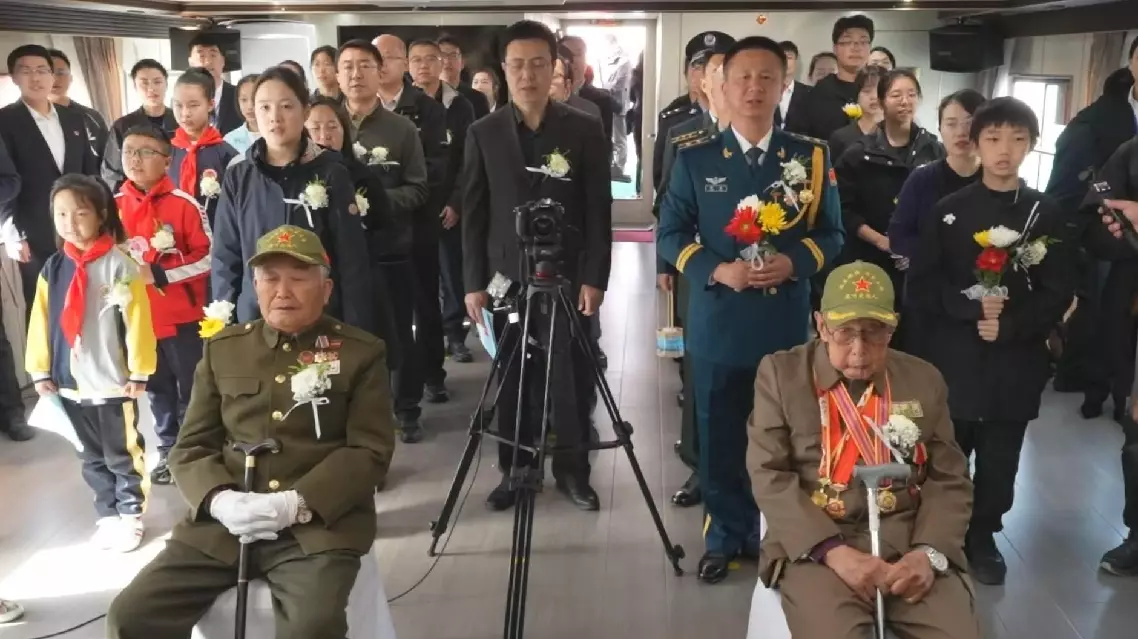
Commemorations held to pay tribute to CPV heroes in northeast China