Skip to Content Facebook Feature Image

Sichuan conducts firefighting drills with intelligent unmanned equipment to boost efficiency

China

China

China

Sichuan conducts firefighting drills with intelligent unmanned equipment to boost efficiency

2025-04-19 21:51 Last Updated At:23:07

Fire rescue authorities in southwest China's Sichuan Province have been conducting comprehensive firefighting exercises using intelligent unmanned equipment to improve the fire brigades' effectiveness in extinguishing fires under complex conditions.

In Chengdu, the capital of Sichuan Province, a simulated fire drill was carried out at a super high-rise building under construction, with thick smoke billowing from a height of 130 meters.

Upon arrival, the fire department immediately deployed a reconnaissance drone to survey and map the area, quickly identifying the fire's source and locating any trapped individuals.

Simultaneously, the department deployed intelligent equipment such as robot dogs and transport drones to deliver rescue supplies to trapped individuals -- either by climbing stairs or flying directly to the scene.

Another challenge was creating a deep channel through the building's facade to allow drone access. At a height of 130 meters, a demolition drone used a laser to lock onto the target window and deployed a diamond-tipped cutting head to break through the tempered glass of the building's curtain wall.

As the glass was removed, a large volume of smoke immediately poured out of the building. Two dry powder firefighting drones, each equipped with a 40-liter powder tank, targeted the source of the flames to contain their spread. Meanwhile, three additional drones coordinated from varying heights, spraying foam agents to finally extinguish the fire.

In some mountainous regions of Sichuan, local fire departments also conducted drills using unmanned equipment in challenging environments. These exercises were carried out across various scenarios, including water bodies, high altitudes, cold weather, and deep canyons.

"The purpose of these exercises is to enhance the fire rescue team's operational capabilities by integrating unmanned and intelligent technologies, making firefighting and rescue operations more scientific and efficient," said Li Daiming, an official with the Sichuan Provincial Fire Rescue Corps.
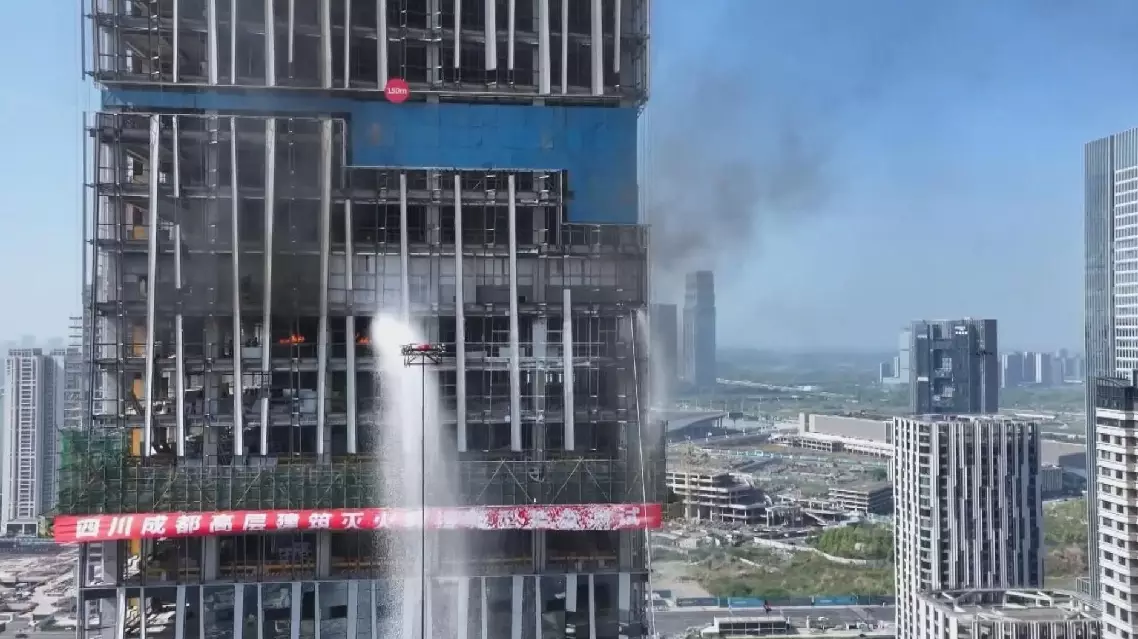
Sichuan conducts firefighting drills with intelligent unmanned equipment to boost efficiency


Sichuan conducts firefighting drills with intelligent unmanned equipment to boost efficiency

The 36th extraordinary session of the Council of the International Maritime Organization (IMO) concluded on Thursday in London, with member states split over who should be held accountable for the closure of the Hormuz Strait.

As a specialized UN agency, the IMO's responsibility is to safeguard global shipping safety and the rights and interests of seafarers. At the meeting, all parties had obvious differences regarding the root causes of the situation and the wording of the documents.

According to data provided by the IMO, since the outbreak of the conflict involving the United States, Israel and Iran, at least seven seafarers have been killed in attacks on merchant vessels in the Strait of Hormuz area, with several others seriously injured. Around 20,000 seafarers remain stranded aboard ships in the region.

Some countries urged condemning the actions of certain country that led to the blockade, while others believe that the root cause of the current maritime tensions in the Middle East lies in the military action launched by the United States and Israel against Iran, and that unilaterally blaming one country is neither objective nor comprehensive.

Multiple representatives emphasized that the IMO should not serve as a platform for political confrontation. They called for balanced, neutral language in resolutions and urged the organization to focus on pragmatic measures within the framework of IMO regulations to safeguard maritime corridors.

Iran's delegate pointed out that the IMO must not become a tool for political pressure, and any coordination on navigation security must involve Iran.

The Russian delegate warned that current international maritime declarations appear biased and one-sided, which hinders efforts to ease the crisis. He called on the IMO to adopt a more balanced stance.

China's delegate echoed the need for inclusive and impartial language, proposing that the resolutions reflect a constructive consensus rather than unilateral accusations. The Chinese side also suggested that language condemning or opposing military actions that lead to the escalation of tensions in the Strait should be added to proposal.

The IMO Council highlighted the urgent need to address the peril faced by numerous stranded commercial ships. It encouraged exploring frameworks, such as maritime safety corridors, as an emergency humanitarian measure to facilitate the voluntary evacuation of ships from high-risk zones to safer waters.

Regarding the U.S. proposal to provide naval escort operations, IMO Secretary-General Arsenio Dominguez said that naval escorts are not a long-term sustainable solution to the current crisis in the Strait of Hormuz, and only an end to the conflict can prevent shipping from becoming collateral damage.

While acknowledging that the root causes of the crisis lie beyond the IMO's mandate, he said he would continue to work with countries engaged in diplomatic efforts to address the situation.

Over the past few days, U.S. President Donald Trump has urged European countries and other allies to join naval escort operations in the Strait of Hormuz. However, European powers have largely rebuffed the request, citing concerns that direct military involvement would escalate regional tensions and risk drawing them into a wider conflict.

IMO members divided over accountability for closure of Hormuz Strait

IMO members divided over accountability for closure of Hormuz Strait

Recommended Articles