British Chancellor of the Exchequer Rachel Reeves on Friday emphasized the UK's commitment to economic cooperation with China, calling disengagement "very foolish", ahead of her Washington visit next week.
In an interview with The Telegraph, Reeves expressed her support for strengthening ties with China rather than building new barriers.
Click to Gallery
British Chancellor warns cutting ties with China would be "very foolish"
British Chancellor warns cutting ties with China would be "very foolish"
British Chancellor warns cutting ties with China would be "very foolish"
British Chancellor warns cutting ties with China would be "very foolish"
"China is the second biggest economy in the world, and it would be, I think, very foolish to not engage. That's the approach of this government," Reeves said.
Reeves pointed to her visit to China earlier this year, where she participated in the 11th China-UK Economic and Financial Dialogue alongside leading British financial services firms, including HSBC, the London Stock Exchange Group, Standard Chartered, and Prudential.
She said the visit aimed to boost the ability of British financial services firms to operate in China by securing more licenses and quotas for British businesses. That visit resulted in a deal she estimated to be worth around 600 million pounds to the British economy.
Reeves also voiced support for Chinese fast fashion company Shein listing on the London Stock Exchange, and said she would be happy to ride in Chinese-made electric vehicles despite so-called "spying fears."
According to The Telegraph, her comments signal the British government's ongoing commitment to deepening trade and financial ties with China - an agenda championed by Prime Minister Keir Starmer.

British Chancellor warns cutting ties with China would be "very foolish"

British Chancellor warns cutting ties with China would be "very foolish"

British Chancellor warns cutting ties with China would be "very foolish"

British Chancellor warns cutting ties with China would be "very foolish"
Smart technologies have reshaped China's ecological and environmental monitoring system, Huang Runqiu, minister of Ecology and Environment, said Thursday in Beijing on the sidelines of the fourth session of the 14th National People's Congress(NPC).
"Regarding ecological and environmental monitoring, we have been promoting the digitalization, informatization, and intelligentization of the entire monitoring process in recent years, reshaping the ecological and environmental monitoring system. For instance, in water environment monitoring and sampling, we have used intelligent drones which can quickly locate sampling points, collect samples accurately, return rapidly, and they are safe and reliable, improving work efficiency by over 70 percent. They are particularly advantageous for sampling during flood seasons and in remote areas," Huang told the press.
"In terms of environmental sample analysis, we have developed 'lights-out laboratories' in recent years. As the name suggests, these labs operate without lights and are unattended. Through robotic arms, robots, and intelligent management systems, they achieve full-process automation and intelligence from sample handover, testing, and analysis to report generation. This has significantly enhanced work efficiency, increasing it by more than eightfold compared to traditional labs. More importantly, it reduces human interference, human error, and even data falsification," he said.
Thanks to the improved ecological and environmental supervision capabilities, the number of environmental violation cases nationwide has decreased from 130,000 five years ago to 43,000 last year, representing a decline of 68 percent, Huang said.
The minister said China has already applied environmental DNA technology in the biodiversity monitoring work.
"In the field of biodiversity monitoring, monitoring aquatic organisms remains a weak point. However, significant progress has been made in recent years as we have developed environmental DNA technology. Although this chip is very small in size, it contains DNA detection information for aquatic organisms, including the finless porpoise and the Chinese sucker, from 19 state-controlled sections in the Jiangsu segment of the Yangtze River. The results showed that over the past five years, more than 20 species of aquatic organisms have increased in this river section, fully demonstrating the tangible effectiveness of the ten-year fishing ban in the Yangtze River," Huang said while showing a chip to reporters.
The 14th NPC, China's national legislature, concluded its fourth session on Thursday.
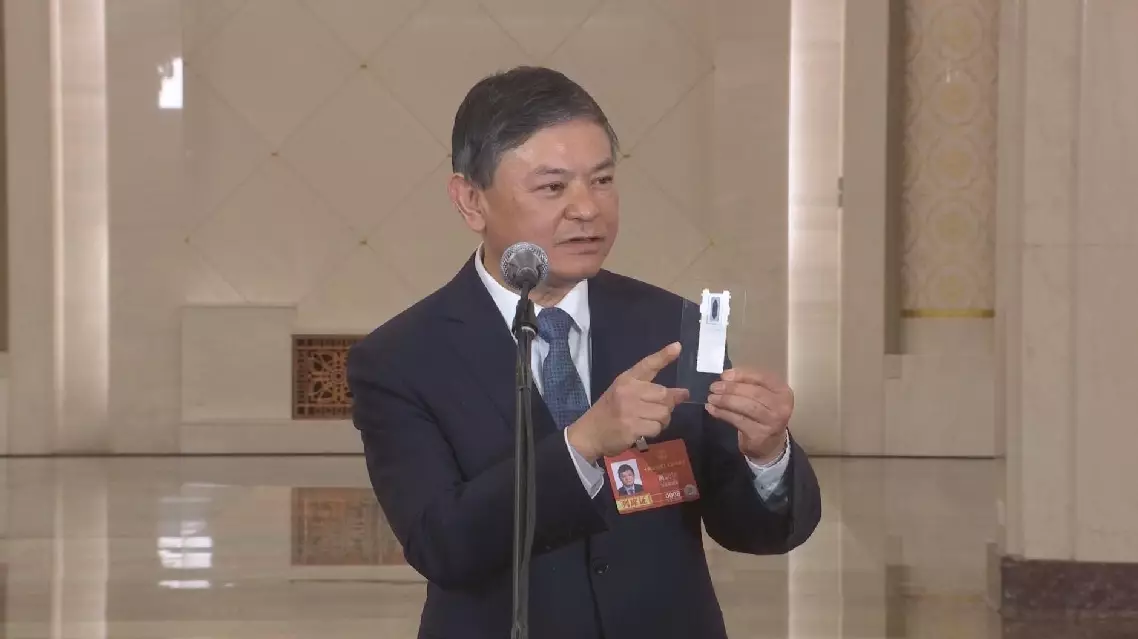
Smart technologies reshape China's ecological, environmental monitoring system: minister