A unique coffee shop in Xiamen City, east China's Fujian Province, is helping young people with autism discover confidence, purpose, and community.
At first glance, the bustling Starry Sky coffee shop in Xiamen's Siming District looks like any other trendy coffee shop. But behind the counter is a team of baristas with a difference - five of the seven employees are young adults with autism.
Opened in December last year, the coffee shop was established by the Xiamen Disabled Persons' Federation to provide meaningful employment for youth on the autism spectrum - a group often referred to in China as "children of the stars."
High-spirited and full of smiles, Gao Yuyuan greets online viewers during a livestream with her special education teacher. Friendly and confident, she works at the front desk.
"Every day, I work behind the bar and help others. I've learned to ask, 'Little one, are you okay? Are you crying? I'll get you a cookie.' I learned I can help people, anyone, everyone," Gao said proudly.
Gao is one of five employees at the coffee shop with autism, alongside Xu Ming, who enjoys organizing and tidying, Lian Manya, who loves crafting, Wang Qiqi, a budding cook and Lu Wujing, who has developed a passion for hand-brewed coffee.
Before starting work, the team underwent a month-long training program led by the coffee shop manager Lyu Yueyang, who also served as one of their instructors.
"In that month, we integrated everything - etiquette, routines, hygiene - into every single class. Only later did we introduce coffee knowledge and baking skills," said Lyu.
Lu quickly discovered that while her employees might take longer to learn social or technical skills, they make up for it with persistence and dedication. They practice over and over again when they don't get it the first time, she said.
Now operating smoothly, the team prepares dozens of coffees and baked goods each day. Customers are noticing the warm atmosphere and the deeper impact.
"This coffee shop gives them a platform. It's a space where they can shine," said Huang Minting, a customer.
For many of the staff, this is their first job and a major milestone in their journey toward independence.
"This coffee shop gave me a work opportunity. It gave me the chance to realize my own value," said Wang Qiqi.
Manager Lyu keeps a notebook where she quietly tracks the emotional ups and downs of her team members with autism, reminding other staff to offer extra support when needed.
Her thoughtfulness hasn't gone unnoticed by colleagues like barista Huang Jingying.
"Whenever a team member is having a tough moment, Lyu notes it down and reminds us to care more," Huang said.
For the parents, the transformation has been nothing short of life-changing.
"It's been over ten years now since we began this difficult journey, ever since she was diagnosed with autism at just over three years old. To finally find a path for these children, it's so moving. These children are treasures in this world. They deserve all the good things as well," said Fang Ying, Gao Yuyuan's mother.
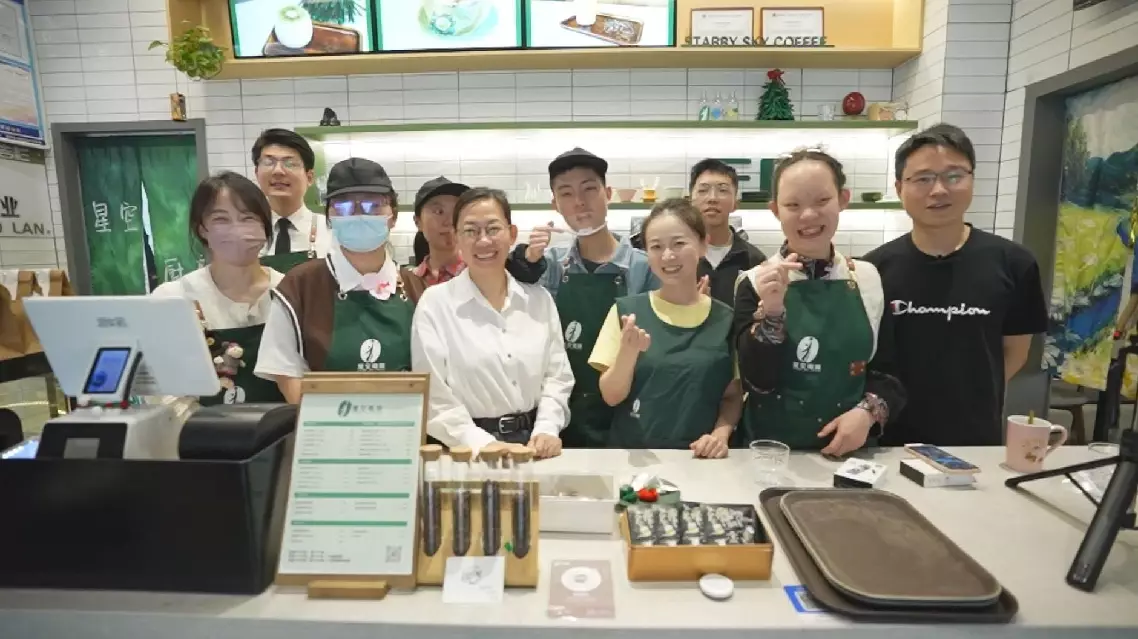
Autistic youth find purpose at Xiamen coffee shop
Cities across China are experiencing a significant tourism boom as the three-day Qingming Festival holiday coincides with the first-ever student spring breaks in multiple cities, creating an extended travel period for many families.
Qingming Festival, or Tomb-Sweeping Day, falls on April 5 this year. It is a traditional Chinese festival for honoring the deceased and paying tribute to ancestors. The holiday also provides a short break for Chinese citizens as they engage in outdoor activities and sightseeing. The Qingming Festival holiday will last from April 4 to 6.
In addition, primary and secondary school students in several regions are going to enjoy their first-ever spring break to head beyond the classroom for travel and engaging in a wide range of activities. In some areas, the spring break takes place just before the three-day Qingming Festival in early April, while in others it extends into the five-day May Day holiday, allowing students to combine leave into six- to eight-day mini-breaks.
With spring in full bloom, many families are venturing into nature to enjoy the spring scenery and experience the spring atmosphere in mountains and fields.
At Maoshan Forest World, a scenic spot in Changzhou, east China's Jiangsu, families from surrounding cities such as Nanjing, Nantong, and Zhenjiang are coming in groups. They interacted with adorable animals and experienced digging for bamboo shoots. Under the guidance of the staff, children identified and dug bamboo shoots, experiencing the joyful moments of labor.
"I want my child to get closer to nature, feel the breath of spring, and experience the joy of labor," said Deng Jie, a tourist.
During the holiday, traveling to famous destinations featured in textbooks has become a popular choice for many families.
In east China's Zhejiang Province, several scenic spots have introduced free admission for primary and secondary school students. At the Yanguan Ancient Town in Haining, many students can experience the spectacular sight of magnificent tidal waves of Qiantang River described in textbook.
"We just rode a bamboo raft and are going to watch the Qiantang River tidal bore tomorrow," said Zhao Ziyu, a tourist.
Integrating educational content with holiday vibes, study tours remain popular during the holiday.
At the Wujiangzhai Scenic Spot in Zunyi, southwest China's Guizhou Province, after watching an ethnic performance, many young visitors went to a lantern shop to experience making intangible cultural heritage lanterns. From constructing bamboo frames to pasting paper and coloring, a teacher guided them step by step, and the visitors incorporated the scenic area's landscapes and their own life expectations into their creations.
In Liangdancheng (city of nuclear bombs), the site where China's first atomic and hydrogen bombs were designed, in Zitong County of Mianyang, southwest China's Sichuan Province, a large number of students visited the local aerospace science and technology museum. In the interactive experience area, students operated simulated spaceflight equipment, acting as little astronauts exploring a virtual universe. By wearing Mixed Reality (MR) glasses, they can observe the mysteries of planets up close.
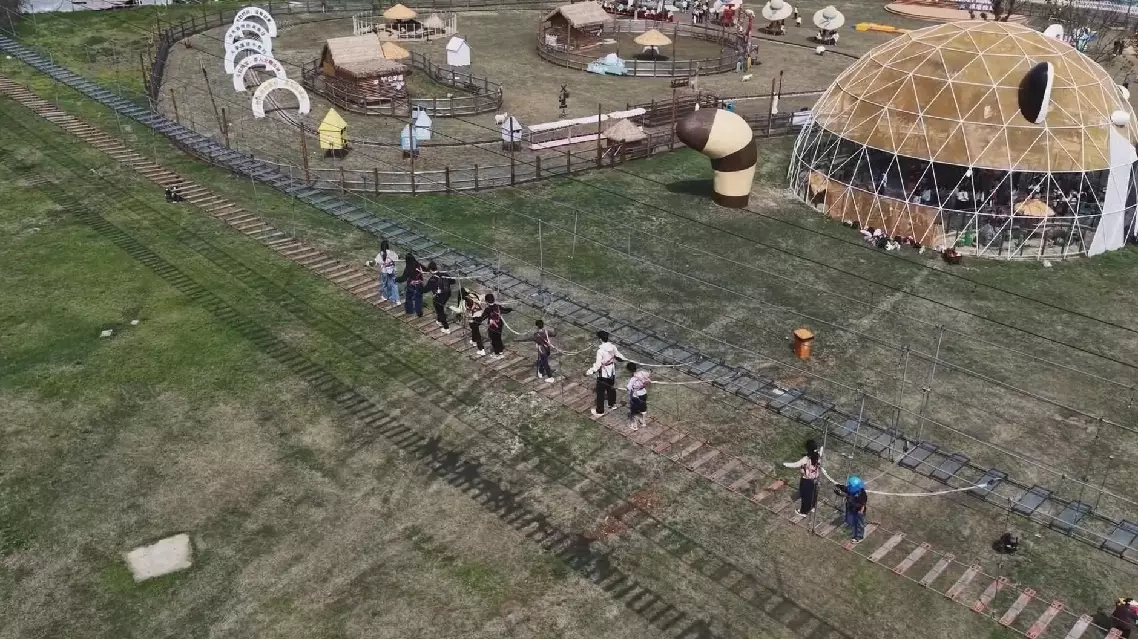
Spring break coincides with Qingming holiday, fueling tourism boom across China