The United Nations marked its 16th Chinese Language Day on Tuesday at its New York headquarters, offering an immersive cultural experience that blended Chinese poetry and music.
This year's event, "Poetic China: Rhymes and Romance," featured Chinese poetry readings, musical performances, and an exhibition on Chinese characters. More than 400 UN diplomats, staff and international guests attended.
Chinese Language Day is celebrated on April 20, around the time of Guyu (Grain Rain), the sixth of the 24 solar terms in the traditional Chinese lunisolar calendar.
"The United Nations Language Day was launched in 2010 and covers six UN official languages. According to arguments from domestic experts, the Permanent Mission of China to the United Nations suggested that April 20, the day of Grain Rain, be designated as Chinese Language Day. It is very well thought out and contains a lot of cultural heritage including to commemorate Cangjie, the legendary figure believed to have invented Chinese characters," said Zou Heyi, a staff member of the Chinese news group of the Department of Global Communications of the United Nations.
At the opening ceremony of the event, China's permanent representative to the United Nations, Fu Cong, said that Chinese is an important bridge that transcends national borders, promotes understanding and builds consensus. It actively conveys the United Nations' position and propositions to the world and makes important contributions to multilateral causes.
Many UN staff and foreign diplomats who like Chinese culture also performed poetry at the event.
"As heaven maintains vigor through movements, a gentleman should constantly strive for self-perfection," UN staff member Zach Danz recited lines from Zhou Yi, or the Book of Changes, an ancient classic of Confucianism.
"This spring morning in bed I'm lying, not to awake till the birds are crying," Guevara Alejandra, representative of the Permanent Mission of Italy to the United Nations, recited lines from a popular Tang Dynasty (618-907) poem by Meng Haoran.
Chinese diplomats also used the DeepSeek artificial intelligence model to create a poem calling on peace and mutual learning among civilizations
"Eighty years through storm and wind we stride, the world now joins in peace side by side. Civilizations chart a course untold, where cultures blend in splendor bright and bold," said Chinese diplomat Zhao Lei.
The event also showcased a performance by the UN singers, who, dressed in traditional costumes, sang the iconic Chinese folk song "Jasmine," and also featured a series of activities such as cultural seminars, calligraphy experience, tea art performances, and exhibitions on Chinese characters.
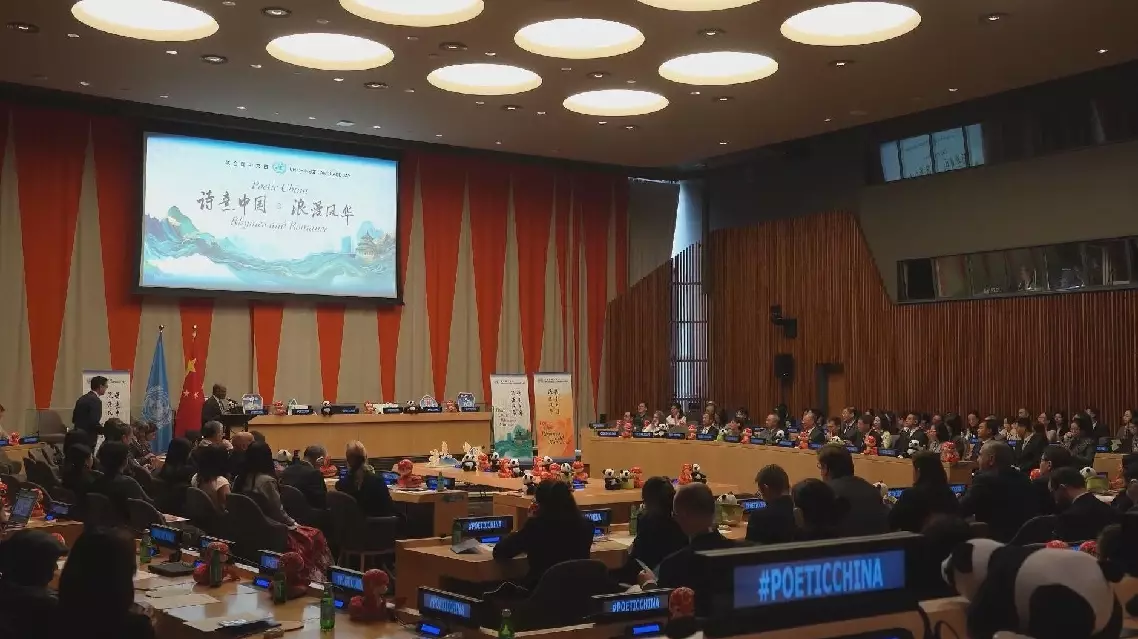
United Nations marks 16th Chinese Language Day