A delegation of 26 religious leaders from 12 countries has concluded a visit to Buddhist sites in Beijing and Lhasa, capital of southwest China's Xizang Autonomous Region, seeking to foster exchanges across multiple sectors.
Their journey began at the Yonghegong Lama Temple in Beijing, where the religious leaders viewed a prominent Qing Dynasty (1644-1911) stone tablet.
Inscribed with an article by Emperor Qianlong in four languages, the obelisk symbolizes China's historical sovereignty over Xizang.
The visit included iconic locations like the Potala Palace in Lhasa.
Religious leaders from Nepal highlighted their country's strong ties with China and expressed a commitment to expanding cooperation in agriculture, technology, and other sectors.
"We are trying very hard to establish a relationship with China. And with the help of education, we can have the linkage in other aspects, in modernized agriculture, in technology, as we are a very good neighboring country," said Subarna Lal Bajracharya, vice chancellor of Lumbini Buddhist University in Nepal.
"Nepal and China, we have a very special relationship. Nepal and China are immediate neighbor countries, we support each other, we exchange culture, religions, peace and also the social harmony, people-to- people, we exchange all the time since many hundred years. We continue to have this wonderful relationship," said Lharkyal Lama, vice chairman of the Lumbini Development Committee of Nepal.
A Buddhist leader from Cambodia called for a united Buddhist community, drawing parallels to China's Belt and Road Initiative and emphasizing unity in diversity.
"We can build a Buddhist community between China and Southeast Asian countries, unity in diversity. Buddhism in Cambodia, Buddhism in Thailand or Sri Lanka or in China, this is different. But even though we are different, we can unite together to work, as the Chinese government they have the Belt and Road Initiative," said Vibol Penh, a member of the Secretariat of the Supreme Sangha Council of Cambodia.
Nishantha Pushpakumara Kandambige, an official from Sri Lanka's Ministry of Buddhasasana, Religious and Cultural Affairs, emphasized the potential for cultural and religious collaboration between Sri Lanka and China.
"So, we can create a good relationship on cultural, social and religious matters. Strengthening cultural activities, both countries' scholarships, and for the monks and other studies, people's students are discussing at the moment," he said.
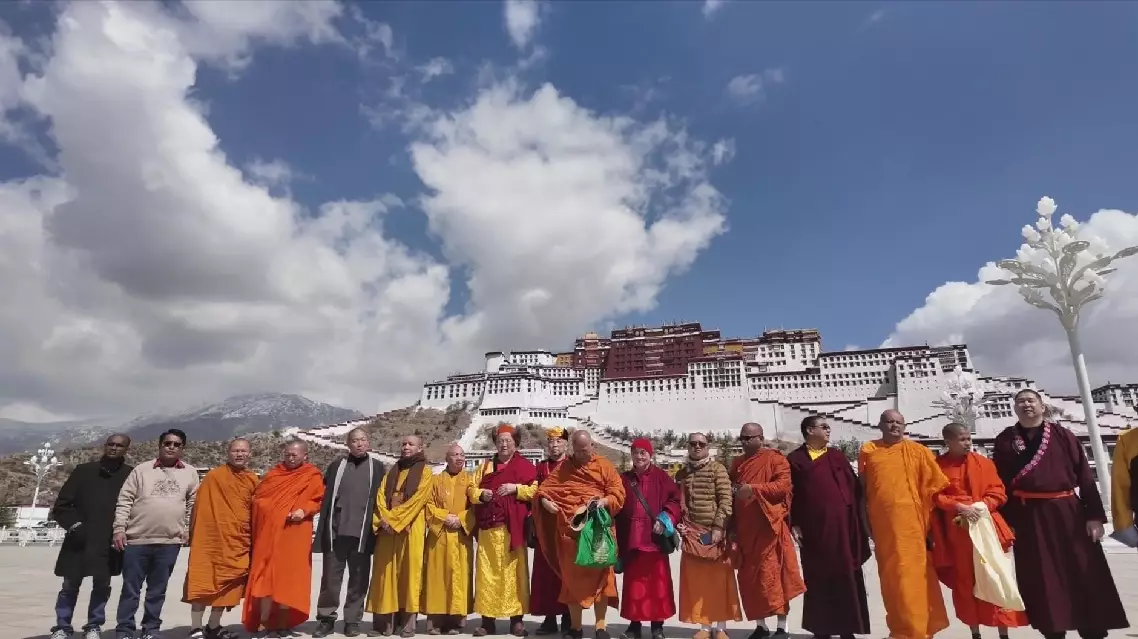
Global religious leaders explore Buddhist heritage in China, seek to strengthen cross-cultural ties