Skip to Content Facebook Feature Image

Sand control measures shield Mogao Grottoes from erosion

China

China

China

Sand control measures shield Mogao Grottoes from erosion

2025-04-22 17:46 Last Updated At:23:27

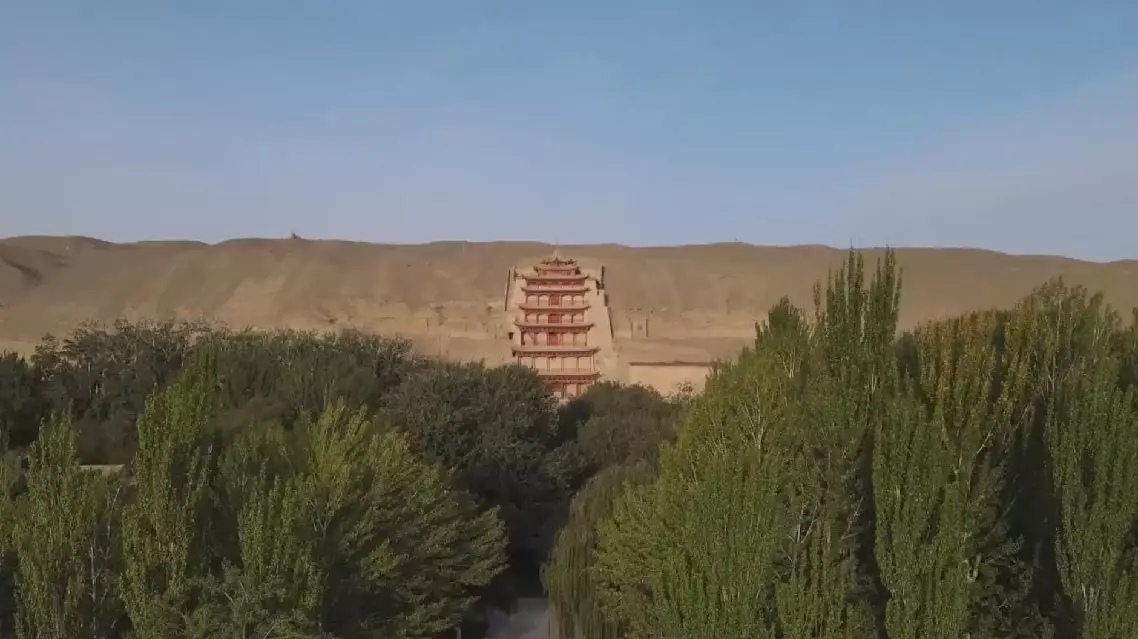
A series of sand control efforts have been implemented to shield the Mogao Grottoes in northwest China's Gansu Province from the relentless forces of wind and sand erosion, yielding remarkable results.

Situated on the edge of a vast desert, the Mogao Grottoes have faced wind and sand threats for centuries. Wind and dust that enter the caves have damaged the murals and colored sculptures, posing significant risks to their preservation.

"Dunhuang is located in an area surrounded by multiple deserts with abundant sand sources. Whenever wind speeds exceed Force four (5.5 meters per second), they stir up sand and dust. The region faces winds of this intensity for over half of the year, posing a major challenge to the preservation of the grottoes," said Qin Xia, a senior engineer at the Dunhuang Meteorological Bureau.

The cliff edge near the Mogao Grottoes is bordered by a vast expanse of gravel Gobi, whose hard texture resists wind-driven sand, allowing it to remain in its natural, untouched state. Adjacent to this gravel Gobi stands a massive A-shaped sand barrier, part of an integrated sand control system.

Beyond the fence, researchers have carefully developed a comprehensive sand control system atop the Mogao Grottoes, designed to effectively block wind and prevent sand erosion.

"This graph shows the sand accumulation in front of the grottoes from 1990 to 2024. In 1990, the sand accumulation was quite high, reaching 28 to 30 kilograms per square meter. However, after the completion of our project, particularly after 2010, the sand accumulation gradually decreased. The amount has stayed remarkably low since 2019. Sand accumulation has dropped by 85 percent from 3,000 cubic meters in the 1980s to less than 200 cubic meters now, which is the most noticeable result," said Zhang Guobin, a researcher at the Dunhuang Academy.

In the fight against wind and sand, the Dunhuang Academy has collaborated with experts from both domestic and international institutions. Together, they have employed a variety of strategies, such as creating sand control trenches, building wooden fences to block sand, and using chemical methods to stabilize the sand. Despite these achievements, efforts to protect the site continue, with ongoing research to develop even more effective solutions against sand erosion.
Sand control measures shield Mogao Grottoes from erosion
Sand control measures shield Mogao Grottoes from erosion
The Iranian government is focusing on public concerns and maintaining stable supplies of essential goods amid recent protests, Iranian President Masoud Pezeshkian said in a televised interview on Sunday.

In the city of Karaj, northwest of the capital Tehran, daily life has largely continued as normal. A video filmed by a local resident on Sunday shows food stores open and grocery shelves fully stocked.

"This is the block near my home, and there are some food stores here. Daily life continues here. Last night we did not see many protests in Karaj. Right now the city is very safe. This is a grocery store close to my home. All the food is available; nothing is in shortage. Here are noodles and different types of beans. Here are dairy products, cheese, and yogurt. I also checked other grocery stores and didn't see any shortages. Everything is available," said local resident Ali Reza.

Iranian officials have described recent disturbances as acts orchestrated by the "enemy," including some carried out by well-trained and armed "terrorists." The incidents have caused casualties among security personnel and civilians, as well as property damage.

The Secretary of Iran's Supreme National Security Council Ali Larijani has directed authorities to severely punish the "terrorists."

Meanwhile, Iran's police chief Ahmad-Reza Radan said on Sunday that the police had raised alert levels and arrested several leaders of the troublemakers during the operations on Saturday.

President Pezeshkian noted in the interview that the normal demands of the Iranian people are reasonable and justified, but they must realize that triggering riots and carrying out terrorist acts are the enemy's attempts to undermine the country. He urged the public to remain vigilant.

Also on Sunday, Iranian Parliament Speaker Mohammad Baqer Qalibaf warned that Tehran would regard U.S. and Israeli bases and facilities in the Middle East as "legitimate targets" if Washington takes military action against Iran. His remarks followed media reports saying U.S. President Donald Trump is "seriously considering authorizing a strike" against Iran.

Iranian state media reported that at least 109 members of Iran's security forces have been killed in clashes since the protests began 14 days ago. Meanwhile, human rights groups based outside the country said the number of protesters killed has exceeded 200, though the figure could not be independently verified.

The protests initially erupted over a sharp depreciation of the rial and sweeping subsidy reforms. Iranian authorities have blamed the unrest on foreign-linked agents and sanctions imposed by the United States.

Iranian president says government focusing on ensuring supplies amid protests

Iranian president says government focusing on ensuring supplies amid protests

Recommended Articles