China's expanding network of advanced scientific facilities is propelling breakthroughs in research and industrial applications, reinforcing the nation's position as a global innovation leader.
Recent months have seen accelerated progress in major projects nationwide. In south China's Guangzhou City, construction has commenced on two major scientific facilities, the Cold Spring Ecosystem Research Facility and the Human Cell Lineage Facility.
Meanwhile in Beijing, several cutting-edge research installations, including the Comprehensive Extreme Condition Experiment Facility and the Meridian Project (Phase II), have recently passed national acceptance inspections. Of the 37 planned science facilities at the Huairou Science City, 16 have now opened their doors to international researchers.
A standout development is Asia's first fourth-generation High Energy Photon Source (HEPS) in Beijing, China's flagship synchrotron radiation facility, which has officially launched its joint commissioning phase, as part of the final construction stage.
This "super X-ray machine", capable of generating light 1 trillion times brighter than sunlight, will provide crucial support for cutting-edge research in advanced materials, aerospace, biomedicine and other fields.
"The facility achieves nanometer-level spatial resolution and picosecond-level temporal resolution. The experimental results already demonstrate the outstanding performance characteristics of this fourth-generation light source," said Pan Weimin, the project's chief director.
China's scientific infrastructure now includes over 60 major facilities among 77 planned national projects, with several achieving world-class status.
The progress spans diverse fields, from the agricultural "Shennong Facility" for crop phenomics research, to final adjustments of the high-efficiency and low-carbon gas turbine test facility, to upgrades at the 4,410-meter-high Large High Altitude Air Shower Observatory (LHAASO) on the Tibetan Plateau.
These facilities are yielding tangible results. Hefei's Steady High Magnetic Field Facility (SHMFF) has supported more than 3,800 research projects, contributing to breakthroughs in superconductors and pharmaceuticals.
In Guangdong Province, the Jiangmen Underground Neutrino Observatory (JUNO) has achieved domestically produced photomultipliers with world-leading efficiency, while the China Spallation Neutron Source in Dongguan City provides crucial data for aviation and energy technologies.
China has moved up one spot to 11th place in the ranking of the world's most innovative economies, making it one of the fastest risers over the past decade, according to the Global Innovation Index (GII) 2024 released by the World Intellectual Property Organization (WIPO).
With continued strategic investment in research infrastructure, China is systematically transforming scientific ambition into technological leadership and industrial advancement.
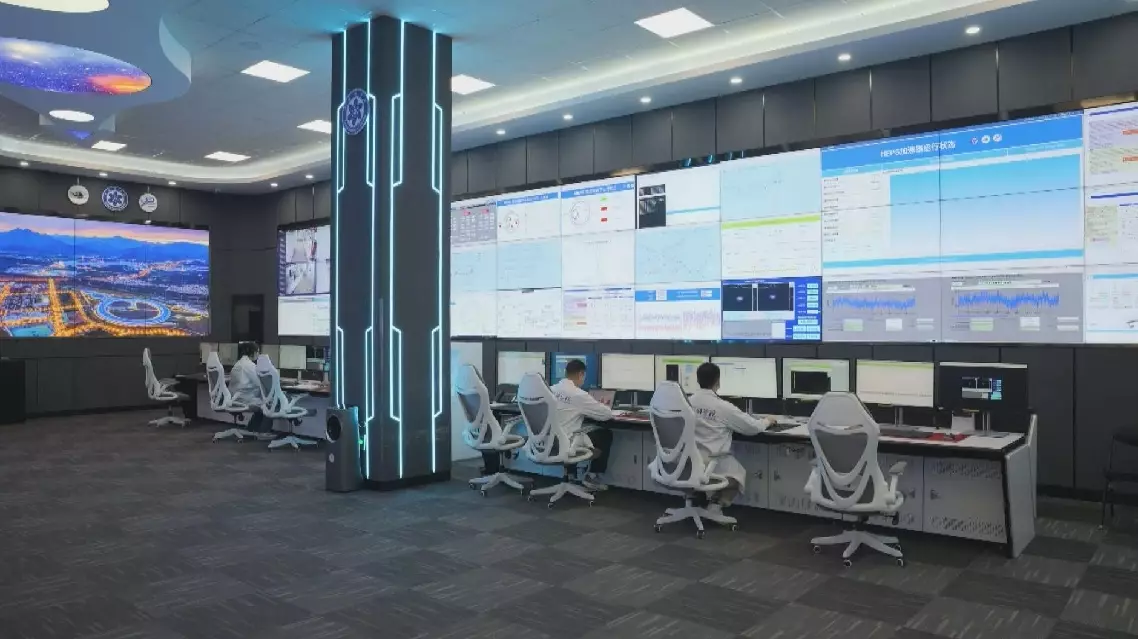
China's mega-science facility construction fuels its global innovation leadership