Russian President Vladimir Putin has reiterated Russia's willingness to resume peace talks with Ukraine, accusing Western nations of escalating regional tensions.
On Tuesday, Putin delivered an address outlining Russia's position on peace negotiations with Ukraine. Putin stated that Russia remains open to dialog, provided discussions build on agreements reached during the 2022 Istanbul consultations and the 2025 Russia-U.S. Anchorage meeting. However, he stressed that continued Ukrainian strikes on Russian civilian targets make direct talks between the two countries' leaders impossible at this stage.
Putin criticized Ukrainian President Volodymyr Zelensky's recent public letter, claiming it failed to create conditions for negotiations and, instead, aimed to further escalate the conflict.
Putin also condemned Western nations for fueling fears of a Russian military threat to justify expanded defense spending and more aggressive policies toward Russia. He emphasized that Russia is fully prepared to respond swiftly and proportionately to all internal and external threats.
Addressing the recent Ukrainian drone strikes deep inside Russian territory, Putin said the attacks were intended to destabilize Russian society and cause public unrest. He added that Western countries have not launched attacks from their own soil for fear of Russian retaliation.
Putin asserted that Russian troops continue their operations on the front line and will accomplish all set objectives.
Also on Tuesday, Russian Foreign Minister Sergei Lavrov echoed Putin's comments, saying Russia is ready at any time to resume negotiations with Ukraine. Lavrov noted that solutions to the conflict had already been agreed upon during last year's Anchorage meeting with the United States, but alleged that the deal was put on hold to allow Ukraine time to rearm.
Meanwhile, Russian Deputy Foreign Minister Sergei Ryabkov pointed out signs of the U.S. drifting away from the Anchorage consensus. He insisted that Russia's position remains unchanged and that Russia-U.S. dialogue on the Ukraine issue has not stopped and will continue.

Putin reaffirms talk readiness, blames West for tensions
Putin reaffirms talk readiness, blames West for tensions
As the lingering U.S.-Iran conflict over the Strait of Hormuz disrupts global oil and gas supply, the Asia-Pacific Economic Cooperation (APEC) forum's energy ministers met in Beijing Thursday to chart a way forward, on whether the region can turn the crisis into opportunities.
The disruption of the Strait of Hormuz since late February 2026 has caused the largest oil supply shock on record, with ongoing daily shortfalls in the multi-million-barrel range. This energy supply shock has exposed the structural vulnerabilities of the Asia-Pacific region, the world's largest energy-consuming area.
As the APEC host this year, China has taken an open and inclusive approach, creating a multilateral dialogue platform. At the current energy ministerial meeting, it is pushing for a full exchange of practical experience among economies and channeling shared wisdom into real cooperative results.
"Since the beginning of this year, navigation through the Strait of Hormuz has been disrupted. China has fully leveraged its energy production, supply and marketing system, actively strengthened cooperation with all other parties, and made important contributions to safeguarding global energy security," said Chinese Vice Premier Ding Xuexiang in addressing the meeting.
The APEC Energy Ministerial Meeting, returning to Beijing after a 12-year hiatus, took place at a critical juncture following this "stress test."
"From our end in Papua New Guinea, we face the impacts of the war in Iran. We are an import-based economy. It did affect us in a great way," said Conrad Kumul, a delegate from Papua New Guinea, on the sidelines of the meeting.
Yet, many see that crises can also serve as catalysts for energy transition.
"The idea now is to push very much forward with the energy transition, even more than before. Now actually, the oil prices are so high that the comparatively renewable energies are very low in price," said Steivan Defilla, president assistant of the APEC Sustainable Energy Center, a high-level international energy think tank led by China's National Energy Administration.
China will hold the 33rd APEC Economic Leaders' Meeting in Shenzhen, south China's Guangdong Province, in November, which marks the country's third time hosting the event following Shanghai in 2001 and Beijing in 2014.
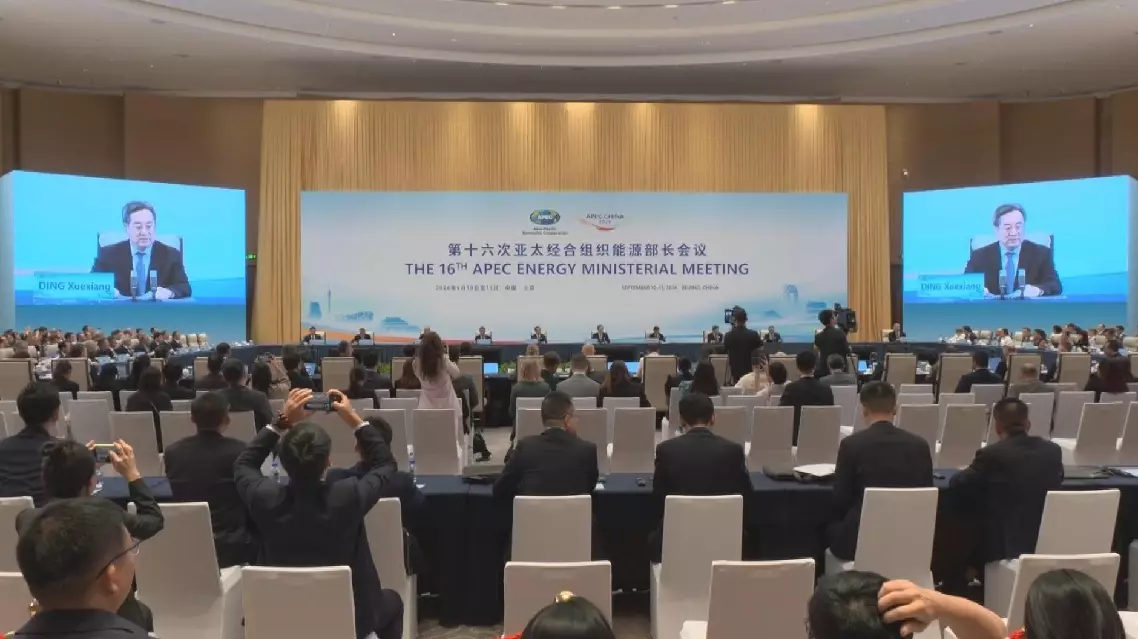
APEC ministers explore new pathways for energy security amid Hormuz crisis