The China National Space Administration (CNSA) announced new progress in lunar and Mars exploration and related international cooperation projects with Pakistan and five other countries during an event marking the 10th China's Space Day on Thursday.
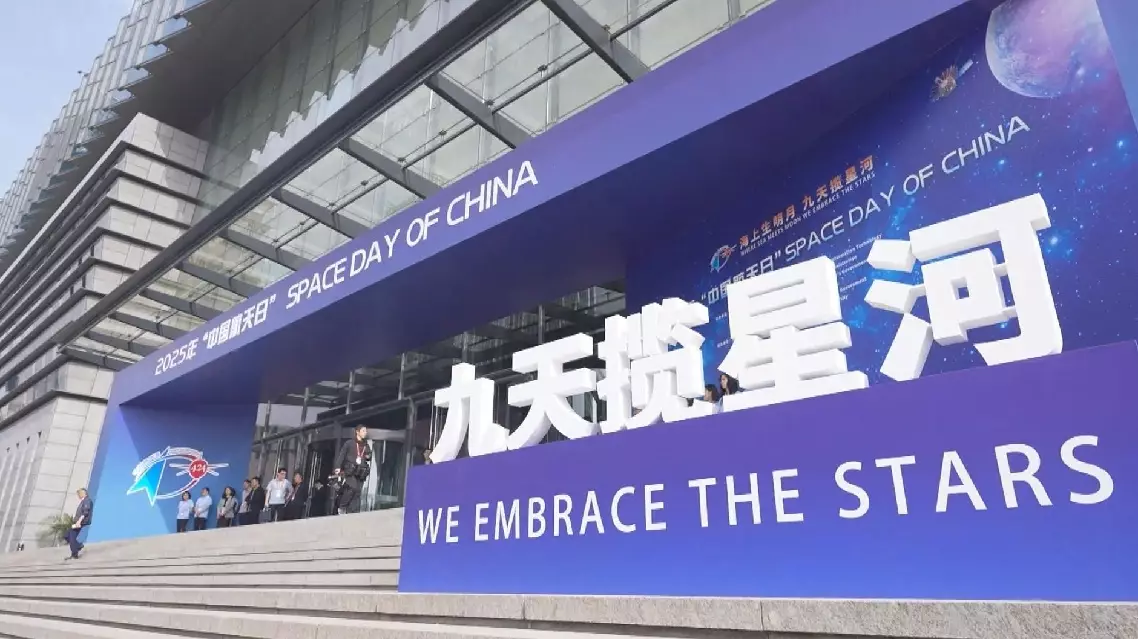
April 24 was designated as China's annual Space Day to commemorate the successful launch of its first satellite, Dongfanghong-1, on April 24, 1970. As part of the 10th Space Day celebrations, over 40 events, including an opening ceremony, the China Aerospace Conference, and various space science popularization and cultural activities, were held at the Shanghai World Expo Exhibition and Convention Center.
The announced developments in China's lunar and Mars exploration initiatives at the opening ceremony included the international selection results for the loan of Chang'e-5 lunar samples, the selection of collaboration projects for the Chang'e-8 mission, and the international cooperation opportunities for the Tianwen-3 Mars sample return mission.
Seven institutions from six countries have been authorized to borrow the lunar samples retrieved by Chang'e-5 in 2020 for scientific research. CNSA signed a Lunar Sample Loan Agreement with five institutions from five countries during the ceremony.
Ten payloads from 11 countries and regions, along with one international organization, were selected for participation in the Chang'e-8 mission, scheduled for launch around 2029. Among these were a multi-functional robot designed by researchers in Hong Kong and a lunar rover developed by Pakistan.
CNSA also invited global partners to jointly advance Mars exploration and research by taking part in the Tianwen-3 Mars mission, which is scheduled for launch around 2028.
It will take two launches to carry out the sample return due to the limited carrying capacities of the current rockets. Two Long March-5 carrier rockets will be used for the mission. Li Dong, Chief Designer of the Long March-5 carrier rocket and newly appointed China Space Goodwill Ambassador for 2025, revealed advancements in next-generation launch vehicle development.
"Currently, the Long March-5 is China's most powerful carrier rocket, with a low-Earth orbit capacity of up to 25 tons. However, to further advance China's space technology and to explore deeper into space, we need even more capable rockets," said the chief designer.
"The Long March-10, now under development, will be crucial in future manned lunar missions. In addition, larger, more advanced rockets, including those with reusable launch technologies, are undergoing intensive feasibility studies and development. I am confident that China's future rockets will make even greater contributions to sustainable space exploration," said Li.
China announces latest international collaboration in lunar, Mars exploration