A new self-service gold trading machine has recently appeared in a shopping mall in Suzhou City of east China's economically developed Jiangsu Province, offering an innovative and efficient way for people to recycle or purchase gold as the safe-haven metal's lure grows.
The ATM machine with a bright golden hue features two functions: "intelligent gold recycling" and "self-service gold purchasing".
After a gold nugget is placed onto a tray, the machine will immediately begin to assess its weight and purity. For instance, a 6.26-gram nugget was valued at 4,830.97 yuan (about 662.81 U.S. dollars) after deducting a service fee.
"We base our recycling price on the real-time gold prices from the Shanghai Gold Exchange. Right now, the recycling price is 789.55 yuan (about 108.33 U.S. dollars) per gram. During the entire recycling process, a service fee of 18 yuan (about 2.47 U.S. dollars) per gram will be charged," said Chen Jia, manager of the gold store which has adopted the machine.
After the initial assessment, customers will have the option to either proceed with the sale or retrieve their gold if they change their mind.
For those opting to sell, they simply enter their bank accounts and proceed to the next step. The machine then melts the gold through high-heat processes, followed by cooling, before completing the transaction. Within around 30 minutes, the amount of money from the transaction will be transferred to the customer's account.
Many residents in Suzhou are intrigued by this new golden ATM and are eager to try it.
"Isn't everything intelligent now? You don't have to worry about being cheated in weight. In terms of the service fee, other gold stores also charge it," said a local resident.
Gold prices have been on a steady upward trajectory, boosted by global instability, inflation concerns and robust central bank buying, rewarding those who were early investors in the precious metal.

ATM machine for gold recycling, purchase unveiled in east China's Suzhou
Chinese Foreign Minister Wang Yi said on Monday that the sovereignty, security and territorial integrity of all countries should be respected, and all acts of attacking civilians and non-military targets should be condemned.
Wang, also a member of the Political Bureau of the Communist Party of China Central Committee, made the remarks in a phone conversation with Bahraini Foreign Minister Abdullatif bin Rashid Al Zayani.
Zayani briefed Wang on the regional situation and the Bahraini position, saying that Bahrain has always been a peace-loving country and should not be subject to unlawful attacks.
The Bahraini side expressed its appreciation and gratitude for China's just stance while voicing its willingness to work with Gulf countries and China to strengthen communication and coordination at both bilateral and multilateral platforms, including the United Nations, so as to achieve regional peace and stability at an early date.
Bahrain will continue to take strong measures to safeguard the security of Chinese personnel and institutions, he said.
For his part, Wang said that the situation in the Gulf region is rapidly escalating and the security of Bahrain has also been compromised, which is of deep concern to China.
China's position is consistent and clear: the sovereignty, security, and territorial integrity of all countries should be respected, and attacks on civilians and non-military targets should be condemned, he said.
The top priority is to immediately cease military operations to prevent the further spread of conflicts, Wang said.
The path to a breakthrough lies in returning to dialogue and negotiation as soon as possible, so as to strive to restore peace, he said, adding that the lasting solution is an unwavering commitment to jointly abide by international law and the fundamental norms of international relations.
As a strategic partner of the Gulf countries and a responsible major country, China has been actively promoting peace and stopping wars, Wang said.
The Chinese government's special envoy on the Middle East issue is currently shuttling through the region for visits and will also visit Bahrain, he said, adding that China will continue to play a constructive role in safeguarding peace and stability in the Gulf region.
Wang also expressed hope that the Bahraini side will continue to ensure the safety of Chinese citizens and institutions in Bahrain.
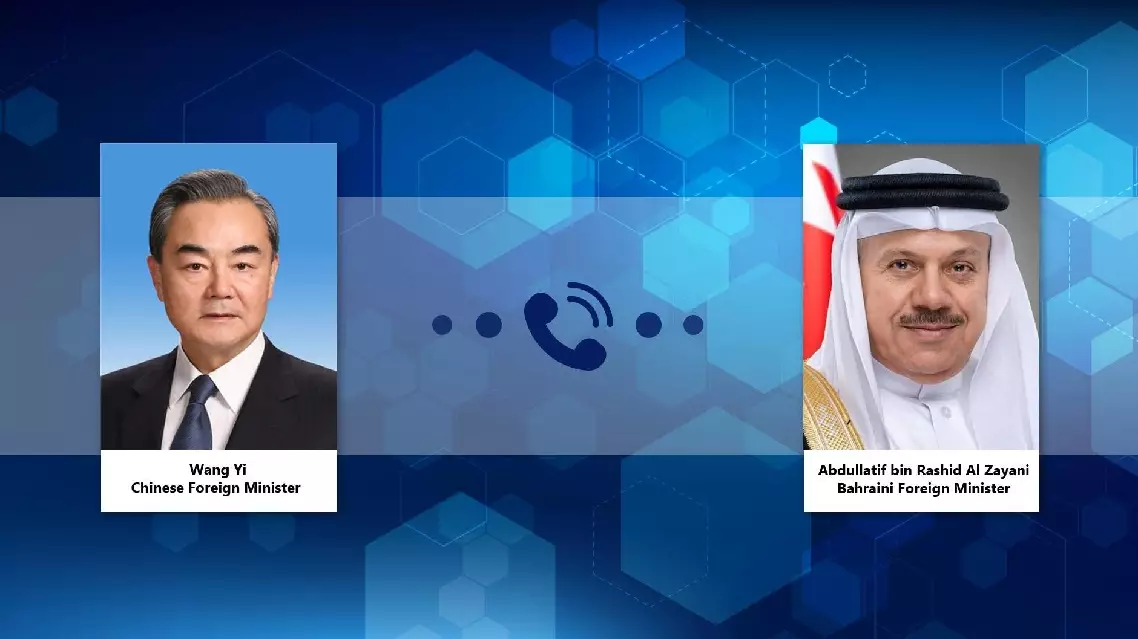
Chinese FM says all acts of attacking civilians, non-military targets should be condemned