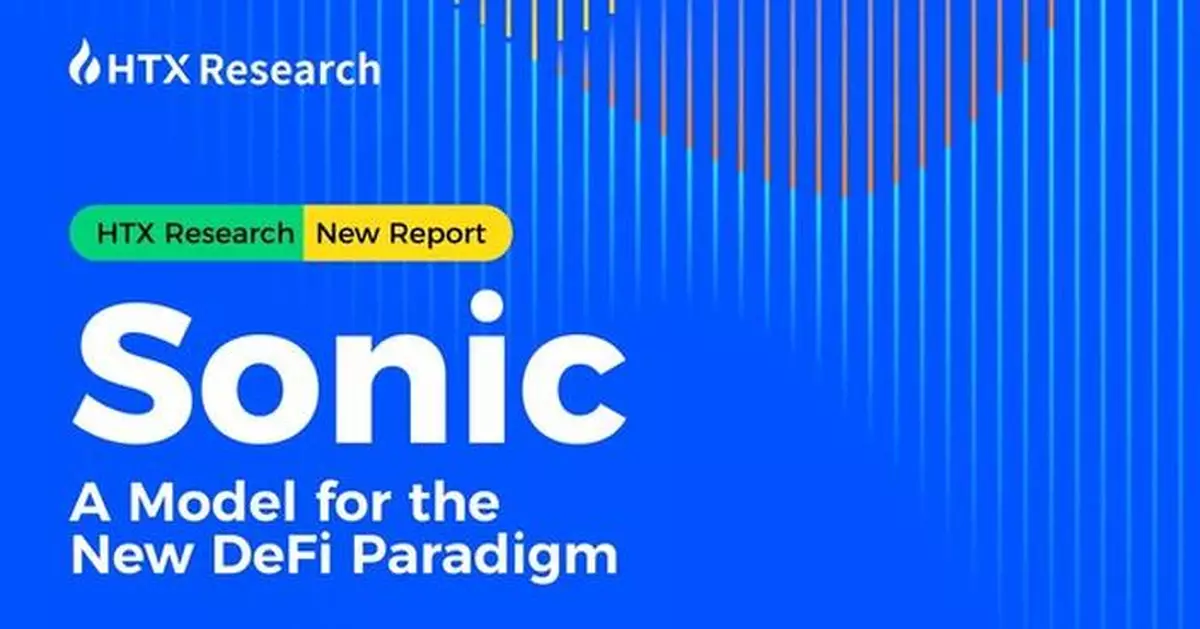
SINGAPORE, April 28, 2025 /PRNewswire/ -- As Layer 2 scaling solutions remain a focal point of industry discourse, Sonic presents a fundamental shift in blockchain architecture. HTX Research has announced the release of its latest report, "Sonic: A Model for the New DeFi Paradigm" The report dives into the details of the Sonic public chain.
Sonic's Evolution: 2000+ TPS, 0.7s Confirmation, Near-Zero Fees
The Fantom Opera blockchain, initially recognized for its speed and throughput as a high-performance aDAG-based Layer 1 solution, encountered scalability limitations as its ecosystem expanded. Its traditional EVM architecture struggled with bloated state storage, slow node synchronization, and execution bottlenecks. To overcome these challenges without resorting to sharding or Layer 2 solutions, Fantom developed Sonic — a fundamental redesign engineered to deliver a significant performance leap.
Sonic Labs, a new team led by CEO Michael Kong, CTO Andre Cronje (founder of Yearn Finance), and Chief Research Officer Bernhard Scholz, dedicated two and a half years to the redesign of Fantom's virtual machine, storage, and consensus. They built Sonic, a new, independent EVM-compatible chain capable of processing over 2,000 TPS, achieving 0.7-second finality, and executing transactions at a cost of $0.0001. It also improves storage efficiency by 90% and reduces node synchronization time from weeks to under two days.
Technical Innovations Driving Sonic's Performance
Sonic's enhanced performance is underpinned by three core technological advancements:
- SonicVM: A newly developed virtual machine fully compatible with the EVM, SonicVM optimizes computationally intensive operations like SHA3 hashing, pre-analyzes jump instructions, delivers significantly faster execution, and supports high throughput.
- SonicDB: Achieving nearly 90% data compression, SonicDB uses a layered storage strategy that splits the blockchain state into two databases: LiveDB for the current global state and ArchiveDB for historical blocks and states. This reduces node requirements and enhances network resilience through greater decentralization.
- Sonic Gateway: Functioning like an "L2-like" bridging solution to Ethereum, it uses a batch processing mechanism that strikes a balance between security and efficiency, enabling seamless two-way asset transfers and ecosystem access.
Stablecoin Ecosystem: Nested Yield and Resilient Growth
Defying market trends in 2025, Sonic's on-chain Total Value Locked (TVL) surged by over 500%, with the total stablecoin supply surpassing $260 million. This growth is driven by sophisticated high-leverage yield mechanisms.
- Silo v2 Loop Lending: Use staked S tokens to borrow stablecoins, achieving up to 20x exposure to capture combined incentives alongside stable yield spreads.
- Euler + Rings Protocol Combo: Deposit USDC to mint scUSD, then use leverage to potentially achieve up to 10x yield, along with Sonic points and protocol rewards.
- Shadow DEX Liquidity Provision for Rewards: By facilitating trading activity, particularly with the S/stS pair on Shadow, users can earn up to 169% APY and a share of trading fees.
Looking ahead, the ecosystem will incorporate Real World Asset (RWA) yields and off-chain payment solutions to create a sustainable and widely used stablecoin ecosystem backed by compliant assets and real-world applications.
Conclusion: Sonic - Leading the Charge in DeFi 2.0
Sonic's high performance, nested yields, and accessibility position it for rapid growth, with the potential to exceed $2B TVL and a multi-billion $S token market cap within a year. More importantly, Sonic is championing an "efficiency revolution" in blockchain design—prioritizing performance and capital efficiency to attract liquidity.
The report identifies technical challenges, including the adaptive AMM's reliance on external oracles, which introduces potential vulnerabilities. Furthermore, the inherent risks of high-leverage strategies in volatile markets necessitate the use of hedging instruments, such as short perpetual futures, to mitigate potential liquidations.
From a broader view, Sonic is well-positioned to lead the expected 2025 DeFi resurgence. Its thriving stablecoin ecosystem boosts the value of both the $S token and the network. Even in a bear market, Sonic demonstrates the potential for DeFi to establish resilient "yield havens" through innovation and performance. With its nested yields, developer-focused incentives, and efficient infrastructure, Sonic provides a model for the industry. The integration of RWAs and payment tools could place Sonic as a critical bridge between on-chain yields and real-world utility, driving DeFi toward mass adoption
For full report, please visit: https://square.htx.com/wp-content/uploads/2025/04/HTX-Research-Latest-Report-1-1.pdf
About HTX Research
HTX Research is the dedicated research arm of HTX Group, responsible for conducting in-depth analyses, producing comprehensive reports, and delivering expert evaluations across a broad spectrum of topics, including cryptocurrency, blockchain technology, and emerging market trends.

** The press release content is from PR Newswire. Bastille Post is not involved in its creation. **

HTX Research Latest Report | Sonic: A Model for the New DeFi Paradigm
New software connects AI agents, skills and workflows across the automation lifecycle
MILWAUKEE, Oct. 21, 2026 /PRNewswire/ -- Rockwell Automation, Inc. (NYSE: ROK), the world's largest company dedicated to industrial automation and digital transformation, today announced the introduction of FactoryTalk® Conductor™, a new AI-native orchestration platform designed to coordinate AI-powered work across the industrial automation lifecycle, creating a foundation for AI-enabled workflows from system design through operation and maintenance. The software will make its public debut at Automation Fair® 2026 in Boston, where attendees will receive an exclusive first look ahead of its planned commercial availability in the first quarter of 2027.
According to Rockwell Automation's 2026 State of Smart Manufacturing Report, one-third of manufacturing operations are already AI-augmented, with adoption expected to accelerate in the years ahead. As manufacturers move from AI experimentation to broader deployment, they need practical ways to connect technology, workflows and expertise. FactoryTalk Conductor is designed to meet that need through a single platform that brings AI together across engineering environments.
"The next phase of industrial AI will be defined by orchestration rather than individual copilots," said Craig Resnick, Vice President, ARC Advisory Group. "Manufacturers need AI technologies that can coordinate tasks across software systems, engineering tools and operational data. FactoryTalk Conductor reflects the industry's evolution toward agentic automation by bringing AI agents, workflows and industrial expertise together in a unified environment."
FactoryTalk Conductor enables users to initiate engineering tasks using natural language and intelligently connects the software, AI capabilities and workflows needed to complete them. At launch, the platform will integrate with Studio 5000 Logix Designer®, Logix Echo™, Emulate3D® and FactoryTalk® Optix™, providing coverage across key design, development, simulation and testing workflows. Additional integrations across Rockwell Automation's software portfolio, including FactoryTalk® Design Studio™, FactoryTalk® Historian, Plex® and Fiix®, are planned to follow, expanding AI-powered workflows across the industrial automation lifecycle.
"What makes FactoryTalk Conductor unique is the combination of AI orchestration and trusted industrial expertise," said Matheus Bulho, senior vice president, software & control, Rockwell Automation. "Customers can leverage Rockwell Automation-verified agents and skills, create capabilities tailored to their business, and connect AI across software, data and services. This creates a scalable foundation for accelerating engineering work while maintaining the standards required in industrial environments."
Key benefits include:
- Supporting enterprise AI and governance requirements, giving organizations the flexibility to leverage FactoryTalk Hub-hosted AI services or connect their preferred large or small language models, including locally hosted open-weight models that can help reduce ongoing token consumption costs.
- Accelerating engineering workflows across the automation lifecycle by coordinating activities across design, development, testing and verification environments.
- Reducing complexity across software applications by enabling AI-powered workflows that span Studio 5000 Logix Designer, Logix Echo, Emulate3D, FactoryTalk Optix and other Rockwell Automation solutions.
- Applying AI with greater confidence and reliability through Rockwell Automation-developed integrations that connect software, data and services across industrial operations.
- Extending trusted automation expertise through Rockwell Automation-verified agents and skills, helping teams accelerate work with capabilities purpose-built for industrial applications.
Manufacturers attending Automation Fair 2026 will be able to experience FactoryTalk Conductor demonstrations across multiple show floor experiences, including Technology & Services Showcase, Industry Pavillion, Innovations, as well as dedicated technical sessions.
Additional information about FactoryTalk Conductor and Automation Fair can be found at www.rockwellautomation.com.
Frequently Asked Questions
What is FactoryTalk Conductor?
FactoryTalk Conductor is an AI-native orchestration platform that connects AI agents, skills, workflows and automation software to help engineers accelerate system design, development and testing activities through natural language interactions and trusted industrial expertise.
How is FactoryTalk Conductor different from an AI copilot?
While traditional AI copilots assist with individual tasks, FactoryTalk Conductor enables multiple AI agents, workflows and software tools to work together across engineering processes. This enables broader automation of complex, multi-step activities that span applications, data sources and teams.
When will FactoryTalk Conductor be available?
FactoryTalk Conductor will be previewed at Automation Fair 2026 in Boston and is expected to be commercially available in the first quarter of 2027.
What Rockwell Automation products can FactoryTalk Conductor work with?
FactoryTalk Conductor is designed to work across a growing portfolio of Rockwell Automation software. At launch, it will support Studio 5000 Logix Designer®, Logix Echo™, Emulate3D® and FactoryTalk® Optix™, with additional integrations planned for FactoryTalk® Design Studio™, FactoryTalk® Historian, Plex®, Fiix® and other solutions over time.
Can customers create and deploy their own AI agents and skills?
Yes. In addition to Rockwell Automation-verified agents and skills, customers can create and deploy their own agents and skills to support company standards, industry requirements and unique engineering workflows
About Rockwell Automation
Rockwell Automation, Inc. (NYSE: ROK), is a global leader in industrial automation and digital transformation. We connect the imaginations of people with the potential of technology to expand what is humanly possible, making the world more productive and more sustainable. Headquartered in Milwaukee, Wisconsin, Rockwell Automation employs approximately 26,000 problem solvers dedicated to our customers in more than 100 countries. To learn more about how we are bringing the Connected Enterprise® to life across industrial enterprises, visit www.rockwellautomation.com.
** This press release is distributed by PR Newswire through automated distribution system, for which the client assumes full responsibility. **

Rockwell Automation Introduces FactoryTalk Conductor, an AI-Native Orchestration Platform for Industrial Automation