CLEVELAND--(BUSINESS WIRE)--Apr 29, 2025--
Lubrizol has secured a distribution partnership with Palmer Holland, Inc. to expand the availability of our innovative ingredient solutions for the nutraceutical, dietary supplement, food and beverage market segments across the Northeastern U.S. region.
This press release features multimedia. View the full release here: https://www.businesswire.com/news/home/20250429133856/en/
The agreement will help meet a growing demand for Lubrizol’s core technology, microencapsulation, which optimizes ingredient delivery and bioavailability, making nutraceutical products both effective and enjoyable. This technological value is reflected in our portfolio of nutraceutical branded ingredients, including LIPOFER™ Iron microcapsules, MAGSHAPE™ Magnesium microcapsules, ZINCNOVA™ Zinc microcapsules, CURCUSHINE™ Curcumin microcapsules, NEWCAFF™ Caffeine Microcapsules, LIPOPHYTOL™ Phytosterol microcapsules, and LIPOCAL™ Calcium microcapsules, all manufactured in Europe.
“Recent clinical and consumer studies have affirmed the benefits of our microencapsulation technology in relation to taste and sensorial profile along with absorption and bioavailability for our products, LIPOFER™ and MAGSHAPE™. We are excited to deliver our innovation to more consumers,” said Ricardo Pereira, Senior Director, Regional Business at Lubrizol. “Our new partnership with Palmer Holland expands our reach, enabling our customers to create their next generation of innovation."
“Lubrizol’s value proposition and focus on quality align well with Palmer Holland’s mission to source branded ingredients designed to meet the needs of tomorrow,” said Bret Horace, Palmer Holland’s Vice President – Consumer & Life Sciences. “With this partnership, we are addressing the needs of our customers by offering a best-in-class solution to assist in the creation of healthier, better-tasting nutraceutical products.”
About The Lubrizol Corporation
Lubrizol, a Berkshire Hathaway company, is a science-based company whose specialty chemistry delivers sustainable solutions to advance mobility, improve well-being and enhance modern life. Every day, the innovators of Lubrizol strive to create extraordinary value for customers at the intersection of science, market needs and business success, driving discovery and creating breakthrough solutions that enhance life and make the world work better. Founded in 1928, Lubrizol has global reach and local presence, with over 100 manufacturing facilities, sales and technical offices and over 7,000 employees worldwide. For more information, visit www.Lubrizol.com.
About Palmer Holland
Established in 1925, today Palmer Holland is a North American specialty chemical and ingredient distributor of raw materials headquartered in Cleveland, Ohio with 50+ account managers and ingredient consultants stationed across the United States and Canada. We are a private, employee-owned company which allows us greater flexibility in the marketplace and a dedicated platform for long-term success. This flexibility enables us to provide our customers and principals with the most effective and efficient solutions. Our partners are rooted in the areas of Agriculture, CASE (coatings, adhesives, sealants, elastomers), Health & Nutrition, Lubricants, and Engineered Materials. For more information about Palmer Holland, please visit our website at www.palmerholland.com.

Lubrizol Enters Nutraceutical Ingredient Distribution Partnership with Palmer Holland Inc. to Expand U.S. Reach
BEIJING (AP) — Breaking with the United States, Canada has agreed to cut its 100% tariff on Chinese electric cars in return for lower tariffs on Canadian farm products, Prime Minister Mark Carney said Friday.
Carney made the announcement after two days of meetings with Chinese leaders. He said there would be an initial cap of 49,000 vehicles on Chinese EV exports to Canada, growing to 70,000 over five years. China will reduce its tariff on canola seeds, a major Canadian export, from about 84% to about 15%, he told reporters.
“It has been a historic and productive two days,” Carney said, speaking outside against the backdrop of a traditional pavilion and a frozen pond at a Beijing park. “We have to understand the differences between Canada and other countries, and focus our efforts to work together where we’re aligned.”
Earlier Friday, he and Chinese leader Xi Jinping pledged to improve relations between their two nations after years of acrimony.
Xi told Carney in a meeting at the Great Hall of the People that he is willing to continue working to improve ties, noting that talks have been underway on restoring and restarting cooperation since the two held an initial meeting in October on the sidelines of a regional economic conference in South Korea.
“It can be said that our meeting last year opened a new chapter in turning China–Canada relations toward improvement,” China's top leader said.
Carney, the first Canadian prime minister to visit China in eight years, said better relations would help improve a global governance system that he described as “under great strain.”
He called for a new relationship “adapted to new global realities” and cooperation in agriculture, energy and finance.
Those new realities reflect in large part the so-called America-first approach of U.S. President Donald Trump. The tariffs he has imposed have hit both the Canadian and Chinese economies. Carney, who has met with several leading Chinese companies in Beijing, said ahead of his trip that his government is focused on building an economy less reliant on the U.S. at what he called “a time of global trade disruption.”
A Canadian business owner in China called Carney's visit game-changing, saying it re-establishes dialogue, respect and a framework between the two nations.
“These three things we didn’t have,” said Jacob Cooke, the CEO of WPIC Marketing + Technologies, which helps exporters navigate the Chinese market. “The parties were not talking for years.”
Canada had followed the U.S. in putting tariffs of 100% on EVs from China and 25% on steel and aluminum under former Prime Minister Justin Trudeau, Carney’s predecessor.
China responded by imposing duties of 100% on Canadian canola oil and meal and 25% on pork and seafood. It added a 75.8% tariff on canola seeds last August. Collectively, the import taxes effectively closed the Chinese market to Canadian canola, an industry group has said. Overall, China's imports from Canada fell 10.4% last year to $41.7 billion, according to Chinese trade data.
China is hoping Trump’s pressure tactics on allies such as Canada will drive them to pursue a foreign policy that is less aligned with the United States. The U.S. president has suggested Canada could become America's 51st state.
Carney departs China on Saturday and visits Qatar on Sunday before attending the annual gathering of the World Economic Forum in Switzerland next week. He will meet business leaders and investors in Qatar to promote trade and investment, his office said.
Associated Press business writer Chan Ho-him in Hong Kong contributed to this report.

Canada's Prime Minister Mark Carney, center, arrives to meet with Chinese President Xi Jinping, at the Great Hall of the People in Beijing, China, Friday, Jan. 16, 2026. (AP Photo/Vincent Thian, Pool)
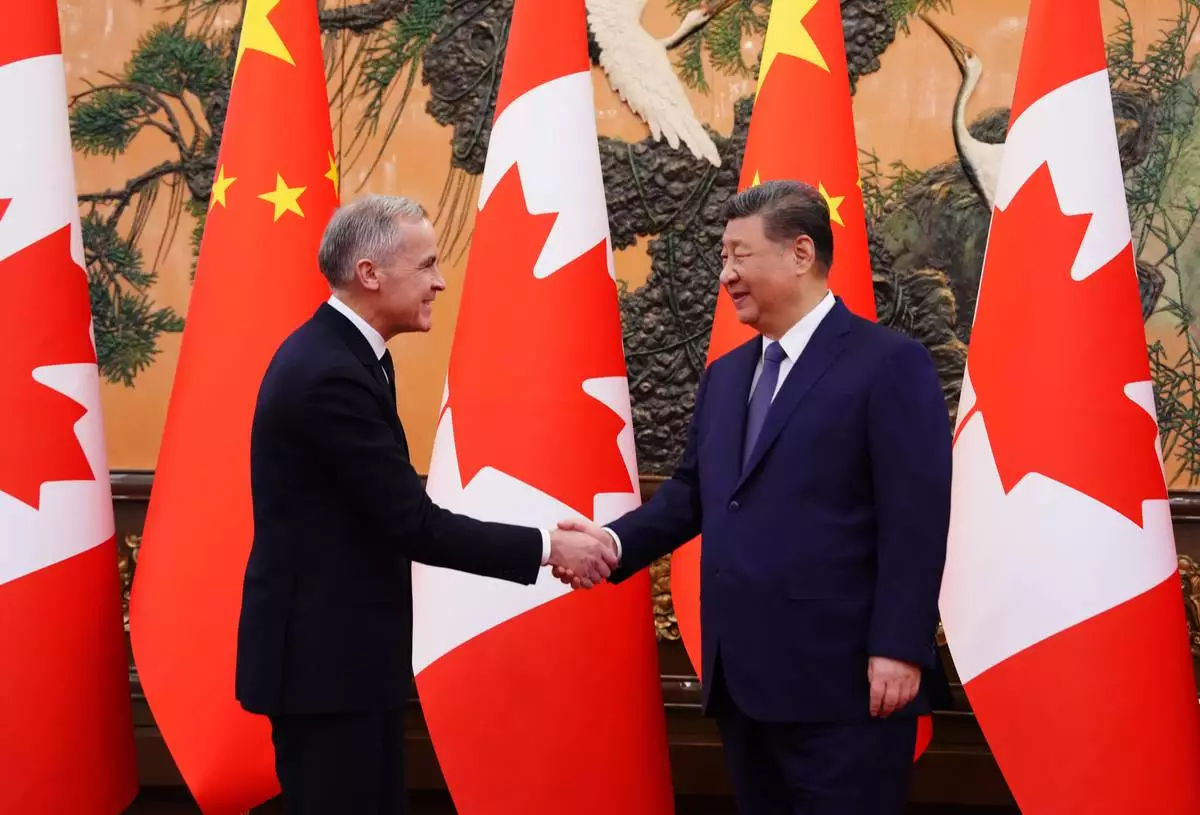
Canada's Prime Minister Mark Carney, left, meets with Chinese President Xi Jinping at the Great Hall of the People in Beijing Friday, Jan. 16, 2026. (Sean Kilpatrick/The Canadian Press via AP)
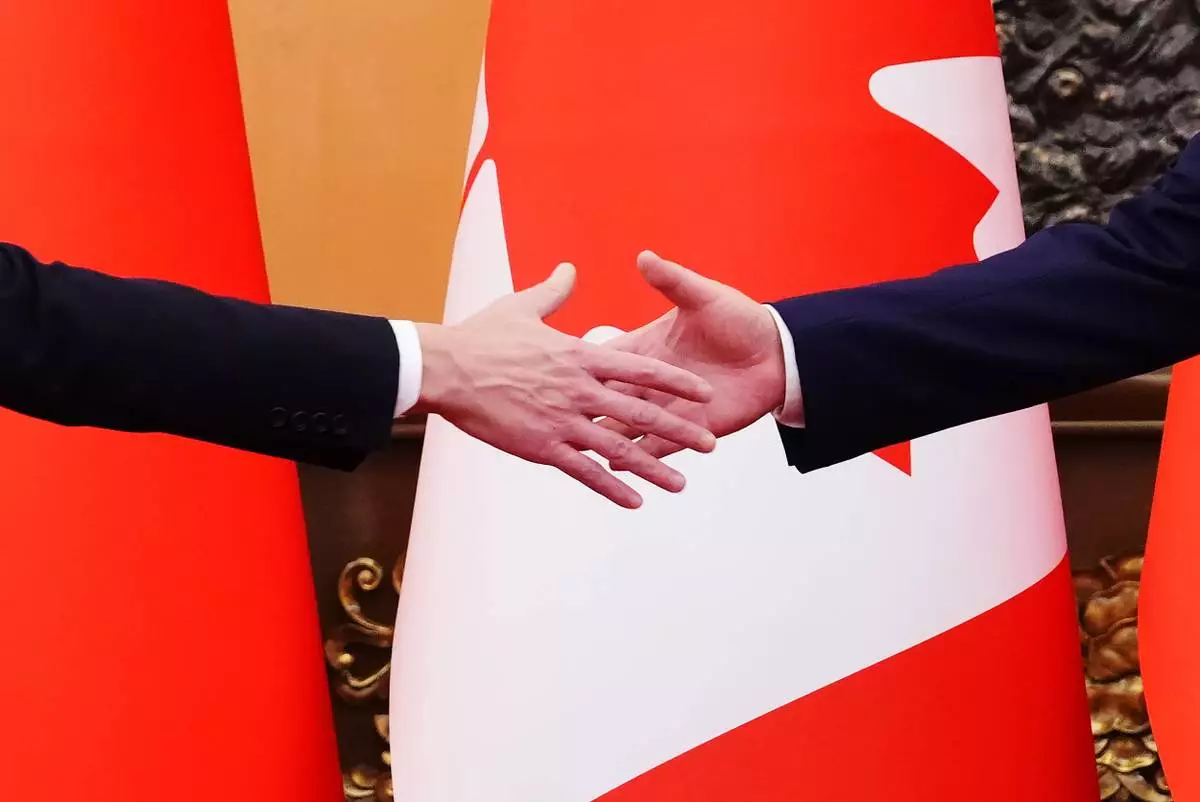
Canada's Prime Minister Mark Carney, left, shakes hands with China's President Xi Jinping at the Great Hall of the People in Beijing Friday, Jan. 16, 2026. (Sean Kilpatrick/The Canadian Press via AP)