Skip to Content Facebook Feature Image

China, Arab states to further enhance cooperation: officials

China

China

China

China, Arab states to further enhance cooperation: officials

2025-04-30 15:55 Last Updated At:17:57

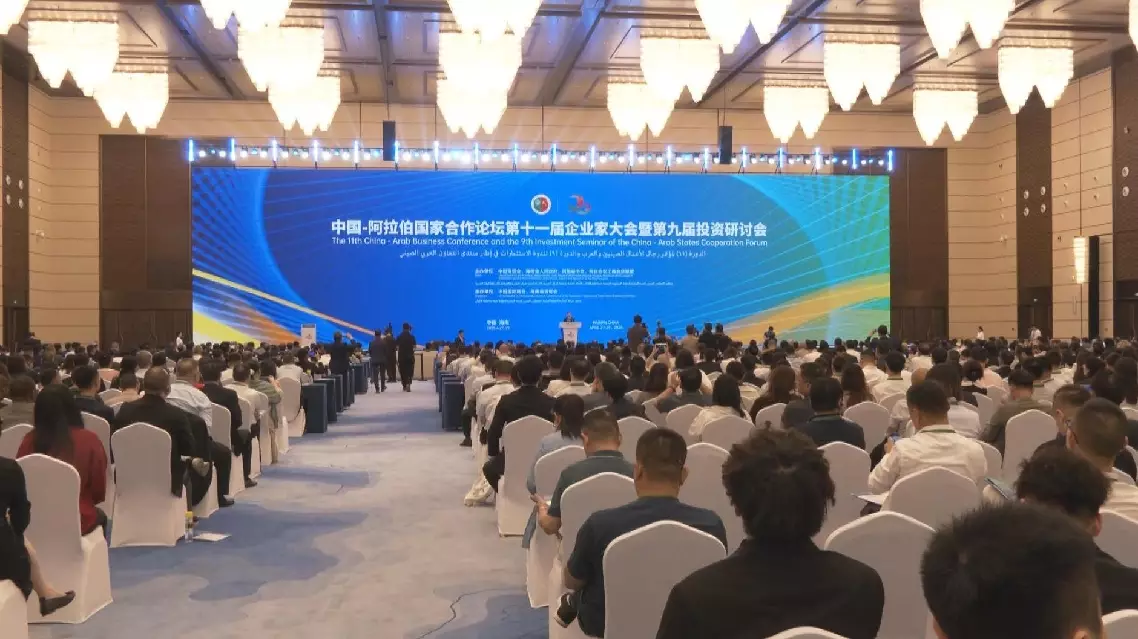
China-Arab States cooperation has seen fruitful results, and is expected to be further enhanced in various sectors, said Chinese officials at the Tuesday concluded 11th China-Arab Business Conference and 9th Investment Seminar of the China-Arab States Cooperation Forum.

China has long been a vital trade partner of Arab states. In the year of 2024, the bilateral trade volume between China and the Arab states exceeded 400 billion U.S. dollars, tenfold compared to less than 40 billion U.S. dollars in 2004.

To further enhance cooperation between China and Arab states, Chinese and Arabian trade promoting organs, the Secretariat of the Arab League, and the the People's Government of south China's Hainan Province co-hosted the three-day forum in Hainan's Haikou City.

"China has maintained its status as the largest trade partner of the Arab States for many consecutive years. In 2024, the total trade volume between China and the Arab States has exceeded 400 billion U.S. dollars. Bilateral investments between China and Arab States cover oil and gas, construction, manufacturing, new energy, health care, and many other sectors," said Ren Hongbin, chairman of the China Council for the Promotion of International Trade (CCPIT), in his speech at the conference.

Beyond the trade numbers, China and Arab states have been deepening the "oil and gas plus" cooperation model over the past years. Bilateral cooperation in cutting-edge technologies like big data, AI, and aviation and aerospace has been strengthened, and the industrial and supply chains of both sides have been integrated.

"We will leverage existing platforms such as the China-Arab Entrepreneurs Conference and the China-Arab Chamber of Commerce to create more cooperation opportunities through information sharing, group visits, and organizing various economic and trade activities," said Sun Xiao, secretary-general of the China International Chamber of Commerce.

To further foster cooperation between China and Arab states, the conference adopted the Haikou Declaration, highlighting strategic cooperation in various sectors,such as green energy, finance, industry, agriculture, and legal services, as well as promoting private sector cooperation and optimizing business environment.
China, Arab states to further enhance cooperation: officials

China, Arab states to further enhance cooperation: officials
Some Iranians in Türkiye are crossing back over the border, driven by worry and desperation, as a nationwide communications blackout in Iran has left them cut off from their loved ones.

Protests have erupted in many Iranian cities since Dec. 28. They initially began with Tehran bazaar merchants demonstrating against the sharp devaluation of the national currency rial, and soaring inflation, before spreading to other cities. The unrest has led to casualties among both security forces and civilians.

At the Turkish-Iranian border, many are returning with no certainty about what awaits them, filled instead with questions and growing fear for those on the other side of the border.

"I went to Van yesterday for internet. I urgently needed to use the internet. I got it done. Now I'm heading straight back. There are protests everywhere. We can't get any news. We can't communicate with our families. And it's not just me, there are many Iranians outside the country who can't reach their families," said Feriste, an Iranian citizen.

With communications blacked out across Iran, those outside the country feel powerless to check on the situation back home. For some, this silence has prompted them to return across the border, even as tensions continue to rise.

"We can't get any news. There is no internet. Everything is shut down. I want to search. I want to find out. I want to see my brother. I'm going to see my family," said Husnu, an Iranian citizen.

"I work in Türkiye, and I have no news from Iran at all. I'm going back because I'm worried about my family. It's been days since I last heard from them, and because I'm worried, I'm returning to Iran now. Of course, we are concerned about our safety. We don't know what awaits us there," said another Iranian.

With protests escalating and government blackouts still in place, many Iranians are caught between staying in safety abroad and risking everything to reconnect with their families.

"We had to come to Türkiye because we couldn't reach our families. Schools were closed already. All official institutions were shut down. We have no information about other cities either, because there is no communication network there. There is no television, no internet. We can't even check Twitter," said Nazlican, another Iranian citizen.

Iranians in Türkiye return home, fearing for their families amid unrest in Iran

Iranians in Türkiye return home, fearing for their families amid unrest in Iran

Iranians in Türkiye return home, fearing for their families amid unrest in Iran

Iranians in Türkiye return home, fearing for their families amid unrest in Iran

Recommended Articles