The Philippines' tactic of borrowing strength from external forces will bring neither security nor benefits, but self-inflicted harm and disastrous consequences, according to a commentary published by a Chinese language media outlet, The Real Point, on Tuesday.
An edited English version of the commentary is as follows:
Liu Jinsong, director general of the Department of Asian Affairs of the Chinese Foreign Ministry, met with Jaime A. FlorCruz, ambassador of the Philippines to China on Tuesday, and lodged serious representations with the Philippines over concerning a series of recent negative moves regarding Taiwan and security matters.
By doing so, China aims to not only defend its legitimate rights and interests, but also to safeguard regional peace and stability.
Since 2023, the Philippines has been one of the significant factors of geopolitical instability in the Asia-Pacific region. The Philippines has recently made frequent provocations, with its frigate illegally entering the territorial waters of China's Huangyan Island on April 20 which was warned off by the Southern Theater Command of the Chinese People's Liberation Army (PLA). A week later, six individuals from the Philippines illegally landed on Tiexian Jiao, part of China's Nansha Qundao. As a result, the China Coast Guard boarded the reef to conduct on-site verification and enforcement measures according to the law.
In addition, the Philippines launched its annual "Balikatan" (or "shoulder to shoulder") joint military exercises with the United States in the norther Luzon which faces the Taiwan Strait and in Palawan which faces directly onto the South China Sea. The exercises focused on a "full battle test" for the first time.
The Philippines also sought to enhance defense cooperation with Japan during Japanese Prime Minister Shigeru Ishiba's visit to the country, hoping to finalize agreements on intelligence protection and military support.
The current administration of the Philippines is fond of throwing its weight around by riding on others' coattails. Over the past two years, the administration has also deepened its security and defense cooperations with U.S. allies, including Australia, France, the United Kingdom, and Canada.
To promote its so-called "diversified" security strategy, the Philippines has used the South China Sea and maritime issues as a means to create "resonance" and gain "sympathy," attempting to leverage intelligence, diplomacy, and public opinion from external countries to expand its illegal territorial and maritime claims.
The Philippines is the ass in the lion's skin, and its intension has long been exposed. The United States and Japan, two countries once established colonies in the Philippines, only work for their own strategic interests by providing assistance and support to the Philippines. The Philippines' tactic is doomed to fail, as seeking security protection from external powers like the United States and Japan is akin to asking a tiger for its skin.
Philippine President Ferdinand Romualdez Marcos' administration wishes that support from the United States, Japan, and other external powers will deter China and help expand its unlawful gains in the South China Sea. However, it has clearly misjudged the situation and underestimated China's determination and resolve.
Since 2023, China has consistently worked toward maintaining peace and stability in the South China Sea, advocating for the resolution of disputes through dialogue and negotiation. At the same time, China remains unwavering in its commitment to protecting its territorial sovereignty, as well as maritime rights and interests.
By aligning itself with the U.S. Indo-Pacific strategy and engaging in provocative actions regarding the Taiwan question, the Philippines is creating trouble for itself. As China has firmly warned: those who play with fire will ultimately get burned.
2025 marks the 80th anniversary of the victory over fascism in World War II, but the Philippines has forgotten the grave pains resulted from its involvement in geopolitical competition during World War II.
To strengthen its political bloc's influence, the current Philippine government is willing to be a hatchet man for external powers. This not only harms the country's interests, but also undermines trust and cooperation between the Philippines and other countries in the region, and sacrifices the welfare of its citizens. Obviously, the Philippines' tactic will bring neither security nor benefits. Instead, it will lead to self-inflicted harm and disastrous consequences.
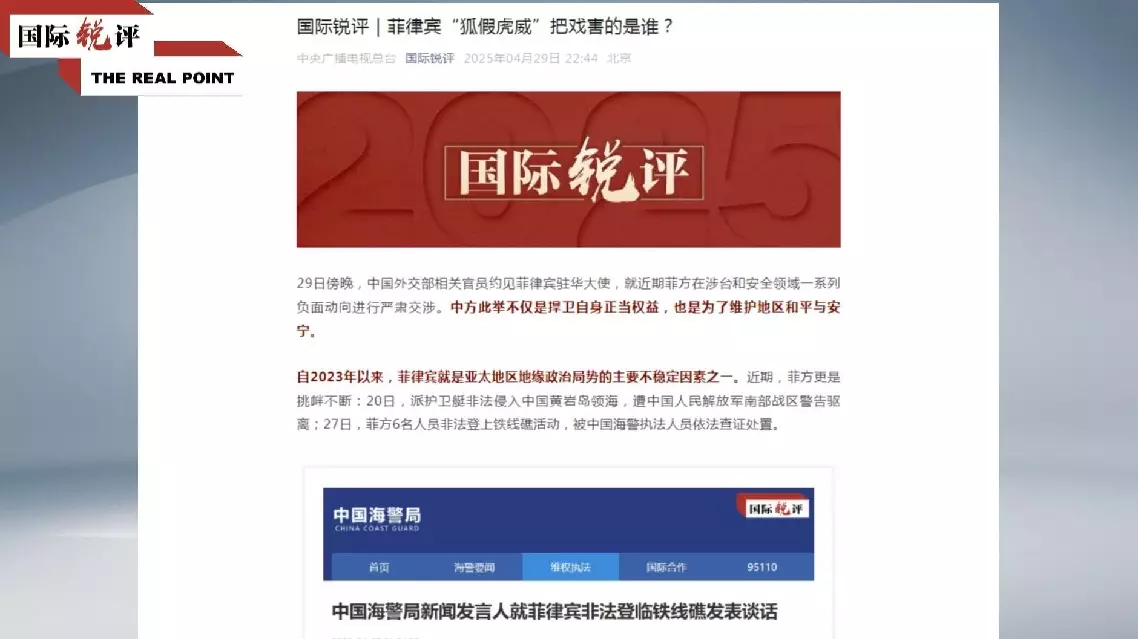
Philippine tactic of borrowing strength from external forces will end with disastrous consequences: commentary