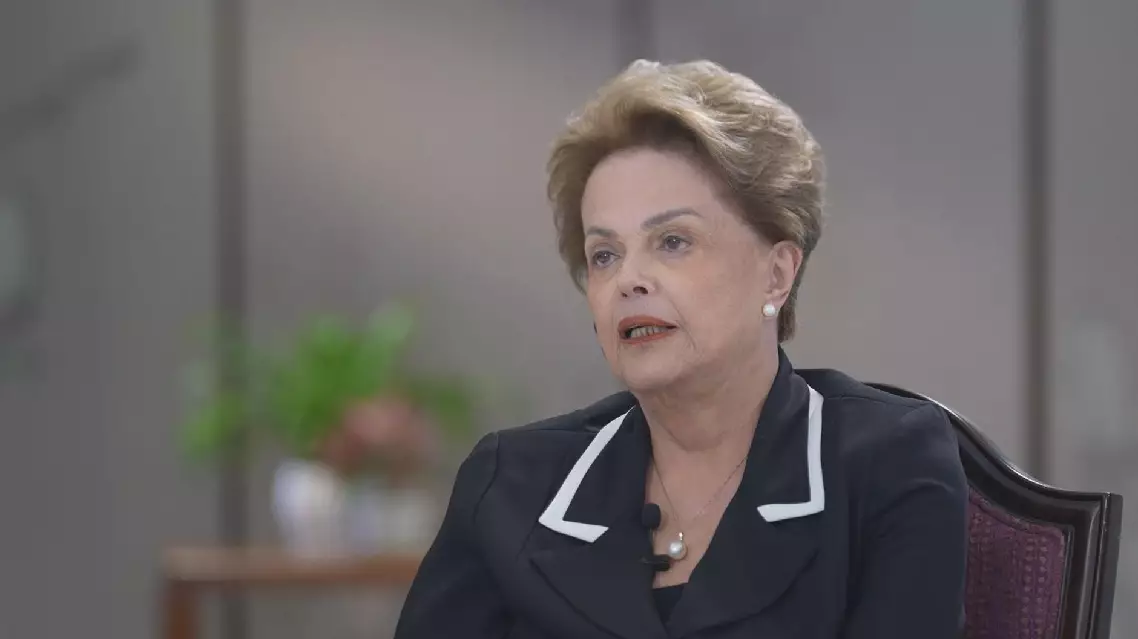
The United States has been arbitrarily imposing tariffs on countries in an attempt to address issues stemming from the dollar's hegemonic status -- an approach that will ultimately fail and harm its own economy, said Dilma Rousseff, president of the New Development Bank (NDB).
In an interview with China Media Group (CMG) in Shanghai on Monday, the NDB president stated that the U.S. has made a grave mistake by initiating the current trade war.
"I think this trade war is perhaps the biggest mistake a country could make. In this trade war, all countries were categorized in a chart, with vague criteria and contradictory financial formulas applied. All nations were subjected to enormous tariff pressure," said Rousseff.
"It is shocking to the world that even uninhabited islands had absurd tariffs imposed on them by the U.S. This is something we cannot silently accept," she added.
Rousseff said the United States is trying to maintain its global hegemony through the abuse of tariffs; however, these policies will only undermine business and consumer confidence and erode the international standing of the U.S. dollar.
"First of all, in my opinion, the U.S. cannot achieve its intended goals through this approach -- it is harming itself. The high additional tariffs announced by the Trump administration on April 2 triggered de-dollarization efforts in other countries, yet the U.S. turned around and criticized others for doing so. The global financial markets experienced massive volatility -- the most severe in decades -- as the U.S. dollar and stock market dropped, and U.S. Treasury bonds became increasingly vulnerable. I believe the tariff measures announced on April 2 are unsustainable and difficult to maintain," she said.
In discussing the root causes of global financial imbalances, she pointed to structural issues in the international monetary system rather than trade policies.
"Secondly, I believe the U.S. current account deficit -- in other words, its trade deficit -- is not the result of tariffs. The real issue lies in the United States' control over a dominant global currency. Valery Giscard d'Estaing, who was France's finance minister under the presidency of Charles de Gaulle, once described the U.S. dollar as having an 'exorbitant privilege' -- meaning the dollar holds a distinct advantage as a global currency," said the NDB president.
"Regardless of cost, interest, or any other consideration, countries entrusted their foreign exchange reserves to the United States, which recycles them while paying very little interest. What does this mean? It means the U.S. can spend without restraint and, as a result, has accumulated massive debt. Now, the U.S. is attempting to eliminate its current account deficit through additional tariffs. It failed in its first attempt, and I believe this second attempt will also be in vain," said Rousseff.

US can't get rid of current account deficit through high tariffs: NDB president
US can't get rid of current account deficit through high tariffs: NDB president