China's transport authorities have taken targeted measures to respond to a holiday return trip peak on Monday, the last day of the five-day May Day holiday.
Data showed that the national railway system is expected to handle more than 20 million passenger trips on Monday.
To manage surging passenger flow smoothly, railway departments nationwide have systematically implemented various measures. For instance, the Baoji East Railway Station in northwest China's Shaanxi Province has leveraged its ticketing system to forecast peak days and critical time intervals in advance, and has formulated daily plans for the operation of security check, ticket checking, entry and exit procedures, as well as staff deployment.
Considering the growing number of family outings and the rising proportion of elderly passengers, China Railway Urumqi Bureau Group has refined its reservation services and optimized entry and exit procedures, offering tailored services to help elderly travelers.
In addition, the China Railway Wuhan Bureau Group has deployed an additional 196 passenger trains on high-demand routes.
Furthermore, the Nanchang West Railway Station in east China's Jiangxi Province has upgraded its ride-hailing waiting area, expanding it from around 200 to over 800 square meters, with the capacity to accommodate up to 500 passengers simultaneously.
"The new waiting area for ride-hailing services is more comfortable and intelligent. You can check the parking location of your ride-hailing vehicle through the LED display screen beside me," said He Shuang, a staffer at the station.
The road network will witness a passenger peak on Monday. Substantial traffic congestion is expected on roads surrounding major cities, railway stations, and airports from 14:00 onward.
East China's Zhejiang Province has currently implemented an overall intelligent emergency response solution on multiple expressways within the province. The smart highway system, which utilizes video AI analysis can accurately identify traffic anomalies and disaster risks.
"This smart management system is mainly based on video AI analysis. It can automatically detect anything abnormal on the road within five seconds, associate them with real-time road conditions, generate traffic control strategies and emergency plans within 30 seconds, and formulate segmented and graded joint control measures," said Luo Guoxing, director of Zhejiang Traffic Group Expressway Shaoxing Management Center.
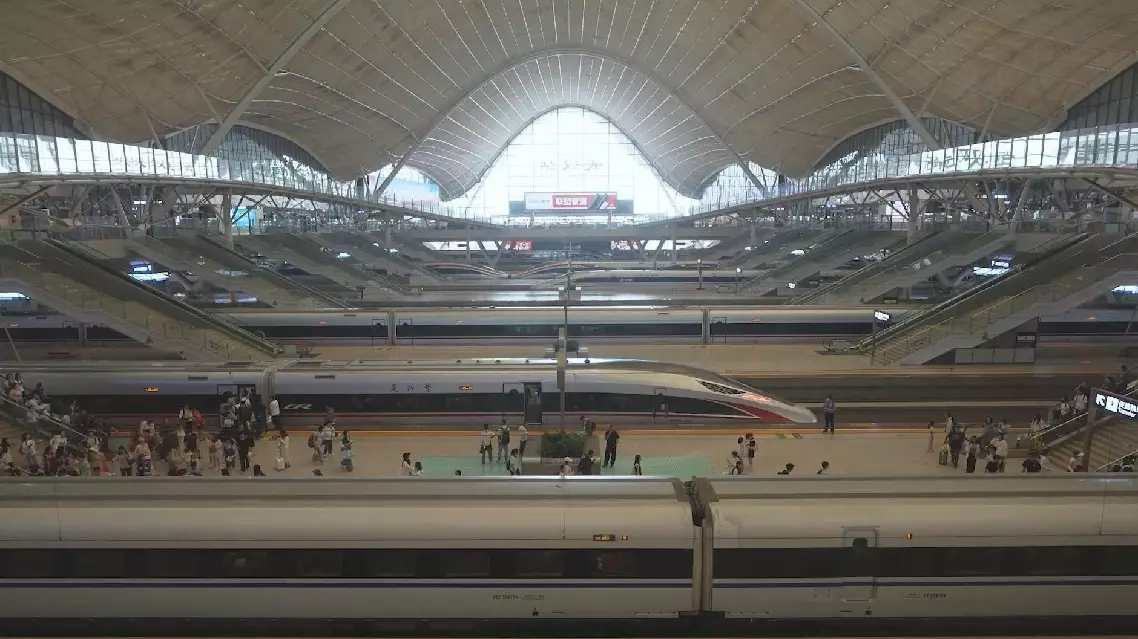
China gears up for return travel peak as May Day holiday comes to close
China gears up for return travel peak as May Day holiday comes to close