Chinese new energy vehicle (NEV) manufacturers have been calm after the United States imposed new auto tariffs and will remain committed to the hard but right path of going out because they know how to deal with the situation after years of Western suppression, said a commentary released by China Media Group on Saturday.
An edited English-language version of the commentary is as follows:
After the Donald Trump administration imposed tariffs on auto imports, European automakers took the initiative and suspended exports to the United States, while Japanese and South Korean automakers stated they were ready to accelerate the construction of factories in America. However, American automakers were the ones who were truly ready. They immediately launched promotional plans, lowering prices to capture market share, including that of the flagship F-150.
What about the impact on China?
Chinese automakers, especially NEV manufacturers, reacted relatively calmly to the auto tariffs, because the U.S. market refused their entry as early as seven years ago.
According to data from China's General Administration of Customs, which started counting NEV exports in 2017, the very largest destination of Chinese NEVs was the U.S. in 2017 and 2018.
In early 2018, top automakers from around the world gathered at the auto show in Detroit, which is known as the Motor City.
Ford, playing at home, saw a Chinese car company at the auto show -- the GAC, which, after studying the North American market for three years, unveiled a new energy concept car developed for the North American market and officially announced at the auto show that it would enter the U.S. market in 2019.
After hearing the news, the American media raised many questions in their reports, doubting if Americans would buy Chinese cars and asserting it was too early for the GAC to enter the U.S. market.
It wasn't the debut of Chinese cars at the North American auto show, but previous brands failed to gain a foothold, because for years, to the North American market, Chinese cars had been poor in quality, weak in performance, and had no brand appeal.
However, Ford didn't think so. Their executives had visited China and seen scenes that people in the U.S. could not see.
As the auto show was taking place, the monthly sales of NEVs in China surged by four times year on year. At that moment, the NEV sales accounted for less than 0.5 percent of the total auto sales in the U.S., while the figure already hit 2.7 percent in China. Meanwhile, the global figure just exceeded 1 percent.
So, Ford had no doubt that China would become the leader in global EV development. The only question for Ford was: Can a battery-electric vehicle stir the soul? This was the title of Ford executive's speech at the auto show.
Where did the hesitation come from?
At that time, the U.S. government just withdrew from the Paris Agreement and delayed the ban on sales of new petrol and diesel vehicles in the U.S., so local automakers were not in a hurry to launch new energy products, meaning there was a precious window for automakers to proceed from research and development to mass production in the U.S. market.
The entry of Chinese automakers into the U.S. market means taking a key share of the global market.
Watching Chinese NEVs entering the U.S. in small quantities and Chinese automakers building dealer networks, Ford executives finally decided to develop NEVs in full gear.
In order to speed up research and development, Ford moved its EV and self-driving car teams to a renovated factory in Detroit.
In the same city, the GAC established a research and development center to develop and test car models for the North American market.
Just as Chinese and American automakers were racing against time, the Trump administration launched a Section 301 Investigation against China. Politicians exploited the public attention on the plans of Chinese automakers to enter the U.S. market to hype up problems with China's trade policies. And then, negative news on China began increasing.
Following the investigation, on July 6, 2018, the U.S. imposed an additional duty of 25 percent on car imports from China, changing the competition between Chinese and U.S. automakers.
Many Chinese automakers gave up the North American market, which marked another failed attempt by them to enter the U.S. market.
The slightly increasing NEV exports from China to the U.S. dropped sharply.
It was not just Chinese automakers that were affected. Many American automakers, including Ford, were forced to stop selling cars produced in China back to the U.S. In the year, Ford's sales in China fell 54 percent year on year.
Many American automakers expressed their hope that the two governments could work together and solve the problem, but the U.S. government insisted on attacking China, so when American automakers encountered their Chinese counterparts in Europe the following year, things became different.
Instead of a free fall, China's NEV exports saw a slight growth in 2019 despite the failed entry into the U.S. market. And the driver for this growth was Europe.
In September 2019, the Frankfurt Motor Show, the world's largest international auto show, took place in Germany, where various time-honored European brands, such as Volkswagen, BMW, Mercedes-Benz, and Porsche unveiled their NEV models.
Ford was also there, sharing an exhibition area with Chinese automakers, the number of which topped all participating countries at 79.
European automakers were not unfamiliar with their Chinese counterparts, because the three giants -- Volkswagen, Mercedes-Benz, and BMW -- had already signed cooperation agreements with Chinese suppliers and manufacturers such as CATL, BAIC, JAC, and GWM.
However, at the next edition of the motor show in 2021, a lot of arguments suddenly emerged, with media reporting that the sales of Chinese NEVs were increasing in Europe simply because they were cheaper.
But this didn't dissuade European automakers from partnering with Chinese companies. They started building connections involving various production links with Chinese NEV firms and promoted the construction of two CATL battery factories in Europe. In this way, China's NEV industrial chain took root in Europe.
In the summer of 2023, the Munich Motor Show opened with 300 fewer exhibitors than at its peak, but it attracted all the attention despite the smaller scale.
During the event, the then German Chancellor Olaf Scholz took the lead in visiting booths of Chinese NEV companies.
Chinese exhibitors took the center stage at the European event, and some people were not happy about it.
Three days later, President of European Commission Ursula von der Leyen announced that the commission would carry out an anti-subsidy investigation into the imports of battery electric vehicles from China.
The EU required as many as 204 Chinese companies to fill out questionnaires. After these companies submitted 21 GB of information, they were required again to fill out more than 100 supplementary questionnaires in over a dozen rounds.
The focus of these questionnaires was on the raw materials, chemical composition and formula of Chinese NEV batteries, and the amount of each main raw material used, such as lithium iron phosphate, graphite, copper and aluminum.
Different from the determined refusal of the U.S., the EU was not only denying Chinese automakers' access to the European market, but also seeking to draw experience and technology from successful Chinese NEV companies and then pass them on to local automakers.
This move didn't halt the trade. Data showed that while China and the EU were negotiating, China's NEV exports to Europe declined slightly but remained first among all continents.
Meanwhile, China's NEV exports to other Asian countries and South America have been growing rapidly.
Due to U.S. tariffs, 2019 was a dark year for China's NEV industry. BYD's profits dropped for the third consecutive year. NIO's lowest share price was 1.19 U.S. dollars. Li Auto and Xiaopeng both experienced capital chain breaks.
That year, the output and sales of NEVs in the Chinese market fell for the first time in history.
Nevertheless, it was also the year when China's NEV exports to Europe began increasing and the year when Chinese automakers started installing intelligent devices into cars before high-end European and American brands did, with competition in the industry becoming increasingly intense.
Such competition, however, drove the rapid growth of China's NEV industry in the following four years and at the same time, pushed European and U.S. automakers to launch smarter products.
In October 2023, one month after the EU launched the anti-subsidy investigation, Volkswagen Group CEO Oliver Blume flew to China with a larger team than his previous two visits in the year.
Soon after Blume left, executives of BMW and Mercedes-Benz also visited China, respectively on October 19 and 20.
Meanwhile, Chinese auto business leaders were also traveling to Europe. Faced with another rejection from the Western market, they chose to step up investment in Europe rather than withdraw.
In the U.S., Ford and CATL jointly built a battery factory in 2023.
When asked if Ford would be pressured by the U.S. government, which has been trying to contain China, Ford CEO said, "We are on the plan, and it's our investment. So, that's as simple as it needs to be." Maybe it does need to be this simple.
From the U.S. to Europe and the current Asia and South America, no one knows the exact time when the changes in China's NEV industry occurred. Perhaps the point of this journey is to tell us that we have always picked the hard but right path -- going out.
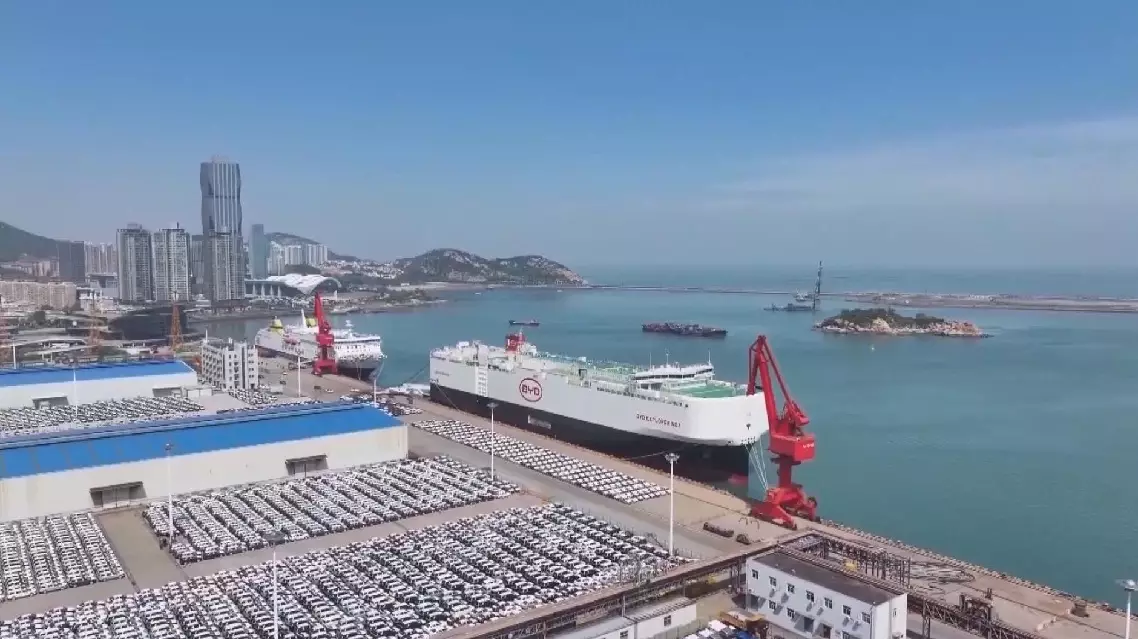
Chinese NEV firms remain committed to global market despite Western suppression: commentary