Ted Williams is the last American Leaguer to hit .400, and there are actually plenty of similarities between him and Aaron Judge.
The one major difference is in the strikeout column, and that's why Judge is highly unlikely to repeat Williams' famous feat.
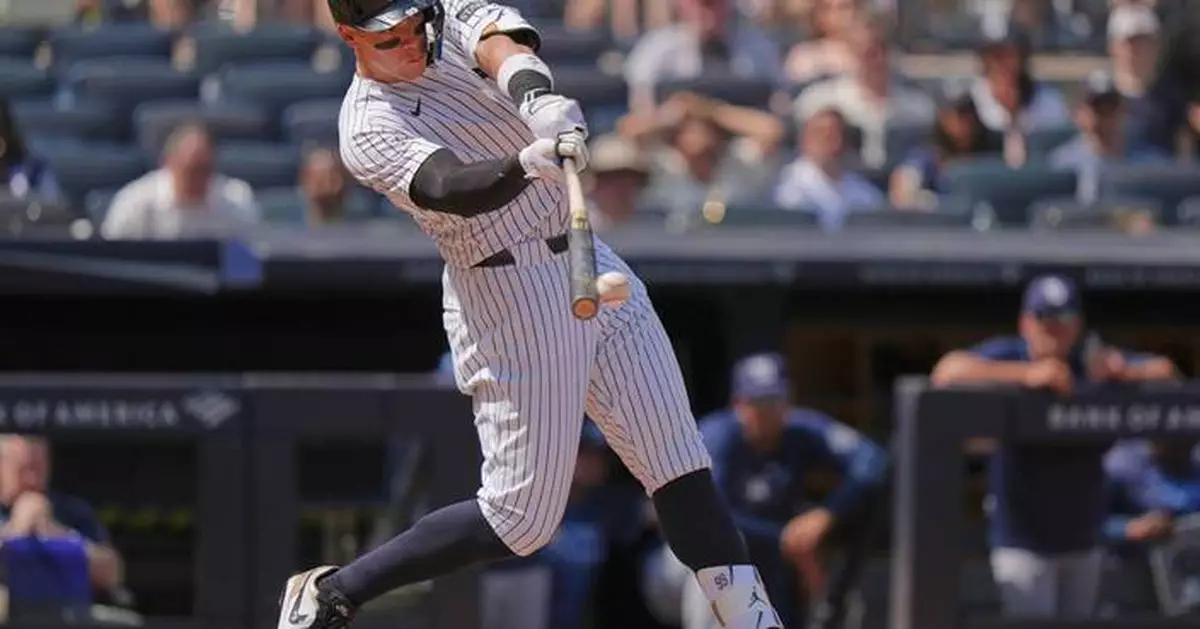
With a .423 batting average through 34 games, Judge leads the major leagues in hitting by a whopping 74 points over New York Yankees teammate Paul Goldschmidt. Judge's OPS of 1.287 is actually the same number Williams finished with when he hit .406 in 1941. Williams averaged a homer every 12.32 at-bats that year. Judge is hitting one every 11.82 so far this season.
But Williams struck out only 27 times in all of 1941. Judge has already done so 31 times.
Judge has struck out in 20.3% of his plate appearances. In the live ball era, only one player in the AL or NL has even hit .350 with a strikeout rate of at least 20%. That was Manny Ramirez at .351 in 2000.
Still, Judge's strengths — and his one big weakness — can help us come up with a road map of sorts for aspiring .400 hitters.
Step One: Shrink the sample size.
It's no accident that all of baseball's .400 hitters played before the season expanded to 162 games. Smaller samples lead to more extreme stats, and when Williams hit .406 in 1941, he only played in 143 games. George Brett played in 117 games when he hit .390 in 1980. Tony Gwynn topped out at .394 in 1994 — the season that ended in mid-August because of a strike.
No, that doesn't mean players should try to get injured or miss games for other reasons. But a high walk total is imperative if you want to qualify for the batting title while still keeping your at-bat total reasonably low. Williams had only 456 at-bats in 1941 because he drew 147 walks.
Ichiro Suzuki was a prolific contact hitter who didn't walk much. He would routinely end up with around 700 at-bats in a season, and it's extremely hard to sustain a .400 average for that long.
Step Two: Make contact.
This is the problem for Judge and other power hitters of this era. A player who strikes out in 20% of his plate appearances has to hit .500 on the PAs he doesn't strike out in if he's going to bat .400 overall. Right now Judge is 55 for 99 when he doesn't strike out — an extraordinary mark but not one that is likely to last.
Step Three: Ride a BABIP heater.
There's a lot of luck involved in a player's batting average on balls in play (BABIP), but there are some ways a hitter can improve it. Hitting line drives is obviously preferable to hitting popups, and speedy players can turn grounders into infield hits, boosting their BABIP — and batting average — that way. George Sisler had a BABIP of .422 in 1922 when he hit .420.
Step Four: Hit homers.
Unfortunately, BABIP numbers like Sisler's don't happen much, especially now. The overall BABIP across the major leagues this year is .288. It was over .300 back in 1930 — which happened to be the year Bill Terry became the last National Leaguer to hit .400. Fielders have more success turning balls in play into outs than they did then, but one way to avoid that is to hit a lot of homers. When Rod Carew hit .388 in 1977, he was boosted by a BABIP of .408, but it was also the year he tied his career high with 14 home runs.
Needless to say, there aren't many players who can combine high walk and home run rates with low strikeouts in a way that adds up to a .400 average. For example, Barry Bonds homered every 6.52 at-bats in 2001 and posted career-best walk (37.6%) and strikeout (6.6%) rates in 2004. His best BABIP was .330 in 2002.
Now let's imagine he pulled off all those career-best rates in the same season, and let's give him 600 plate appearances. The rest of the numbers would shake out like this: 226 walks, 40 strikeouts, 374 at-bats, 57 home runs and 148 hits. But that would still only be an average of .396.
One player who could have made a run at .400 but never really did was Wade Boggs, whose highest average was .368. Boggs had a BABIP of .396 in 1985, then posted his one big home run year in 1987 when he hit 24 — one every 22.96 at-bats. In 1988, he struck out in a minuscule 4.7% of his plate appearances while walking in 17.4%.
If we combine those rates into one hypothetical season like we did with Bonds, we end up with: 600 PAs, 104 walks, 28 strikeouts, 496 at-bats, 22 homers and 199 hits. That's a .401 average.
Jake Meyers went 4 for 4 with two homers and seven RBIs in Houston's 8-3 victory over the Chicago White Sox on Saturday. He tied a franchise record with 13 total bases.
The Toronto Blue Jays rallied from a 6-0 deficit in the sixth inning to beat the Boston Red Sox 7-6 in 10 on Wednesday night. Toronto had a 1.6% chance to win in the sixth, according to Baseball Savant.
The Blue Jays actually wiped out the deficit quickly. Daulton Varsho hit a two-run homer in the sixth and Alejandro Kirk followed with a solo shot. Then Anthony Santander tied it with a three-run homer the following inning. Kirk eventually won it with a bases-loaded single in extra innings.
AP MLB: https://apnews.com/hub/mlb
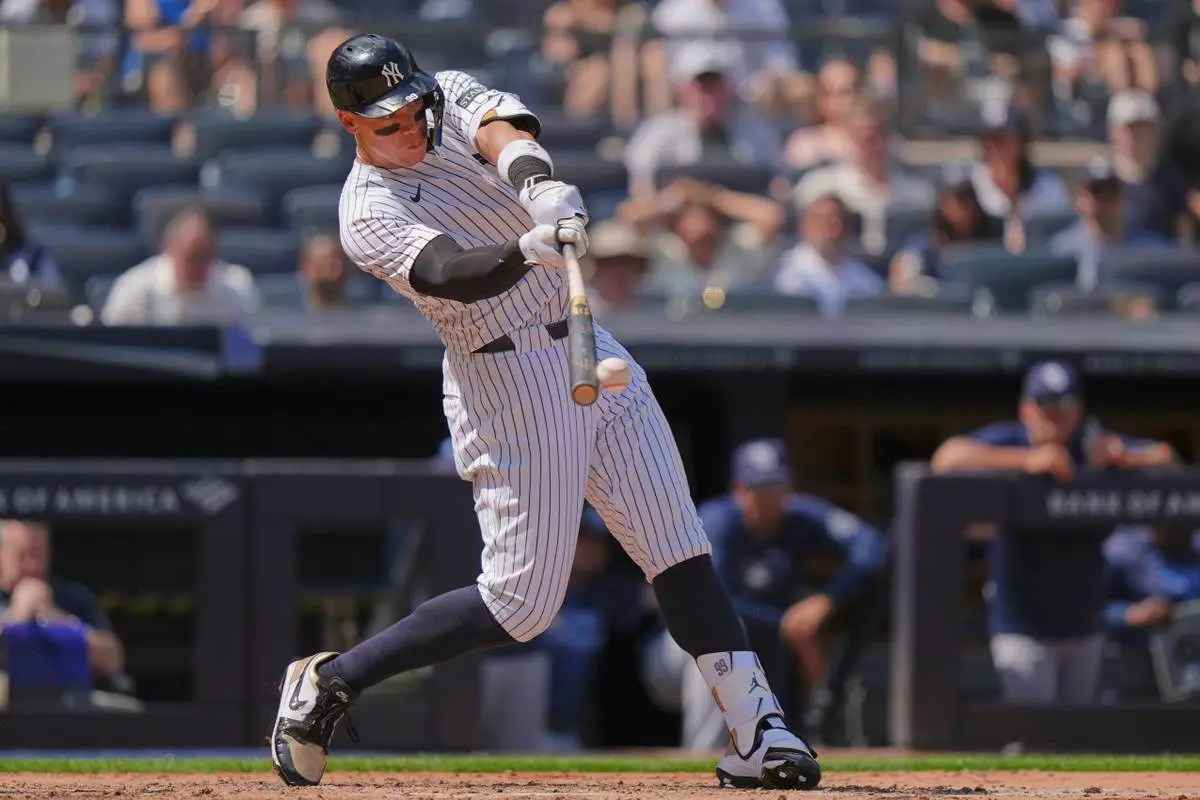
New York Yankees' Aaron Judge hits a single during the sixth inning of a baseball game against the Tampa Bay Rays, Saturday, May 3, 2025, in New York. (AP Photo/Frank Franklin II)