Agricultural cooperation between China and Russia has become a key highlight of their growing bilateral relations, with trade in farm machinery and key crops like rapeseed and soybeans strengthening year by year.
In Russia's Krasnoyarsk region which is known for its vast fields of rapeseed, the top Russian agricultural export to China, Chinese-made tractors are now widely deployed by local people.
Just a few years ago, such equipment was rare in Siberia. At present, Chinese agricultural machinery companies are not only providing cost-effective solutions but also offering customized designs suited to the harsh local climate.
"We've already made four rounds of custom modifications to the imported tractors. Chinese companies have been improving their products, as the fifth round has been planned to carry out to further enhance power and hydraulic systems based on farmer feedback," said Konstantin Etchin, a local manager for Chinese agricultural machinery sales.
Chinese agricultural machinery dealers in Russia are increasing their stock of spare parts to ensure timely maintenance services for customers.
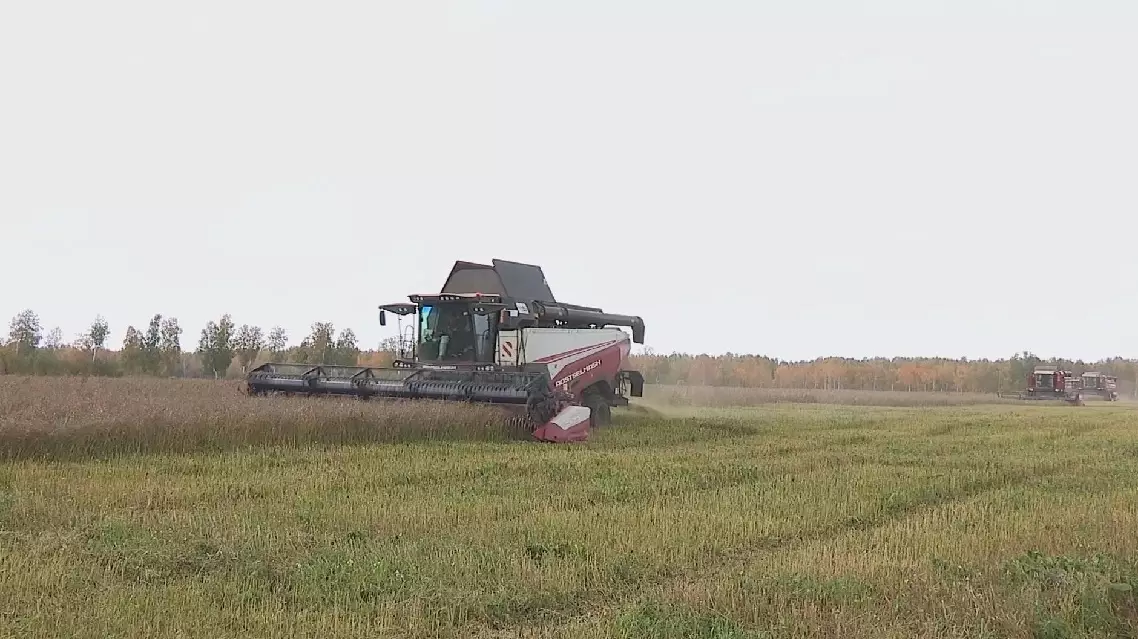
Local farmers have expressed high satisfaction with the pricing of the equipment, noting that Chinese-made tractors and combine harvesters are 30 to even 50 percent cheaper than their European counterparts.
The wide variety and competitiveness of Chinese agricultural machinery are evident at various Russian trade fairs and large-scale farm equipment expos.
With Chinese machinery in wide use, Russian farmers are expanding rapeseed cultivation -- nicknamed "black gold" for its profitability -- and planning to introduce soybeans, which are in high demand in China and beneficial to soil health.
Although rapeseed cultivation is challenging, it brings considerable economic benefits.
Through close cooperation with China, local agricultural producers have seen their incomes stabilized and their farming equipment significantly upgraded.
"Demand for rapeseed is extremely high. Buyers are ready to purchase as soon as the harvest begins, and by the end of the harvest season, nearly all the rapeseed is sold out -- yet people still call to ask if any is left," said Oleg Startsev, director of a local farm.
Currently, Krasnoyarsk is a key region for rapeseed cultivation and processing in Russia.
To prevent excessive export of raw materials, the Russian government has implemented export duties on rapeseed. This policy has, to some extent, driven large-scale domestic investment in local oil refining. As a result, the rapeseed oil exported to China is now in the form of unrefined finished products.
"This is our semi-finished product. The oil will next undergo filtration before being packed into containers for transport. The rapeseed oil is heated to 80 degrees Celsius to maximize the filtration effect, ensuring that only the purest rapeseed oil is delivered to the Chinese market," said Mikhail Usoltsev, manager from an edible oil refinery.
This year, local farmers plan to expand cultivation of another crop in high demand in the Chinese market -- soybeans. For Siberia, this is a new addition to the agricultural landscape. Unlike rapeseed, which can deplete soil nutrients, soybeans actually help improve soil conditions.
China's vast demand has also driven scientists to successfully develop new high-yield soybean varieties that are drought- and frost-resistant. At the same time, researchers are working on creating a range of soybean-based products that are both tasty and healthy.
In the next one to two years, China may be able to import not only soybeans from Siberia, but also soy-based cheese and beverages.
Rapeseed, agricultural machinery, and soybeans all bear witness to the deepening agricultural cooperation between China and Russia.
China-Russia agriculture ties thrive with machinery, crop trade