Finance ministers and central bank governors from the Association of Southeast Asian Nations (ASEAN), China, Japan and the Republic of Korea (ASEAN Plus Three or 10+3) finished their 28th annual meeting in Milan on Sunday.
Co-chaired by China and Malaysia this year, the meeting focused on global and regional macroeconomic developments and regional financial cooperation under the 10+3 framework and issued a joint statement.
According to the statement, participants supported the updating of the strategic direction for ASEAN+3 financial cooperation and agreed to launch technical assistance tools aimed at addressing medium- to long-term structural challenges.
Members affirmed the progress of the discussion on the Chiang Mai Initiative Multilateralization (CMIM) and welcomed the new director of ASEAN+3 Macroeconomic Research Office and the expansion of the ASEAN+3 Financial Think-tank Network, said the statement.
The 10+3 also welcomed the in-depth development of the local bond market in the region and approved the concept document of the future roadmap for the Disaster Risk Financing Initiative, the statement noted.
In his remarks, China's Finance Minister Lan Fo'an said that the current global economic landscape is undergoing profound adjustments, with globalization facing rising trends of unilateralism and protectionism.
Despite these challenges, he said, the ASEAN+3 regional economy has demonstrated strong resilience and held considerable growth potential.
China stands ready to work with ASEAN+3 partners to uphold openness and inclusiveness and to deepen regional financial cooperation continuously with a view to providing stability and certainty amid global turbulence, Lan said.
In addition, all parties at the meeting endorsed the establishment of Rapid Financing Facility (RFF) with the incorporation of eligible non-dollar currencies including Chinese yuan as currencies of choice under the CMIM for providing financing to member economies.
Pan Gongsheng, governor of the People's Bank of China, said compared with the existing mechanisms under the CMIM, the new facility is expected to feature faster disbursement and a broader range of applications.
He also stressed that due to the expanding role of Chinese yuan in global settlements, the People's Bank of China is confident in ensuring the availability of the currency and will promote its further use under the CMIM.
The CMIM, one of the arrangements that fosters financial integration among Asian countries, aims to create a regional foreign exchange reserve in a bid to tackle the imbalance in international payments and short-term liquidity shortage.
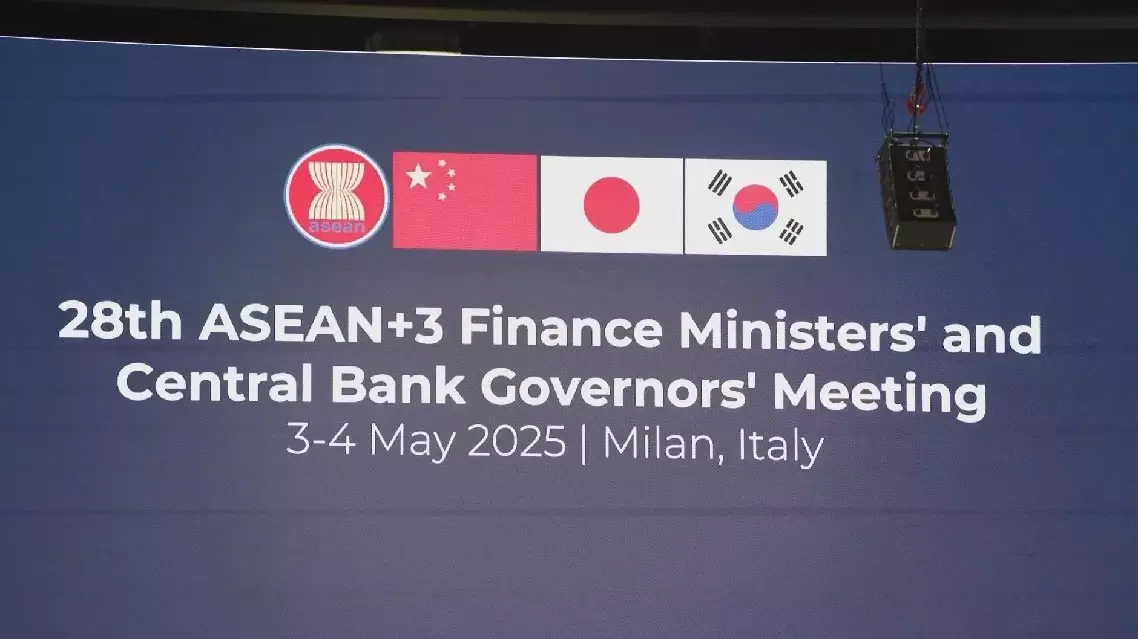
ASEAN+3 finance ministers, central bank governors conclude meeting