China's performing arts market raked in over 2.1 billion yuan (about 299 million U.S. dollars) of revenue during the May Day holiday, with total ticket sales reaching across a diverse range of stagecraft categories.
According to data from the China Association of Performing Arts, 33,500 commercial performances (excluding those in entertainment venues) were held across China during the five-day holiday from May 1-5, with combined ticket sales expanding by 3.6 percent compared to last year. The number of attendees reached 10.3 million, up by 0.47 percent year on year.
During the holiday, professional theater performances made up the majority of all commercial performances, covering drama, musicals, operas, acrobatics, and traditional Chinese opera. The total box office of large-scale commercial performances -- those with over 5,000 audience members -- reached 1.2 billion yuan (about 168 million U.S. dollars) during the May Day holiday, marking a 5 percent year-on-year increase.
The surge in interest in performances also helped drive cultural tourism spending during the five-day period, with hotels, restaurants, and shops benefiting from a surge in customers drawn by the performances.
In scenic tourism areas, diversified performances during the May Day holiday significantly enhanced the cultural experiences of visitors. Nationally, large and medium-sized tourism performance projects saw ticket sale revenues reaching 685 million yuan (about 95 million U.S. dollars), up 9.08 percent year on year, with audience numbers reaching 5.58 million, an increase of 6.11 percent.

China's performing arts market rakes in 2.1 billion yuan of revenue during May Day holiday
The 32nd Asia-Pacific Economic Cooperation (APEC) Ministers Responsible for Trade Meeting concluded in east China's Suzhou on Saturday, yielding fruitful results and laying significant groundwork for the APEC Economic Leaders' Meeting in November.
The trade ministers' meeting focused on "building an open and predictable regional and multilateral economic and trade order" and "fostering new engines of innovative and dynamic trade and investment cooperation."
Chinese Commerce Minister Wang Wentao briefed the media on the meeting's outcomes at a press conference.
Wang said the meeting issued a joint statement titled the Suzhou Statement, and approved the latest edition of the APEC Roadmap for Innovative, Competitive and Resilient Services.
All parties agreed to advance policy innovation and reform in services trade, build an open and predictable investment environment, improve regional trade facilitation and supply chain resilience, strengthen standards coordination, and enhance intellectual property protection, Wang told the media.
He also said that substantial progress was made on a framework document for regional digital trade cooperation and the ministers emphasized promoting inclusive AI development, strengthening AI-related trade, and bridging the digital divide to ensure shared benefits from digital transformation.
The minister noted that the outcomes of the meeting demonstrated strong cooperation willingness, highlighted an innovation-oriented approach, and reflected inclusiveness and shared benefits. "The fact that Asia-Pacific economies can come together, uphold the original aspiration of promoting trade and investment liberalization and facilitation while supporting economic growth and prosperity, and engage in in-depth discussions on the important issue of 'where multilateral and regional economic and trade cooperation is headed,' fully demonstrates that open regionalism and true multilateralism enjoy broad support, and that mutual success and shared development serve the fundamental interests of all economies," Wang said.
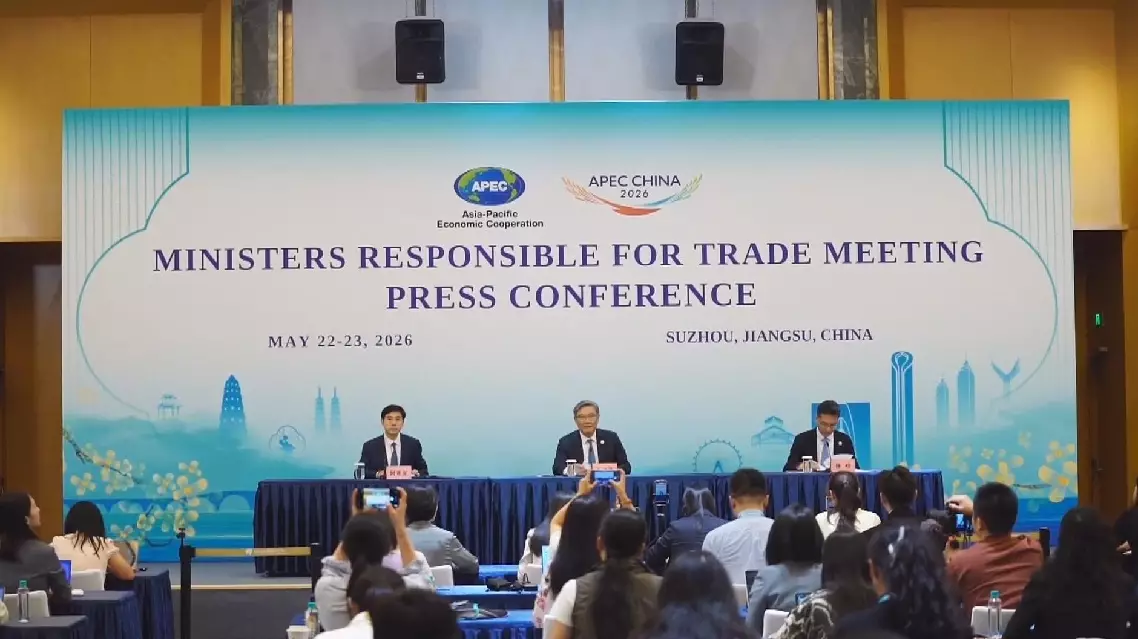
2026 APEC trade ministers' meeting concludes with fruitful results