Skip to Content Facebook Feature Image

Cadence Accelerates Physical AI Applications with Tensilica NeuroEdge 130 AI Co-Processor

News

Cadence Accelerates Physical AI Applications with Tensilica NeuroEdge 130 AI Co-Processor
News

News

Cadence Accelerates Physical AI Applications with Tensilica NeuroEdge 130 AI Co-Processor

2025-05-08 04:29 Last Updated At:04:50

SAN JOSE, Calif.--(BUSINESS WIRE)--May 7, 2025--

Cadence (Nasdaq: CDNS) today announced the Cadence ® Tensilica ® NeuroEdge 130 AI Co-Processor (AICP), a new class of processor designed to complement any neural processing unit (NPU) and enable end-to-end execution of the latest agentic and physical AI networks on advanced automotive, consumer, industrial and mobile SoCs. Based on the proven architecture of the highly successful Tensilica Vision DSP family, the NeuroEdge 130 AICP delivers more than 30% area savings and over 20% savings in dynamic power and energy without impacting performance. It also leverages the same software, AI compilers, libraries and frameworks to deliver faster time to market. Multiple customer engagements are currently underway, and customer interest is strong.

This press release features multimedia. View the full release here: https://www.businesswire.com/news/home/20250507015536/en/

“With the rapid proliferation of AI processing in physical AI applications such as autonomous vehicles, robotics, drones, industrial automation and healthcare, NPUs are assuming a more critical role,” said Karl Freund, founder and principal analyst of Cambrian AI Research. “Today, NPUs handle the bulk of the computationally intensive AI/ML workloads, but a large number of non-MAC layers include pre- and post-processing tasks that are better offloaded to specialized processors. However, current CPU, GPU and DSP solutions involve tradeoffs, and the industry needs a low-power, high-performance solution that is optimized for co-processing and allows future proofing for rapidly evolving AI processing needs.”

Featuring an extensible design that enables seamless compatibility with in-house NPUs, Cadence Neo ™ NPUs and third-party NPU IP, the Tensilica NeuroEdge 130 AICP performs offloaded tasks with high performance and better efficiency than its application-specific predecessors. Taking the inherent power, performance and area (PPA) advantages of Tensilica DSPs to new levels, the NeuroEdge 130 AICP delivers over 30% area savings and a more than 20% reduction in dynamic power and energy with comparable performance to Tensilica Vision DSPs on AI networks and operators. Other benefits include:

“Cadence has proven AI co-processor use cases with our Tensilica DSPs. With AI workloads transforming and becoming less domain-specific, our AI SoC and systems customers have been seeking a small and efficient AI-focused co-processor for better PPA and future-proofing,” said Boyd Phelps, senior vice president and general manager of the Silicon Solutions Group at Cadence. “Continuing our track record of IP innovations, we’ve introduced a purpose-built new class of processor. Designed as an NPU companion, the Tensilica NeuroEdge 130 AICP raises the bar for performance efficiency to address our customers’ most demanding AI applications.”

“AI and computer vision are playing an important role in a growing range of embedded applications,” said Jeff Bier, founder of the Edge AI and Vision Alliance. “But AI models and associated pre- and post-processing steps are evolving rapidly; for example, today many developers are adopting transformer-based multimodal models and LLM-based AI agents. We applaud Cadence’s ongoing innovation in flexible and efficient processors, which are key to making edge AI and vision widely deployable.”

The Tensilica NeuroEdge 130 AICP is supported by the Cadence NeuroWeave ™ Software Development Kit (SDK), a single SDK used across all of Cadence’s AI IP. Leveraging the Tensor Virtual Machine (TVM) stack, the NeuroWeave SDK is easy to use and allows architects to tune, optimize and deploy their AI models for Cadence’s AI IP. The Tensilica NeuroEdge 130 AICP also comes equipped with a lightweight standalone AI library, allowing customers to directly program AI layers on the new processor and bypass potential overheads of some compiler frameworks.

Customer and Partner Endorsements

“As a leader in SoC solutions targeting the automotive market, indie focuses on SoC architecture innovation to deliver high performance with area and power efficiency. To achieve this, we integrate processing elements into our SoCs optimally suited to particular computational functions, ensuring that our solutions can meet the demands of ADAS systems for computer vision, radar and sensor fusion. indie has successfully deployed Tensilica DSPs in multiple production ADAS SoCs. We welcome the addition to Cadence’s IP portfolio of the NeuroEdge AICP and supporting tools, software libraries and ecosystem to address evolving AI-enabled automotive applications.”

Hervé Brelay, Vice President of SW Engineering at indie

“MulticoreWare’s longstanding partnership with Cadence has positioned us to support OEMs and Tier 1 partners deploying AI workloads in automotive and other edge environments. Through these collaborations, we’ve observed firsthand how NPUs often fall short as a complete, standalone AI deployment solution. Building on Cadence’s leadership in DSP technology, the new NeuroEdge AICP hardware and SDK elegantly address this gap. AI SoC modules built around the NeuroEdge AICP not only deliver peak performance for today’s leading models but also offer the flexibility to accommodate future AI innovations.”

Dr. John Stratton, CTO, MulticoreWare

“Neuchips is revolutionizing data centers and server farms with cutting-edge SoCs designed to handle the immense processing demands of large language models and transformers. As the SoC AI subsystems are frequently challenged with supporting pre- and post-processing stages, it is great to see that the NeuroEdge AICP is designed to manage such tasks. Cadence’s mature Tensilica toolchain and software infrastructure help make it easy to integrate this new IP into complex SoC designs.”

Ken Lau, CEO of Neuchips

Availability

The Tensilica NeuroEdge 130 AICP is generally available now and is ISO 26262-ready for the automotive market. To learn more, visit the Cadence Tensilica NeuroEdge 130 AICP landing page.

About Cadence

Cadence is a market leader in AI and digital twins, pioneering the application of computational software to accelerate innovation in the engineering design of silicon to systems. Our design solutions, based on Cadence’s Intelligent System Design ™ strategy, are essential for the world’s leading semiconductor and systems companies to build their next-generation products from chips to full electromechanical systems that serve a wide range of markets, including hyperscale computing, mobile communications, automotive, aerospace, industrial, life sciences and robotics. In 2024, Cadence was recognized by the Wall Street Journal as one of the world’s top 100 best-managed companies. Cadence solutions offer limitless opportunities—learn more at www.cadence.com.

© 2025 Cadence Design Systems, Inc. All rights reserved worldwide. Cadence, the Cadence logo and the other Cadence marks found atwww.cadence.com/go/trademarksare trademarks or registered trademarks of Cadence Design Systems, Inc. All other trademarks are the property of their respective owners.

Category: Featured

The Cadence Tensilica NeuroEdge 130 AI Co-Processor is a new class of processor designed to complement any NPU and enable end-to-end execution of the latest agentic and physical AI networks.

The Cadence Tensilica NeuroEdge 130 AI Co-Processor is a new class of processor designed to complement any NPU and enable end-to-end execution of the latest agentic and physical AI networks.

SURIN, Thailand (AP) — Fighting raged Saturday morning along the border of Thailand and Cambodia, even after U.S. President Donald Trump, acting as a mediator, declared that he had won agreement from both countries for a new ceasefire.

Thai officials said they did not agree to a ceasefire. Cambodia has not commented directly on Trump’s claim, but its defense ministry said Thai jets carried out airstrikes Saturday morning.

Thai Foreign Minister Sihasak Phuangketkeow said Saturday that some of Trump's remarks didn't “reflect an accurate understanding of the situation.”

He said Trump’s characterization of a land mine explosion that wounded Thai soldiers as a “roadside accident” was inaccurate, and did not reflect Thailand's position that it was a deliberate act of aggression.

Sihasak said that Trump’s willingness to credit what may be “information from sources that deliberately distorted the facts” instead of believing Thailand hurt the feelings of the Thai people “because we consider ourselves — we are proud, in fact — to be the oldest treaty ally of the United States in the region.”

The latest large-scale fighting was set off by a skirmish on Dec. 7 that wounded two Thai soldiers and derailed a ceasefire promoted by Trump that ended five days of earlier combat in July over longstanding territorial disputes.

The July ceasefire was brokered by Malaysia and pushed through by pressure from Trump, who threatened to withhold trade privileges unless Thailand and Cambodia agreed. It was formalized in more detail in October at a regional meeting in Malaysia that Trump attended.

More than two dozen people on both sides of the border have officially been reported killed in this past week’s fighting, while more than half a million have been displaced.

The Thai military acknowledged 15 of its troops died during the fighting, and estimated earlier this week that there have been 165 fatalities among Cambodian soldiers. Cambodia has not announced military casualties, but has said at least 11 civilians have been killed and more than six dozen wounded.

Trump, after speaking to Thai Prime Minister Anutin Charnvirakul and Cambodian Prime Minister Hun Manet, announced on Friday an agreement to restart the ceasefire.

“They have agreed to CEASE all shooting effective this evening, and go back to the original Peace Accord made with me, and them, with the help of the Great Prime Minister of Malaysia, Anwar Ibrahim,” Trump wrote in his Truth Social post.

Trump’s claim came after midnight in Bangkok. Thai Prime Minister Anutin had, after his call with Trump, said he had explained Thailand’s reasons for fighting and said peace would depend on Cambodia ceasing its attacks first.

The Thai foreign ministry later explicitly disputed Trump’s claim that a ceasefire had been reached. Anutin's busy day on Friday included dissolving Parliament, so new elections could be held early next year.

Cambodian Prime Minister Hun Manet, in comments posted early Saturday morning, also made no mention of a ceasefire.

Hun Manet said he held phone conversations on Friday night with Trump, and a night earlier with Malaysia’s Prime Minister Anwar Ibrahim, and thanked both “for their continuous efforts to achieve a long-lasting peace between Cambodia and Thailand.”

“Cambodia is ready to cooperate in any way that is needed," Hun Manet wrote.

Anwar later posted on social media that he was urging the two sides to implement a ceasefire on Saturday night. Cambodia's prime minister, also posting online, endorsed the initiative, which included having Malaysia and the United States help monitor it. However, Thai Prime Minister Anutin denied that his country was even in negotiations over the proposal.

Thailand has been carrying out airstrikes on what it says are strictly military targets, while Cambodia has been firing thousands of medium-range BM-21 rockets that have caused havoc but relatively few casualties.

BM-21 rocket launchers can fire up to 40 rockets at a time with a range of 30-40 kilometers (19-25 miles). These rockets cannot be precisely targeted and have landed largely in areas from where most people have already been evacuated.

However, the Thai army announced Saturday that BM-21 rockets had hit a civilian area in Sisaket province, seriously injuring two civilians who had heard warning sirens and had been running toward a bunker for safety.

Thailand's navy was also reported by both sides' militaries to have joined the fighting on Saturday morning, with a warship in the Gulf of Thailand shelling Cambodia's southwestern province of Koh Kong. Each side said the other opened fire first.

——

Peck reported from Bangkok. Sopheng Cheang in Serei Saophoan, Cambodia, and Matthew Lee in Washington contributed to this report.

A man sits in a tent as he takes refuge in Banteay Menchey provincial town, Cambodia, Saturday, Dec. 13, 2025, after fleeing home following fighting between Thailand and Cambodia. (AP Photo/Heng Sinith)

A man sits in a tent as he takes refuge in Banteay Menchey provincial town, Cambodia, Saturday, Dec. 13, 2025, after fleeing home following fighting between Thailand and Cambodia. (AP Photo/Heng Sinith)

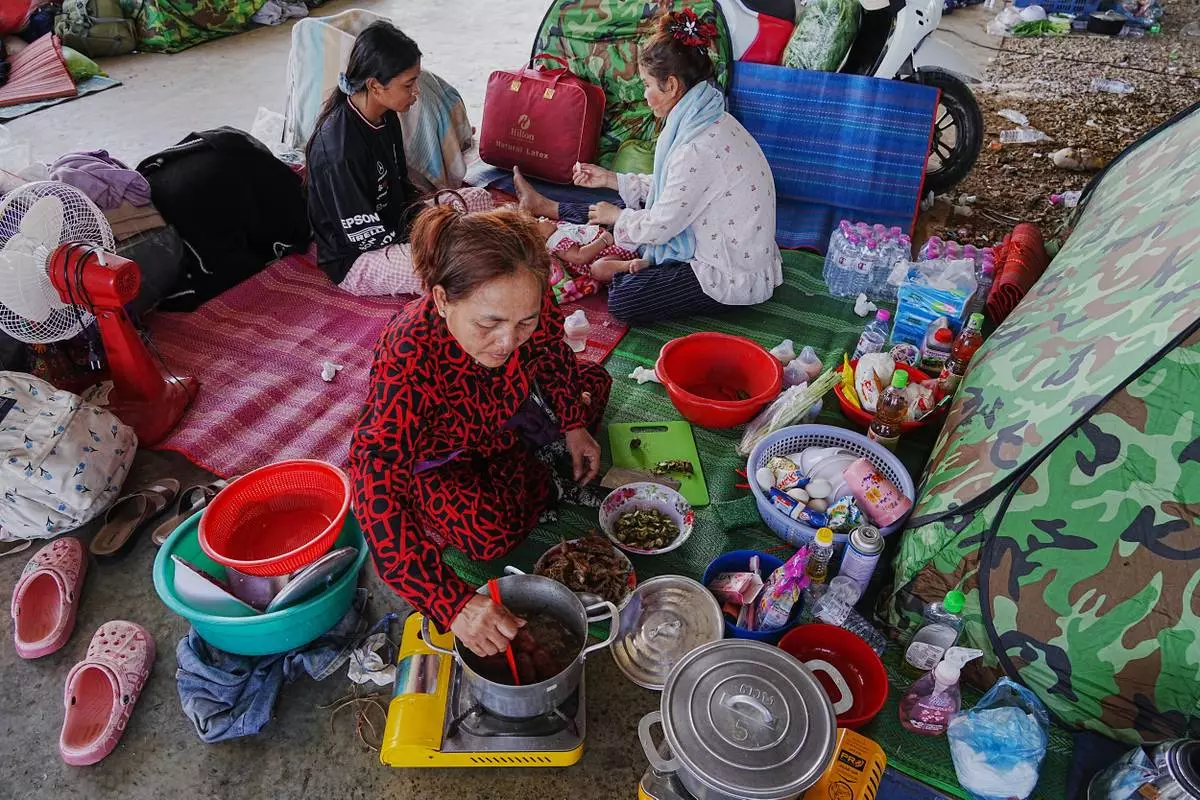
An evacuee cooks soup as she takes refuge in Banteay Menchey provincial town, Cambodia, Saturday, Dec. 13, 2025, after fleeing home following fighting between Thailand and Cambodia. (AP Photo/Heng Sinith)

An evacuee cooks soup as she takes refuge in Banteay Menchey provincial town, Cambodia, Saturday, Dec. 13, 2025, after fleeing home following fighting between Thailand and Cambodia. (AP Photo/Heng Sinith)

An evacuee tastes soup as she takes refuge in Banteay Menchey provincial town, Cambodia, Saturday, Dec. 13, 2025, after fleeing from home following fighting between Thailand and Cambodia. (AP Photo/Heng Sinith)

An evacuee tastes soup as she takes refuge in Banteay Menchey provincial town, Cambodia, Saturday, Dec. 13, 2025, after fleeing from home following fighting between Thailand and Cambodia. (AP Photo/Heng Sinith)

Evacuees cook food as they take refuge in Banteay Menchey provincial town, Cambodia, Saturday, Dec. 13, 2025, after fleeing homes following fighting between Thailand and Cambodia. (AP Photo/Heng Sinith)

Evacuees cook food as they take refuge in Banteay Menchey provincial town, Cambodia, Saturday, Dec. 13, 2025, after fleeing homes following fighting between Thailand and Cambodia. (AP Photo/Heng Sinith)

Children raise their hands while receiving donation from charity as they take refuge in Banteay Menchey provincial town, Cambodia, Saturday, Dec. 13, 2025, after fleeing homes following fighting between Thailand and Cambodia. (AP Photo/Heng Sinith)

Children raise their hands while receiving donation from charity as they take refuge in Banteay Menchey provincial town, Cambodia, Saturday, Dec. 13, 2025, after fleeing homes following fighting between Thailand and Cambodia. (AP Photo/Heng Sinith)

Evacuees wait to receive donation from local charity as they take refuge in Banteay Menchey provincial town, Cambodia, Saturday, Dec. 13, 2025, after fleeing homes following fighting between Thailand and Cambodia. (AP Photo/Heng Sinith)

Evacuees wait to receive donation from local charity as they take refuge in Banteay Menchey provincial town, Cambodia, Saturday, Dec. 13, 2025, after fleeing homes following fighting between Thailand and Cambodia. (AP Photo/Heng Sinith)

Village security volunteers and resident run into shelter while the blasts sounded too close in Buriram province, Thailand, Friday, Dec. 12, 2025, following renewed border conflict between Thailand and Cambodia. (AP Photo/Sakchai Lalit)

Village security volunteers and resident run into shelter while the blasts sounded too close in Buriram province, Thailand, Friday, Dec. 12, 2025, following renewed border conflict between Thailand and Cambodia. (AP Photo/Sakchai Lalit)

Recommended Articles