Experts from both Russia and China have emphasized the growing importance of the Russia-China relationship, describing it as a model for global collaboration, rooted in mutual respect and shared interests.
Alexander Lukin from the Russian Academy of Sciences highlighted the importance of avoiding global conflict and working together, while Zhao Long from the Shanghai Institute for International Studies underscored the commitment to upholding post-WWII order and creating a more sustainable global governance structure.
"Russia and China are a perfect example of a new type of relationship of great powers or big powers like you say in China. And this is the kind of the world that we actually want to see. You asked what kind of world we want to see, we want to see a world where greater powers or big powers cooperate with each other like they did during WWII as allies, and a short period after the WWII. Unfortunately, this corporation collapsed, because they began to fight each other or struggle with each other, and the cold war began. I don't think we need a new third world war to understand that we all need to cooperate with each other. In a way, just like Russia and China do, without necessarily agreeing on every single issue. But at the same time, thinking positively about this corporation and each other," said Lukin, academic head of Institute of China and Contemporary Asia of Russian Academy of Sciences.
"The China-Russian comprehensive partnership sends a clear signal, a message to the world that the major powers are still capable of engaging one another on the basis of equality, mutual respect and shared interest, and also shows our commitment to secure and uphold the so-called post war world order and also to aiming for creating a more equal and sustainable global governing structure," said Zhao, deputy director of Institute for Global Strategic and Security Studies of Shanghai Institute for International Studies.
Together, the insights from Lukin and Zhao stressed the growing importance of Russia-China relations in shaping a stable and cooperative global future.

Russia-China relations highlight new model of global cooperation: experts
As Chinese-made new energy vehicles continue to power ahead and take the world by storm, the answer to what makes the country's smart manufacturing power strong enough to lead global auto production can be found in the electric vehicle (EV) HyperFactory of Chinese electronics maker Xiaomi.
The tech giant, better known for its smartphones and home appliance products, marked its bold foray into the auto market in 2021, when it set up a state-of-the-art factory in the Being Economic-Technological Development Area, also known as Beiing E-Town -- a key innovation hub for China's autonomous driving industry.
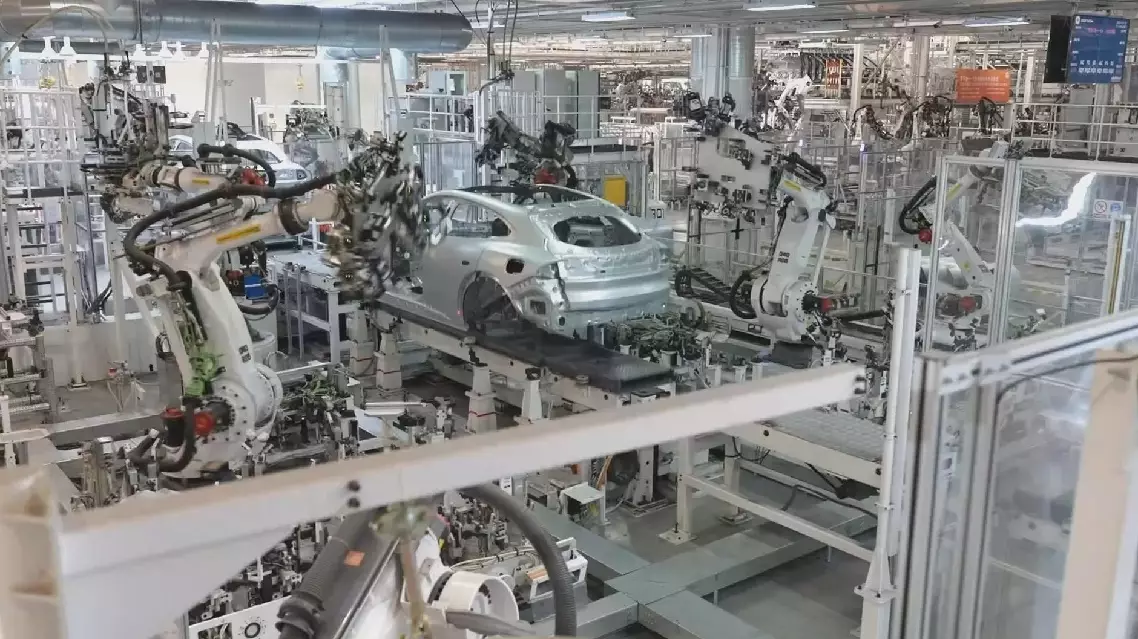
Despite the enormous scale of this facility, there are few workers in sight, with robotic arms instead moving with precision and speed, seamlessly assembling vehicle body components.
Every single Xiaomi SU7 electric car is born in this factory, where production lines run day and night, with a new car rolling off the line every 76 seconds. More than 700 robots work in sync across these highly automated production lines. Key processes are 100 percent automated -- making this facility a true example of next-generation manufacturing.
Song Jiaqiang, a production technology director at the Xiaomi EV HyperFactory, said the plant has set a benchmark in China's push for new quality productive forces -- an initiative aiming to promote high-tech development through innovation -- thanks to its exceptional application of artificial intelligence and automated processes.
"The first thing is the incredible level of automation and intelligence in this factory. Key processes are 100 percent automated. On top of that, we've introduced an industry-first AI (artificial intelligence) quality inspection system, which boasts an accuracy rate of 99.9 percent," he said.
Inside the factory, robots operate 24-hours a day, and they don't even need human staff to maintain their battery life -- when power runs low, they autonomously locate charging stations and recharge themselves.
Beyond core process automation, even material handling is finished by autonomous mobile robots, keeping the production lines running around the clock without interruption.
"The factory is packed with over 700 industrial robots. Right here in the body shop, we're looking at a 91 percent overall automation rate," said Song.
This advanced level of automation has been the key to Xiaomi's success, speeding up operational efficiency, ensuring greater build accuracy and ultimately delivering higher quality products, as Song explains.
"Take the rear door assembly, for example. Robots handle everything, from automatically picking up the part and inserting bolts, to placing it onto the body. They then inspect both the body and the component, while simultaneously tightening and adjusting the bolts to achieve a perfect fit with minimal gaps. It's a fully automated, intelligent process that drastically reduces, or even eliminates the need for human involvement," he said.
China's world-leading prowess in the smart manufacturing looks set to continue as the Xiaomi factory aims to further boost speed and AI capabilities, while helping upgrade the performance of domestically-made equipment.
Xiaomi's EV HyperFactory offers glimpse into future of smart manufacturing