The trade volume between China and Latin America rose 6 percent year on year to a record high of 518.47 billion U.S. dollars in 2024, the latest data from China's Ministry of Commerce showed.
According to the ministry, during the first three months of this year, the total trade volume between China and Latin America stood at 118.3 billion U.S. dollars, with China's exports at 65.73 billion U.S. dollars and imports at 52.58 billion U.S. dollars.
As for investment, China directly invested 14.71 billion U.S. dollars in Latin America in 2024.
From January to March this year, China's industry-wide direct investment in Latin America reached 270 million U.S. dollars.
As of March 2025, Latin American countries have invested in and established 37,000 enterprises in China.
In terms of contracted projects, Venezuela, Brazil, Ecuador, Argentina and Mexico are the main markets for Chinese contractors.
By the end of 2024, China had signed a total of 300.61 billion U.S. dollars worth of contracted projects in Latin America, with a turnover of 190.78 billion U.S. dollars.
From January to March 2025, the value of China's newly-signed contracted projects in the region reached 14.68 billion U.S. dollars, generating a business turnover of 5.99 billion U.S. dollars.
With regard to free trade cooperation, the China-Nicaragua and China-Ecuador free trade agreements officially came into effect in January and May 2024, respectively.
The protocol to upgrade China-Chile free trade agreement is being implemented well. And the free trade pact between China and Costa Rica works well too.
China and Peru have achieved substantial progress toward concluding the negotiations on upgrading a free trade agreement.

China-Latin America trade volume hits record high in 2024
The China-Laos Railway has become a major transport artery in Southeast Asia, cutting freight times, expanding passenger flows and linking regional economies.
The China-Laos Railway, a landmark project of high-quality Belt and Road cooperation, began operations in December 2021. The 1,035-kilometer railway connects Kunming, the capital of southwest China's Yunnan Province, with Vientiane, the capital of Laos.
It has significantly enhanced regional connectivity, boosted regional economic growth, and facilitated people-to-people and cultural exchanges.
Passengers can now travel by rail all the way from Thailand to China, a journey that would have been difficult to imagine just a few years ago.
"I traveled up from Bangkok last night on the overnight train, and now I'm traveling up to Luang Prabang and then on to Kunming to explore Yunnan province. It's really easy to use the app and to book the trains, so so far so good. Everything seems to be working out," said an Australian passenger.
Jie Sen, a passenger service staff at Vientiane Railway Station, said the railway has become an important channel for cross-border travel.
"Passengers from more than 120 countries and regions have traveled on the railway. International trains between China and Laos now run four times a day, with the fastest trip from Kunming South to Vientiane taking just 9 hours and 36 minutes," he said.
"In terms of freight transport, cross-border shipping time has been reduced from five to seven days by road to just one to two days by rail. More than 3,800 categories of goods are now transported via the railway. Its logistics network reaches 19 countries and regions, including Laos, Thailand, Vietnam and Singapore," said He Xuqiang, head of Vientiane Railway Station.
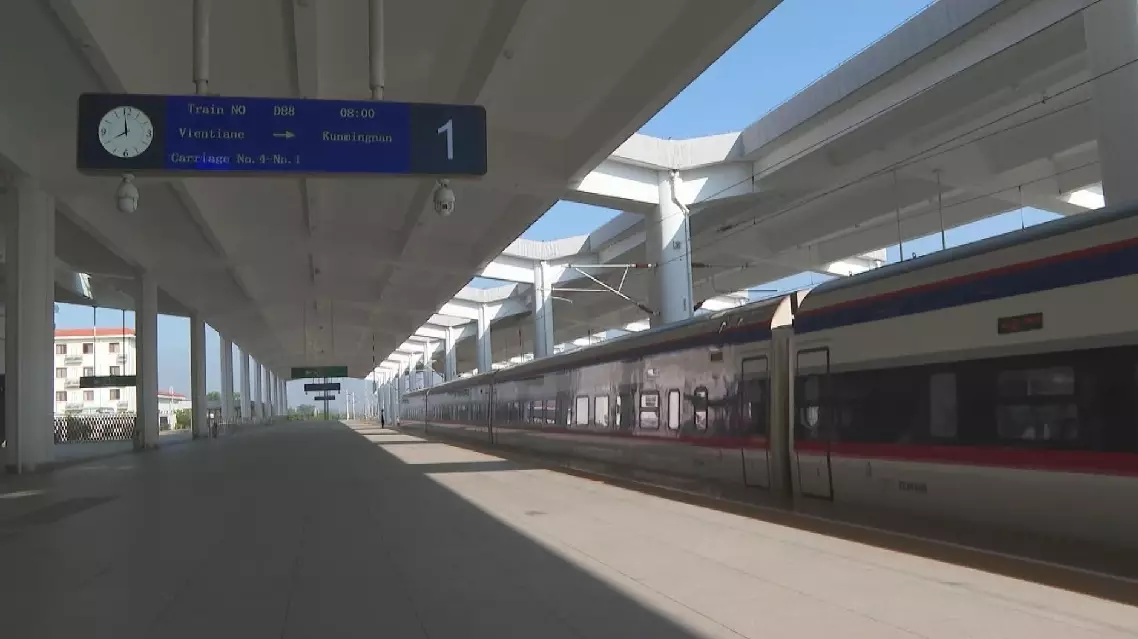
China-Laos Railway becomes key regional transportation corridor