As the U.S. adjusts its tariffs on Chinese goods, the once-paused trade with the American market is picking up again in Yiwu City of east China's Zhejiang Province, a city known as the "world's supermarket."
According to a joint statement released on Monday after the latest round of high-level China-U.S. economic and trade talks, both China and the U.S. have committed to removing the 91 percent tariffs and suspending the 24 percent tariffs for 90 days, while retaining the remaining 10 percent tariffs. The tariff cut has been a boost for many foreign trade businesses in Yiwu.
On Tuesday afternoon, Wen Congjian, a business owner in Yiwu, was busy contacting foreign trade companies and his U.S. clients to follow up on orders. Wen specializes in sports jerseys and used to sell over a million fan shirts during each World Cup. With the U.S. being one of the co-hosts of the 2026 FIFA World Cup alongside Canada and Mexico, it has long been a key market for his business. His plans were disrupted in April when the U.S. began raising tariffs, but recent tariff reductions have brought his overseas orders back on track.
"These pants are for the foreign trade company I just spoke with. The moment we finished sampling and were ready to place the order, tariffs surged, and his order were all stalled. After hearing the news yesterday about the tariff cut, he called me right away and said the order would be confirmed for production by tonight, with around 20,000 pieces. The tariff cut is great for manufacturers like us because it allows exports of our products to resume normally," said Wen.
As manufacturers resume production, logistics firms are also accelerating shipments. At a logistics company in Yiwu, a 6,000-square-meter warehouse was already packed, with about half the goods initially intended for the U.S. The company is now clearing inventory while receiving new products for shipment. "With today's and tomorrow's products added up, we expect around 2,000 cubic meters of goods to be warehoused. They will be loaded for shipping this Friday and Saturday. After tariff rates stabilized, we expect this outbound volume to continue through June and July, possibly even longer in a centralized and consistent manner," said Zeng Xibao, manager of the logistics company.
In the past month, the unstableness of the U.S. tariff policies has had major impacts for businesses on the whole supply chain. Having learned from the experience, many companies in Yiwu say that they will continue to focus on diversifying their markets to improve risk resilience.
"It is definite that we are going to diversify our market and increase efforts to expand our own brands internationally. For example. We have explored new markets in Europe, like Spain and the Netherlands," said Luo Jingang, deputy manager of a cosmetics company in Yiwu.
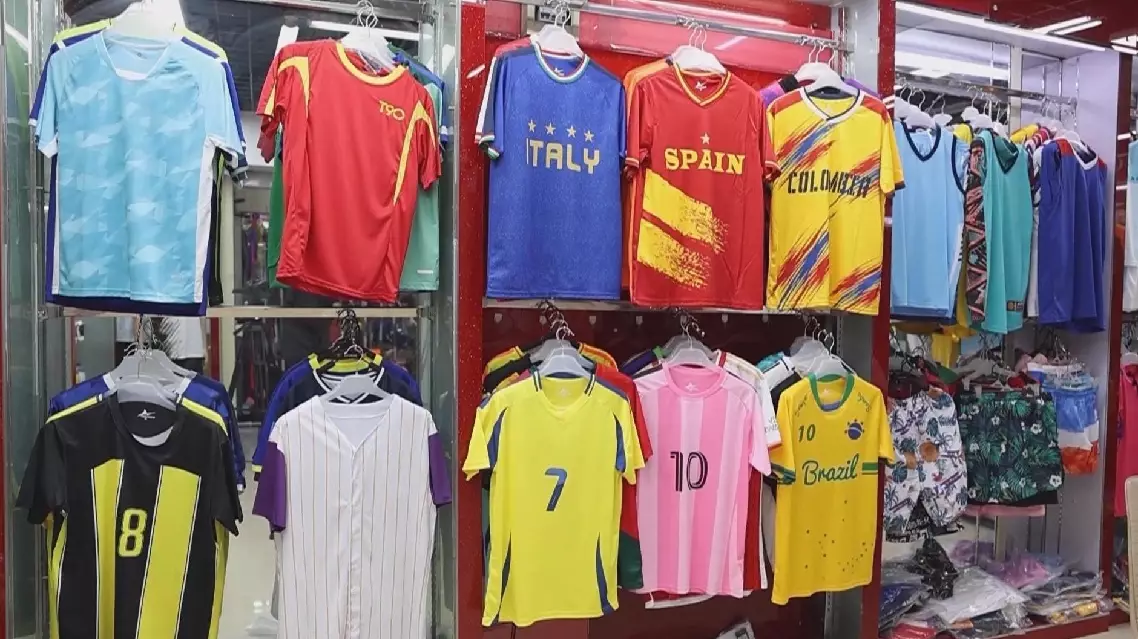
Export companies revitalized in Yiwu as China-U.S. tariff drops
The Guangdong–Hong Kong–Macao Greater Bay Area (GBA) is emerging as a key engine for China's fast-growing low-altitude economy by leveraging its dense industrial networks, efficient logistics systems, and rapid innovation capacity.
From logistics and manufacturing to urban services, the region is building an integrated industrial chain that allows low-altitude industries to scale up at unprecedented speed, thus turning drone-based applications from isolated trials into large-scale, commercial operations.
China's 15th Five-Year Plan, covering 2026 to 2030, calls for the cultivation of new pillar industries and the accelerated development of strategic emerging industrial clusters, including the low-altitude economy.
At a drone operations center in Bao'an District, Shenzhen City in south China's Guangdong Province, a dozen logistics drones take off and land within minutes. Urgently needed production parts, documents, and small parcels are dispatched from here to cities in the province including Dongguan, Zhongshan, and Zhuhai.
Behind these high-flying aircraft lies what observers describe as an "invisible industrial chain", built on speed and efficiency.
"Look at this aircraft. About 90 percent of its components come from nearby areas. Relying on Shenzhen's strong logistics capabilities and its complete supply chain, these parts can be delivered to our factory within half an hour for assembly, processing, and production," said Li Kunhuang, person-in-charge of Shenzhen GODO Innovation Technology Co., Ltd.
Once a new product is unveiled, testing and calibration begin immediately at the drone testing field. As soon as the process is completed, the new models can be put into real-world operation, realizing almost “zero delay” from research and development to application.
Supported by a robust industrial chain, low-altitude routes in Shenzhen are effectively connecting the urban landscape. From its Bao'an District to Songshan Lake in Dongguan City, production components can be delivered within one hour. Supplies are transported between Zhuhai City's Xiangzhou Port to Dong'ao Island in just 25 minutes. And light industrial goods can travel round-trip within a single day between Guzhen Town in Zhongshan City and Xinhui District in Jiangmen City.
More low-altitude application scenarios are expected to be implemented in the near future.
In Qianhai District, Shenzhen is accelerating the construction of a pilot demonstration zone of low-altitude integrated three-dimensional transportation hub.
"We have built the country's first low-altitude integrated three-dimensional transportation hub, and are gradually developing a pilot flight zone that integrates multiple scenarios such as inspection, logistics, and cultural tourism. This will provide technical support for the next step of commercializing cross-border logistics and emergency rescue services across the Guangdong–Hong Kong–Macao Greater Bay Area," said Wu Xuemin, head of the Shenzhen Qianhai Low-Altitude Integrated Three-Dimensional Transportation Hub Pilot Demonstration Zone.
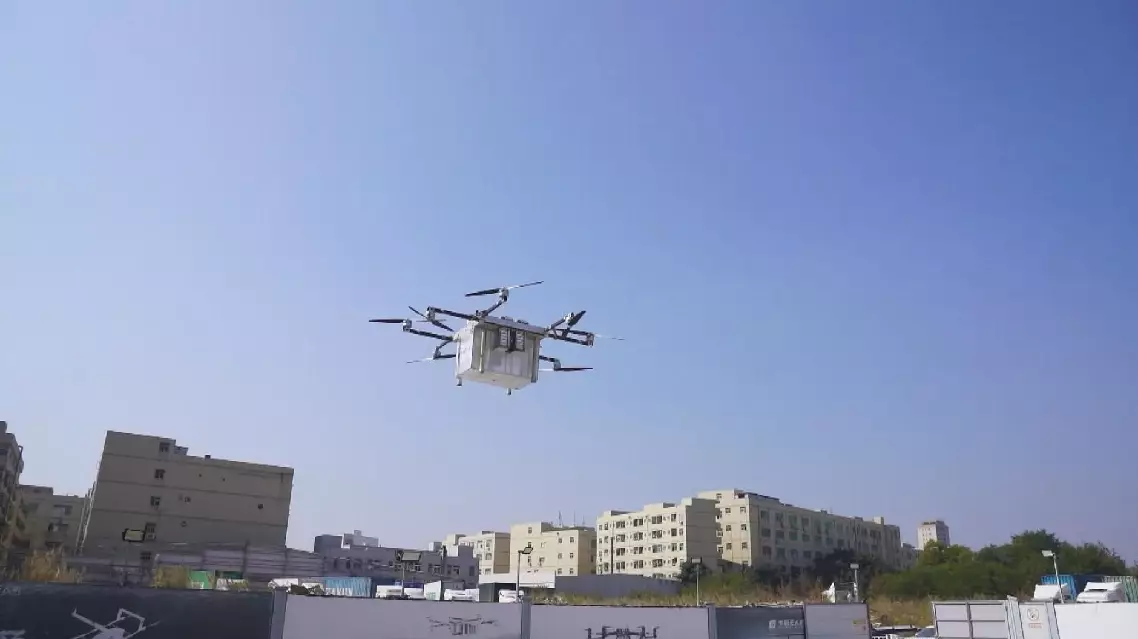
Integrated supply chains propel Greater Bay Area's low-altitude economy growth